
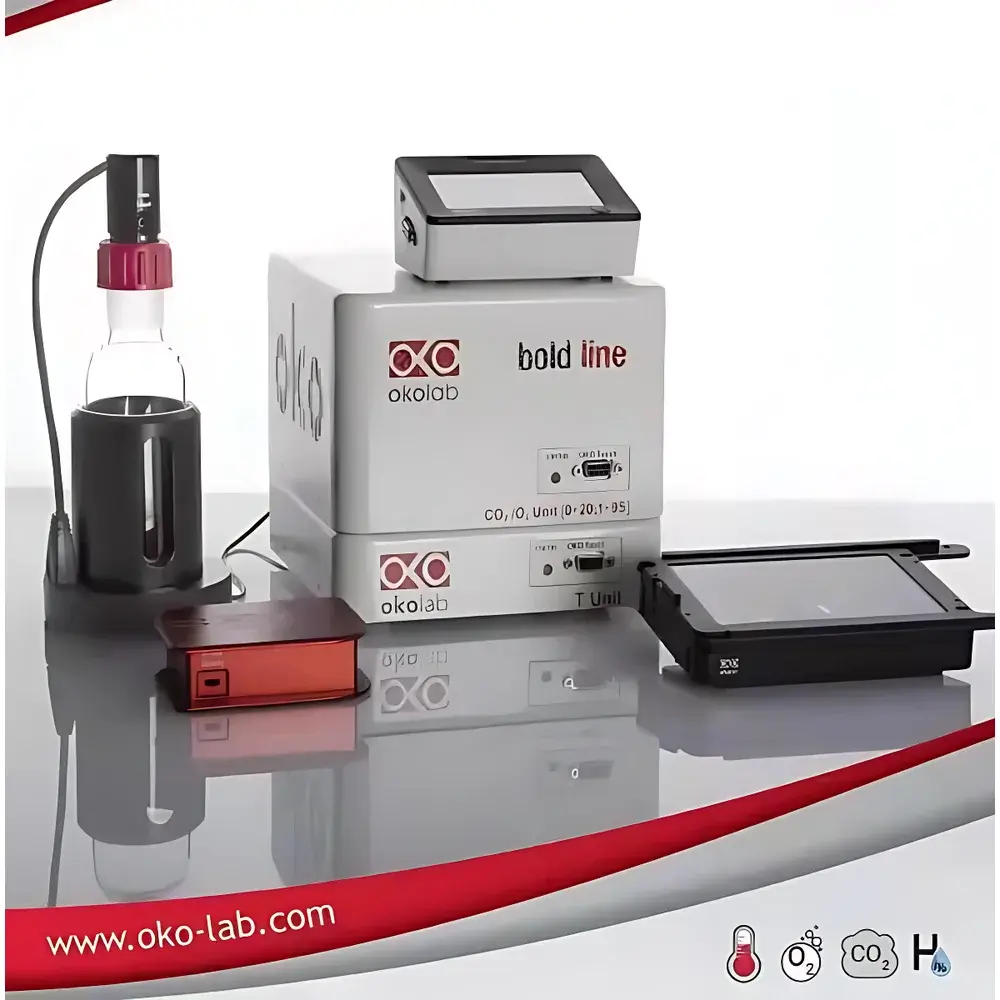
OKOLAB H301 Stage-Top Live-Cell Incubation System
| Brand | OKOLAB |
|---|---|
| Origin | Italy |
| Model | H301 |
| Temperature Range | 3–60 °C |
| Temperature Uniformity | ±0.3 °C |
| Humidity Control | 85–95% RH at 25 °C |
| CO₂ Sensor | NDIR dual-wavelength, ±0.1% accuracy, 10-year lifespan |
| Temperature Accuracy | ±0.1 °C (sample-feedback mode), ±0.3 °C (chamber-feedback mode) |
| Humidity Resolution | 1% RH |
| Gas Control | Digital CO₂ or CO₂/O₂ mixing module with TTL input support and SDK for third-party integration |
| Optional Objective Heater Sleeve | Three size variants (19–24 mm, 25–32 mm, 33–42 mm) |
Overview
The OKOLAB H301 Stage-Top Live-Cell Incubation System is an engineered environmental control platform designed for real-time, high-fidelity microscopy of living cells under physiologically relevant conditions. Unlike conventional incubators, the H301 integrates directly onto the microscope stage—minimizing thermal drift, optical path perturbation, and mechanical vibration—while maintaining precise, independent regulation of temperature, humidity, and gas composition (CO₂ and/or O₂) in the immediate microenvironment surrounding the specimen. Its core architecture leverages active feedback control across five thermally isolated zones: stage base, chamber lid, sample chamber, ambient environment, and objective heater sleeve. This multi-point sensing and actuation strategy ensures spatial stability critical for time-lapse imaging, FRAP, FRET, calcium imaging, and single-cell tracking experiments lasting hours to days. The system operates on a closed-loop principle: NDIR-based CO₂ detection enables continuous gas concentration verification; resistive humidity sensing coupled with water-jacket temperature modulation delivers dynamic vapor pressure control; and PID-regulated Peltier elements provide rapid thermal equilibration without overshoot.
Key Features
- Stage-integrated design with minimal footprint and zero interference with optical train alignment or Z-axis travel.
- Five independent temperature control channels with selectable feedback modes (sample- or chamber-referenced), delivering ±0.1 °C stability in sample-feedback configuration.
- Active humidity regulation via precision-controlled water-jacket heating—eliminating manual water refills and preventing condensation or desiccation during long-term imaging.
- Digital gas control module with NDIR CO₂ sensor (±0.1% accuracy, 10-year operational lifetime) and optional O₂ blending capability for hypoxic, hyperoxic, or anaerobic studies.
- Intuitive 7-inch capacitive touchscreen interface with real-time visualization of all monitored parameters (T, RH, CO₂, O₂, heater status, error codes).
- SmartBox-enabled remote operation: full parameter setting, data logging download, and diagnostic telemetry via Ethernet or Wi-Fi—compatible with GLP-compliant audit trail requirements.
- SDK-supported API integration for synchronization with acquisition software (e.g., MetaMorph, Micro-Manager, NIS-Elements) and automated experimental workflows.
Sample Compatibility & Compliance
The H301 accommodates a broad range of standard and custom sample formats through interchangeable chamber inserts and adapter plates—including 35 mm and 60 mm Petri dishes, multiwell plates (6–96-well), Lab-Tek chambers, and microfluidic devices. Dedicated lids support microinjection, perfusion, and electrode access without compromising environmental integrity. All materials contacting the sample chamber meet USP Class VI biocompatibility standards and are autoclavable or ethanol-cleanable. The system supports compliance with ISO 13485 quality management systems and is routinely deployed in laboratories adhering to GLP and GMP frameworks. Its digital gas controller and SmartBox telemetry provide full traceability for FDA 21 CFR Part 11–aligned electronic records when paired with validated software environments.
Software & Data Management
Data acquisition and device control are managed via OKOLAB’s proprietary ControlSuite software (Windows-based), which logs timestamped, channel-synchronized readings at user-defined intervals (1 s to 60 min resolution). Export formats include CSV and MATLAB-compatible .mat files, enabling downstream statistical analysis and kinetic modeling. SmartBox firmware supports secure TLS-encrypted remote access, role-based user permissions, and configurable alarm thresholds with email/SNMP notifications. Audit logs record every parameter change, login event, and system fault—retained for ≥180 days and exportable for regulatory review. Third-party integration is enabled through documented RESTful API endpoints and native TTL trigger I/O for hardware synchronization.
Applications
- Long-term time-lapse imaging of stem cell differentiation, mitosis, migration, and wound healing assays.
- Functional imaging under controlled hypoxia (0.1–5% O₂) or hyperoxia (up to 95% O₂) for cancer metabolism and ischemia-reperfusion studies.
- Electrophysiology-coupled live-cell imaging requiring stable pH (via CO₂ buffering) and minimal thermal noise.
- High-content screening using automated microscopes where environmental consistency across plates and days is essential for assay reproducibility.
- Developmental biology applications involving zebrafish, C. elegans, or organoid cultures demanding tight humidity control to prevent evaporation-induced osmotic stress.
FAQ
What is the minimum temperature setpoint below ambient?
The H301 achieves a minimum operating temperature of 3 °C—making it suitable for low-temperature cell cycle arrest or cold-shock experiments.
Can the system maintain humidity at 37 °C?
Yes—humidity control remains active across the full temperature range, with specified performance of 51–95% RH at 37 °C and 26–95% RH at 50 °C.
Is CO₂ calibration required by the user?
No—the NDIR sensor is factory-calibrated and drift-compensated; no routine recalibration is needed over its 10-year service life.
How does the system prevent condensation on objective lenses?
By independently heating the objective sleeve to match or slightly exceed the chamber temperature, the H301 eliminates thermal gradients that cause dew formation on lens surfaces.
Does the H301 support dual-gas (CO₂ + O₂) mixing out of the box?
The standard configuration includes CO₂-only control; CO₂/O₂ mixing requires the optional dual-gas module, which provides independent mass flow control and real-time concentration verification for both gases.





