
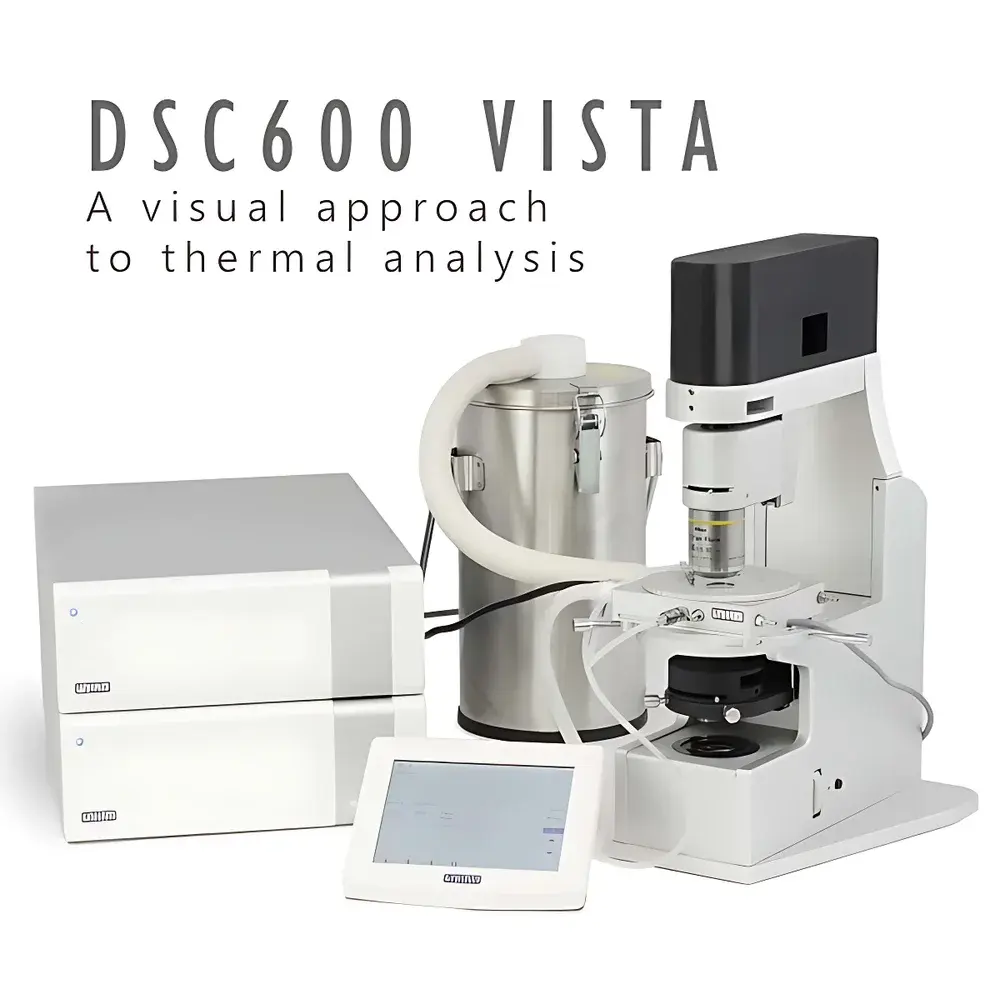
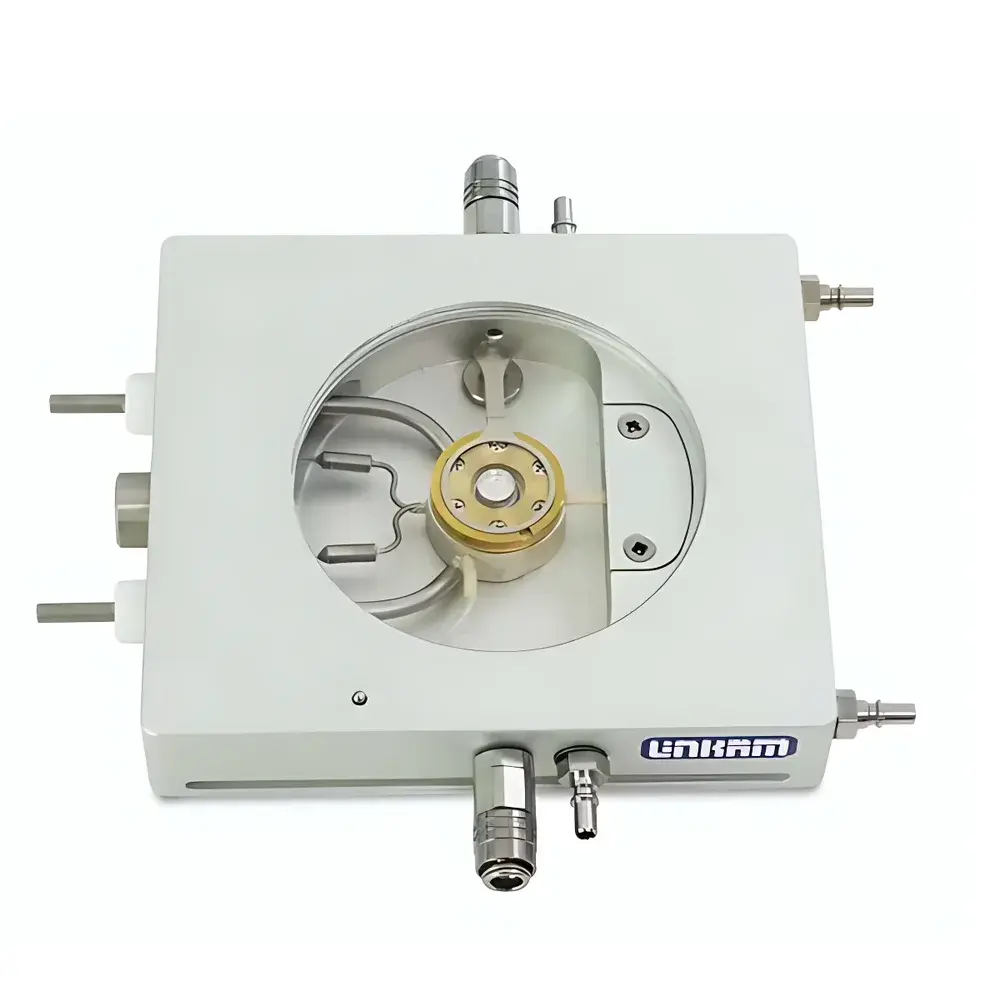
Linkam DSC600 Microscope-Compatible Differential Scanning Calorimeter
| Brand | Linkam |
|---|---|
| Origin | United Kingdom |
| Model | DSC600 |
| Temperature Range | −196 °C to 600 °C |
| Temperature Accuracy | ±0.1 °C |
| Heating/Cooling Rate | up to 130 °C/min |
Overview
The Linkam DSC600 is a high-precision, microscope-integrated differential scanning calorimeter engineered for in situ thermal analysis of solid-state phase transitions under optical observation. Unlike conventional benchtop DSC systems, the DSC600 operates as a temperature-controlled stage mounted directly on optical microscopes—enabling real-time correlation between thermodynamic events (e.g., melting, crystallization, glass transition, solid–solid polymorphic transitions) and concurrent morphological evolution at micron-scale resolution. Its core measurement principle combines differential heat flow detection with proprietary Thermal Analysis by Structural Change (TASC) image-processing algorithms. TASC quantifies pixel-level intensity and texture variations across time-lapse microscopy sequences, transforming qualitative visual changes into quantitative thermal event markers. This dual-modality architecture is particularly suited for applications where sample mass is limited (<100 µg), heterogeneity must be assessed spatially, or subtle enthalpic events occur below the detection threshold of conventional DSC.
Key Features
- Single-sample-cell design eliminates baseline drift caused by thermal asymmetry between sample and reference cells—improving signal-to-noise ratio and long-term baseline stability.
- Wide operational temperature range from cryogenic (−196 °C, using liquid nitrogen cooling) to high-temperature (600 °C) regimes, with temperature accuracy maintained at ±0.1 °C and stability better than ±0.05 °C over 30 minutes.
- Programmable heating/cooling rates up to 130 °C/min, supporting both rapid screening and ultra-slow ramp protocols (e.g., 0.1 °C/min) for high-resolution transition characterization.
- Vacuum-tight or gas-purged sample chamber compatible with inert (N₂, Ar), oxidative (air, O₂), or reactive atmospheres—fully configurable via external gas manifolds and pressure monitoring ports.
- TASC software module performs automated, frame-by-frame analysis of transmitted/reflected light micrographs, extracting structural change kinetics synchronized with thermal data streams.
- Modular mechanical interface supports integration with upright and inverted optical microscopes (Olympus, Zeiss, Leica, Nikon), including polarized light, darkfield, and phase contrast configurations.
- Multi-instrument synchronization capability via TTL triggers and analog I/O ports enables coordinated operation with FT-IR spectrometers, Raman microscopes, X-ray diffractometers, and confocal laser scanning systems.
Sample Compatibility & Compliance
The DSC600 accommodates solid powders, thin films, single crystals, polymer blends, pharmaceutical compacts, and biological tissues—typically loaded in standard 0.17-mm-thick glass coverslip assemblies or custom metal/glass sample holders. Sample volumes range from <10 µg to ~5 mg, with optimal sensitivity achieved at 20–200 µg. All thermal protocols comply with ISO 11357 (Plastics — Differential Scanning Calorimetry), ASTM E794 (Melting and Crystallization Temperatures by DSC), and USP <1151> (Pharmaceutical Thermal Analysis). The system’s hardware and firmware architecture support audit trails, electronic signatures, and data integrity controls aligned with FDA 21 CFR Part 11 requirements when deployed in regulated GLP/GMP environments.
Software & Data Management
Control and analysis are performed via Linkam’s proprietary LinkSystem software (v6.0+), which provides synchronized acquisition of thermal, imaging, and environmental parameters. Raw data files (.lkd) store calibrated temperature, heat flow, stage position, gas flow, vacuum pressure, and full-resolution TIFF image stacks with embedded metadata (time stamp, setpoint, ramp rate, camera exposure). TASC analysis generates derivative curves of structural change rate (dS/dt), enabling direct comparison with dH/dT from DSC output. Export formats include CSV, MATLAB .mat, and HDF5 for third-party modeling (e.g., kinetic fitting in Kinetics Neo or Thermo-Calc). Software validation documentation (IQ/OQ/PQ templates) and 21 CFR Part 11 configuration packages are available upon request.
Applications
- Polymorph screening and solid-form identification in preformulation studies, where DSC600 detects low-enthalpy solid–solid transitions (e.g., enantiotropic ↔ monotropic shifts) invisible to conventional DSC.
- Hot-melt extrusion and spray-dried dispersion characterization—monitoring amorphous content, recrystallization onset, and phase separation kinetics during thermal stress.
- Crystal growth inhibition assessment in supersaturated solutions using in situ nucleation temperature mapping.
- Thermal degradation profiling of biodegradable polymers and lipid-based nanocarriers under controlled oxygen partial pressures.
- Validation of thermal sterilization cycles for medical device materials via real-time melt-recrystallization tracking.
- Geological mineral phase transformation studies (e.g., kaolinite → metakaolin) under simulated diagenetic conditions.
FAQ
Can the DSC600 be used with confocal laser scanning microscopes?
Yes—the stage features standardized kinematic mounts and optical path clearance for most commercial CLSM platforms; laser transmission through the sapphire window is supported at wavelengths from 400 nm to 2500 nm.
Is calibration traceable to NIST standards?
Temperature calibration uses certified ITS-90 reference materials (indium, tin, zinc, aluminum); heat flow calibration employs certified sapphire standards. Full calibration certificates with uncertainty budgets are provided with each system.
Does the system support automated multi-sample sequential analysis?
Not natively—the DSC600 is a single-position stage; however, integration with motorized microscope stages and robotic sample changers is possible via LabVIEW or Python API (available under OEM agreement).
What is the minimum detectable enthalpy change?
Detection limit depends on sample mass and transition sharpness; for 50 µg of pure indomethacin under 10 °C/min ramp, the system resolves ΔH ≥ 0.05 J/g with signal-to-noise >10:1.
Are replacement parts and service support available outside the UK?
Yes—Linkam maintains authorized service centers in the US, Germany, Japan, China, and Australia; all critical components (heating elements, sensors, vacuum feedthroughs) are stocked globally with ≤5-business-day lead time.



