
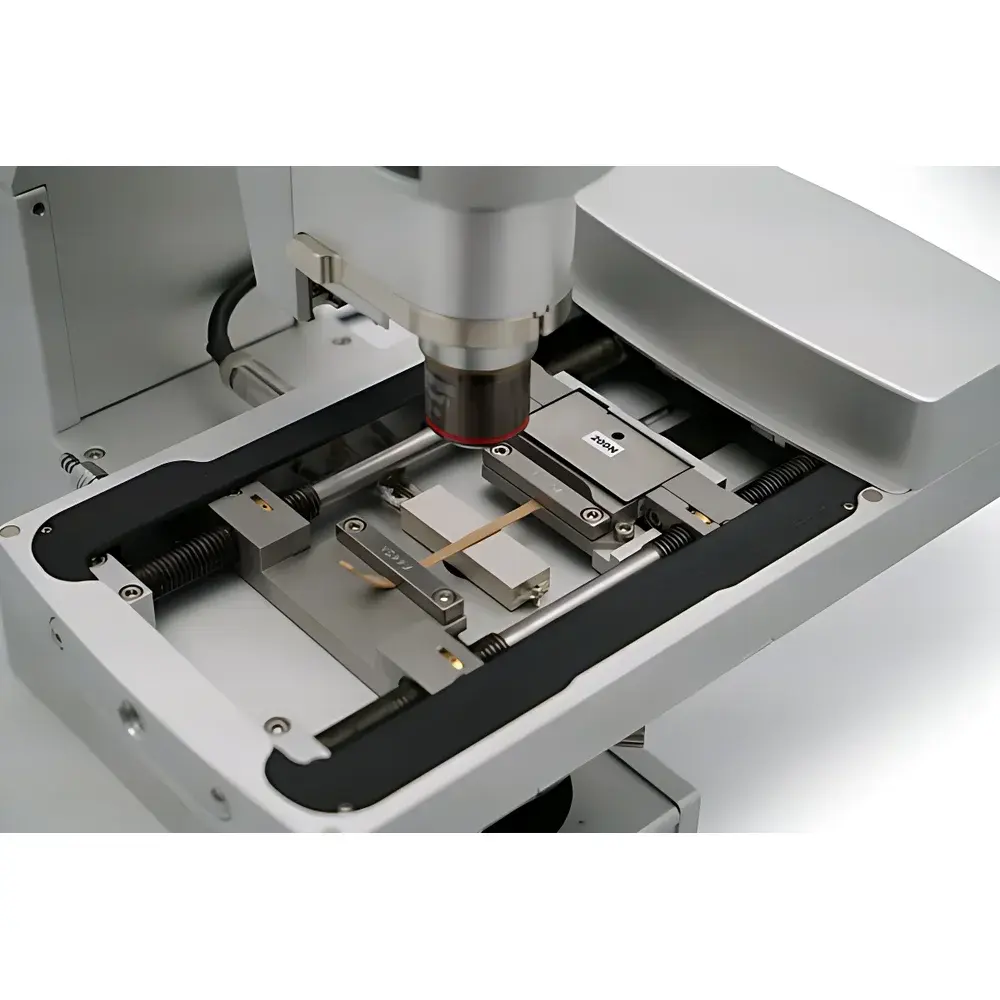
Linkam MFS Modular Force Stage for In Situ Microscopy
| Brand | Linkam |
|---|---|
| Origin | United Kingdom |
| Model | MFS |
| Force Range | 0–20 N / 0–200 N |
| Force Resolution | 0.0001 N (20 N range), 0.001 N (200 N range) |
| Displacement Resolution | 1 µm |
| Maximum Travel | 85 mm |
| Speed Range | 0.1–5000 µm/s |
| Temperature Range | −196 °C to +600 °C |
| Environmental Control | Vacuum, inert gas, or humidity-controlled (with RH95 module) |
| Optical Compatibility | Transmission/reflection light, X-ray, Raman, FTIR |
| Electrical Measurement Option | Conductive fixtures available |
Overview
The Linkam MFS Modular Force Stage is an advanced in situ mechanical testing platform engineered for high-precision, temperature- and environment-controlled characterization of material mechanical behavior under optical, spectroscopic, or synchrotron observation. Unlike conventional force meters or universal testing machines, the MFS integrates a calibrated linear actuator, high-resolution displacement encoder, and thermally stable stage architecture into a compact microscopy-compatible format. It operates on the principle of controlled uniaxial loading—applying precisely defined tensile, compressive, or multi-point bending forces while simultaneously enabling real-time imaging or spectral acquisition. Its core design enables direct correlation between macroscopic mechanical response (stress–strain, creep, relaxation) and microscopic structural evolution (e.g., crack initiation, phase transformation, fiber alignment), making it indispensable for research in polymer science, metallurgy, soft matter physics, and functional materials development.
Key Features
- Modular architecture supporting interchangeable fixtures—including tensile grips, compression platens, three-point bending jigs, and custom-designed holders—to accommodate diverse sample geometries and test protocols.
- Dual-force-range capability: switchable 0–20 N (high-sensitivity mode) and 0–200 N (high-load mode), each with dedicated force transducer calibration and resolution optimized for respective applications.
- Sub-micron displacement resolution (1 µm) via integrated high-accuracy optical encoder, ensuring reproducible strain quantification across thermal cycles.
- Wide dynamic speed control (0.1–5000 µm/s), programmable as a function of temperature or time, enabling rate-dependent mechanical analysis such as strain-rate sensitivity mapping.
- Full environmental integration: compatible with Linkam’s RH95 relative humidity controller (10–95% RH, ±2% accuracy), vacuum sealing (<10⁻² mbar), and purged inert-gas operation (N₂, Ar) to eliminate oxidation or moisture interference during elevated-temperature testing.
- Multi-modal optical access: designed for transmission and reflection illumination; validated for use with synchrotron X-ray diffraction (XRD), micro-Raman spectroscopy, and Fourier-transform infrared (FTIR) systems without optical path obstruction.
- Electrical characterization readiness: optional conductive sample holders and feedthroughs allow concurrent measurement of resistance, impedance, or piezoresistive response during mechanical deformation.
Sample Compatibility & Compliance
The MFS accommodates solid specimens up to 25 mm in length and 10 mm in thickness, including thin films, fibers, hydrogels, metallic ribbons, ceramic pellets, and composite laminates. Sample mounting is facilitated by standardized kinematic interfaces compatible with Linkam’s range of heating/cooling stages (e.g., TS1500, HFS600). The system complies with ISO 6892-1 (tensile testing of metallic materials), ASTM D638 (plastics tensile properties), and ISO 178 (flexural properties of plastics). All force and displacement data are traceable to UKAS-accredited calibration standards. For regulated environments, the MFS supports audit-ready data logging when paired with Linkam’s TC125 temperature controller and TMS94 software—enabling full 21 CFR Part 11 compliance through user authentication, electronic signatures, and immutable audit trails.
Software & Data Management
Control and data acquisition are managed via Linkam’s proprietary TMS94 software suite, which provides synchronized multi-parameter scripting (temperature, force, displacement, dwell time, ramp rate). Real-time force–displacement–temperature curves are plotted with auto-scaling and overlay capabilities. Raw data export is supported in CSV and HDF5 formats for post-processing in MATLAB, Python (NumPy/Pandas), or commercial FE platforms. The software includes built-in modules for stress–strain conversion, modulus calculation (secant, tangent, dynamic), hysteresis loop analysis, and time–temperature superposition (TTS) preparation. All experimental metadata—including calibration certificates, environmental conditions, and hardware configuration—are embedded directly into output files to ensure FAIR (Findable, Accessible, Interoperable, Reusable) data principles.
Applications
- Temperature-dependent viscoelasticity mapping of thermoplastics and shape-memory polymers across glass transition regimes.
- In situ fracture mechanics studies of brittle ceramics and intermetallics using synchrotron-based micro-tomography.
- Electromechanical coupling analysis in piezoelectric thin films and stretchable conductors.
- Hydration–deformation coupling in biomaterials (e.g., collagen scaffolds, alginate hydrogels) under controlled RH profiles.
- Creep and stress relaxation behavior of solder alloys and low-melting-point metals near solidus temperatures.
- Phase-transformation-induced strain evolution in NiTi shape-memory alloys during thermal cycling.
FAQ
Can the MFS be used inside a scanning electron microscope (SEM)?
Yes—the MFS is available in an SEM-compatible version (MFS-SEM) featuring non-magnetic construction, ultra-high-vacuum sealing, and low-outgassing materials, fully certified for chamber pressures down to 10⁻⁷ mbar.
Is third-party software integration possible?
Yes—Linkam provides documented DLL and LabVIEW driver support, enabling bidirectional communication with custom automation frameworks and industrial MES systems.
What is the typical lead time for custom fixture design?
Standard fixtures ship within 2 weeks; bespoke mechanical designs (e.g., miniature torsion or shear jigs) require 6–8 weeks from final engineering approval.
Does the system support closed-loop strain control?
Yes—displacement feedback from the onboard encoder enables true closed-loop strain-rate or strain-hold control, independent of thermal expansion drift.
How is thermal drift compensated during long-duration tests?
The MFS incorporates real-time thermal expansion correction algorithms based on stage-specific coefficient-of-thermal-expansion (CTE) models, validated against NIST-traceable dilatometry reference data.



