
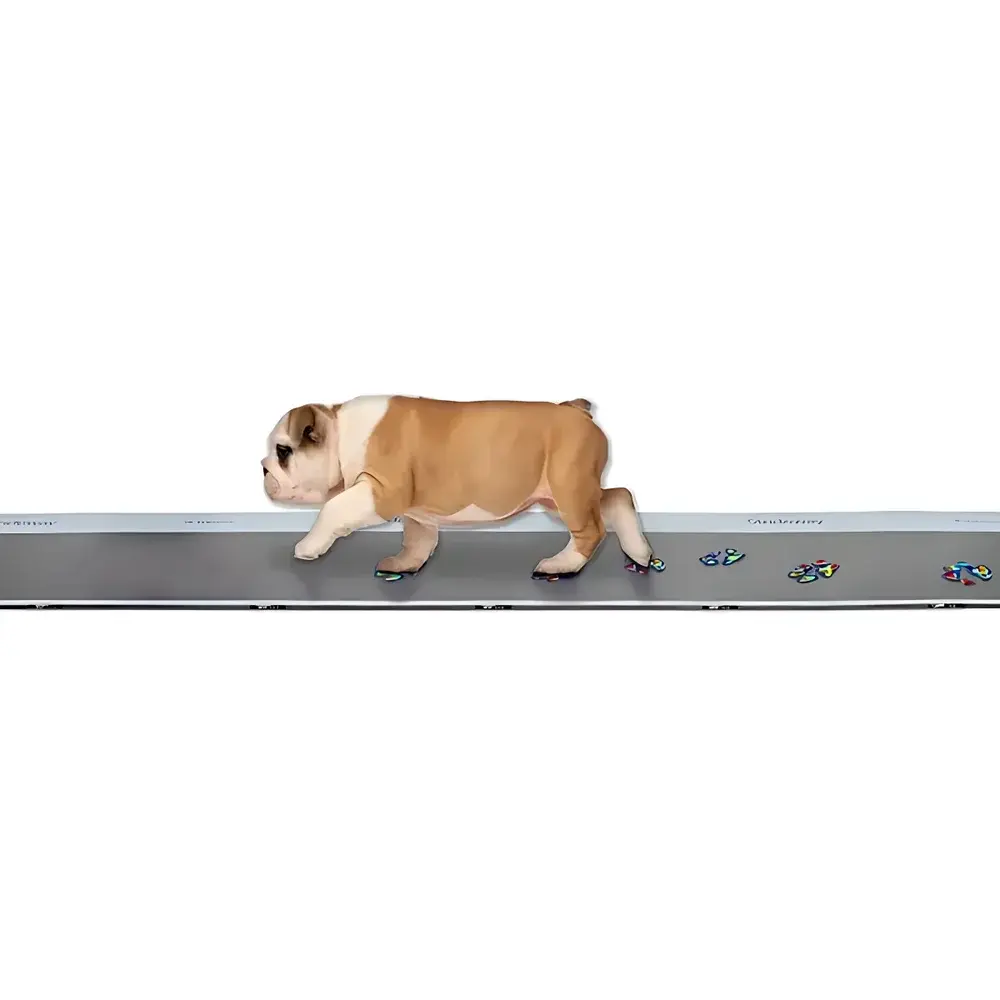
Tekscan Strideway Pressure-Based Animal Gait Analysis System
| Brand | Tekscan |
|---|---|
| Origin | USA |
| Manufacturer Type | Authorized Distributor |
| Product Origin | Imported |
| Model | Strideway |
| Pricing | Available Upon Request |
Overview
The Tekscan Strideway Pressure-Based Animal Gait Analysis System is an engineered solution for objective, quantitative assessment of locomotor function in preclinical and veterinary research. Utilizing high-resolution capacitive pressure sensor technology embedded within a continuous walkway, the system captures dynamic plantar pressure distributions at sampling rates up to 100 Hz—enabling precise temporal-spatial resolution of footfall events across multiple consecutive strides. Unlike subjective visual gait scoring, Strideway delivers calibrated, repeatable metrics grounded in biomechanical principles—including ground reaction force (GRF) vector components, center-of-pressure (COP) trajectory, stance/swing phase duration, and inter-limb symmetry indices. Designed for integration into GLP-compliant animal facilities and academic behavioral phenotyping cores, the system supports both spontaneous and trained walking paradigms under controlled environmental conditions.
Key Features
- High-density pressure sensor array (≥1 sensor/cm²) with ±2% full-scale accuracy across 0–100 kPa range, optimized for paws, hooves, and small-clawed species
- Modular walkway design: standard 1.2 m length (extendable to 2.4 m), width configurable from 15 cm (rodent) to 30 cm (canine/large ovine)
- Real-time acquisition and visualization of pressure-time curves, COP paths, and footprint segmentation per limb
- Automated stride detection and parameter extraction—including step length, stance time, swing time, base of support, peak pressure, and pressure-time integral (impulse)
- Inter-limb symmetry ratio calculation (e.g., left:right peak pressure, fore:hind weight-bearing distribution) with statistical confidence intervals
- Rugged, cleanable acrylic surface compatible with disinfectants and compliant with IACUC-approved housing protocols
Sample Compatibility & Compliance
The Strideway system accommodates a broad spectrum of laboratory and agricultural species—from mice and rats (15–40 g) to rabbits, guinea pigs, dogs (up to 40 kg), goats, and sheep. Its low-profile, non-invasive architecture eliminates harnesses or tethering, minimizing stress-induced artifacts and supporting ethologically valid gait expression. All hardware and firmware comply with FCC Part 15 Class B and CE EMC Directive 2014/30/EU. Data acquisition workflows are structured to align with OECD Test Guidelines 425 (Acute Oral Toxicity) and 443 (Extended One-Generation Reproductive Toxicity Study), where gait endpoints serve as secondary functional biomarkers. Audit trails, user access controls, and raw data export (ASCII, HDF5) support adherence to FDA 21 CFR Part 11 requirements when implemented with validated software configurations.
Software & Data Management
Strideway operates with Tekscan’s GaitScan v5.2 software—a Windows-based platform validated for research use only (RUO). The software enables batch processing of multi-animal trials, customizable region-of-interest (ROI) definition for paw/hover analysis, and export of over 40 standardized gait parameters per limb per stride. All processed datasets include embedded metadata (animal ID, date/time, operator, protocol version) and support traceability through hierarchical folder structures. Raw pressure frames are archived losslessly; processed metrics are exportable to CSV, MATLAB (.mat), or Python-compatible formats for downstream statistical modeling (e.g., mixed-effects ANOVA, principal component analysis of gait signatures). Software validation documentation—including IQ/OQ protocols—is available upon request for regulated environments.
Applications
- Osteoarthritis and neuropathic pain models: longitudinal tracking of weight-bearing asymmetry during disease progression or therapeutic intervention
- Orthopedic device evaluation: functional assessment of fracture fixation implants, tendon grafts, or joint replacements in large-animal models
- Neuropharmacology: dose-response characterization of CNS-active compounds affecting motor coordination (e.g., dopaminergic agents, GABA modulators)
- Rehabilitation science: quantification of recovery kinetics post-surgical limb immobilization or spinal cord injury
- Biomechanics of locomotion: comparative analysis of substrate interaction across flooring materials, inclines, or textured surfaces
- Toxicology screening: early detection of peripheral neurotoxicity via subtle alterations in stride regularity or pressure dispersion
FAQ
Is Strideway suitable for high-throughput screening in rodent colonies?
Yes—automated stride detection and batch analysis reduce manual annotation time by >70% compared to video-based methods. A single operator can process 20+ mice per hour with consistent inter-rater reliability (ICC >0.92).
Can the system be integrated with existing motion capture or EMG setups?
Yes—Strideway provides TTL synchronization pulses and API-accessible timestamps for hardware-level alignment with Vicon, Qualisys, or Delsys Trigno systems.
What calibration procedures are required prior to use?
Factory calibration is performed pre-shipment. Field verification uses NIST-traceable dead-weight loads applied at defined grid points; full recalibration is recommended annually or after physical impact to the sensor surface.
Does Tekscan provide application support for study design?
Yes—Tekscan’s Applications Engineering team offers protocol consultation, including power analysis for gait parameter selection, sample size estimation, and statistical framework recommendations aligned with journal reporting standards (ARRIVE 2.0).





