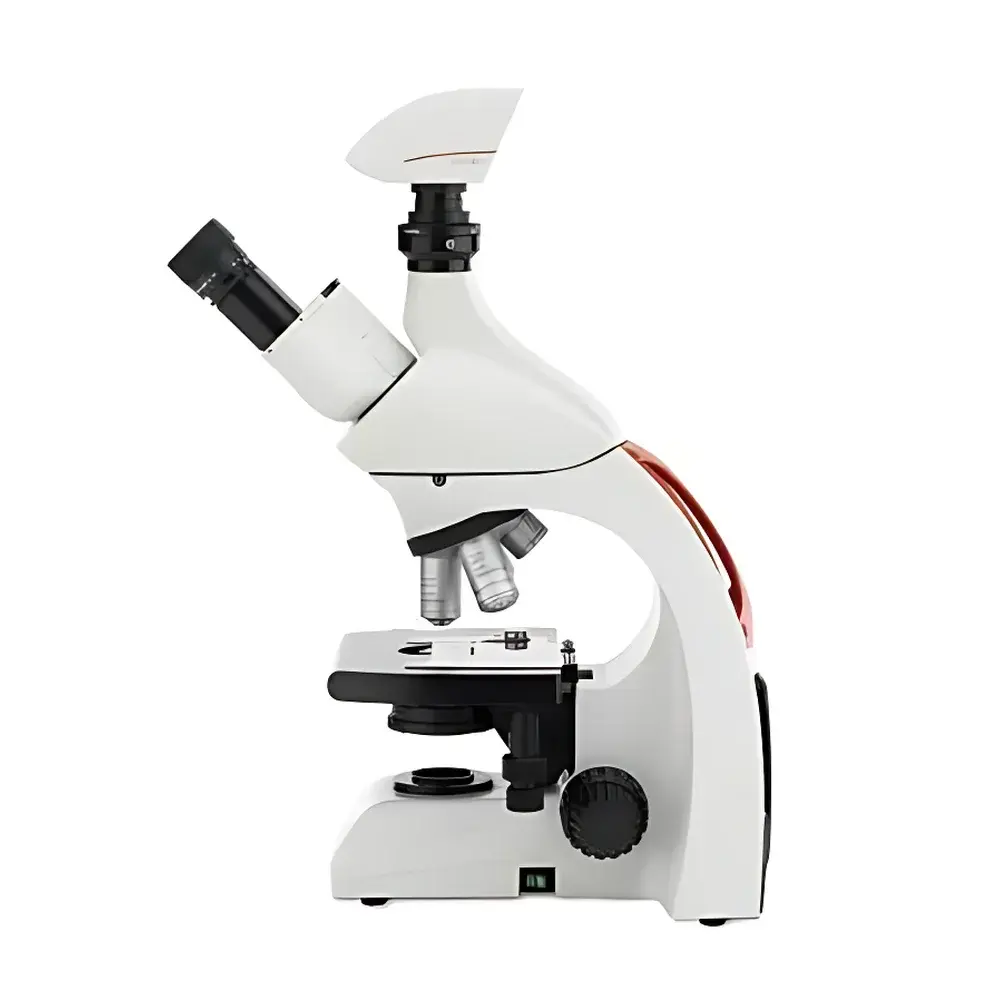
Leica DM750 P Polarizing Microscope
| Brand | Leica |
|---|---|
| Origin | Germany |
| Model | DM750 P |
| Field of View | 20 mm |
| Portability | Integrated Handle |
| Cable Management | Internal Routing |
| Intended Use | Educational & Routine Polarized Light Microscopy |
| Regulatory Status | CE-compliant, ISO 9001-manufactured instrumentation |
Overview
The Leica DM750 P Polarizing Microscope is a purpose-built, entry-level polarized light microscope engineered for pedagogical clarity and operational robustness in undergraduate laboratories, geoscience teaching suites, and materials science introductory courses. It operates on the fundamental principles of transmitted polarized light microscopy—employing a polarizer beneath the condenser and an analyser above the objective turret—to reveal birefringence, extinction angles, interference colors, and crystal orientation in anisotropic specimens. Unlike research-grade polarizing systems requiring motorized stages or strain-free optics, the DM750 P delivers consistent optical performance through fixed, strain-free achromatic objectives and precision-aligned polarization components calibrated to DIN-standard angular tolerances. Its mechanical stability, low thermal drift, and simplified optical path minimize setup time and reduce user-induced variability—critical attributes when managing cohorts of novice microscopists across multiple lab sessions.
Key Features
- DIN-standard 20-mm field-of-view eyepieces providing wide-area sample visualization without edge distortion—essential for rapid identification of mineral aggregates or polymer domains.
- Four fixed-magnification achromatic objectives (4×, 10×, 40×, 100× oil-immersion optional) with anti-fungal coating and parfocal alignment ensuring seamless magnification transitions during student-led observation.
- Integrated ergonomic carrying handle and compact footprint (280 × 220 × 340 mm) enabling safe transport between classroom, lab bench, and storage cabinets—designed to withstand repeated relocation without optical misalignment.
- Internal cable routing system conceals power and illumination wiring within the base column, eliminating tripping hazards and reducing cable fatigue from repeated setup/teardown cycles.
- 6-V/30-W halogen illumination with centerable, adjustable brightness control and built-in heat-absorbing filter—optimized for long-duration student use while preserving specimen integrity under prolonged exposure.
- Polarizer and analyser wheels with engraved 0°–90° angular scales and positive click-stop positions at key orientations (0°, 45°, 90°), facilitating reproducible extinction angle measurement and quantitative teaching exercises.
Sample Compatibility & Compliance
The DM750 P accommodates standard 1-mm-thick petrographic thin sections (26 × 46 mm), metallurgical polished mounts, polymer films, pharmaceutical crystalline preparations, and textile fiber slides. Its stage features dual-scale vernier calipers (0.1 mm resolution) and spring-loaded clips for secure, vibration-damped specimen retention. All optical components comply with ISO 10934-1 (microscope nomenclature) and EN 61000-6-3 (EMC emissions). The instrument bears CE marking per Directive 2014/30/EU (EMC) and 2014/35/EU (LVD), and is manufactured under Leica Microsystems’ ISO 9001:2015 certified quality management system. While not validated for GLP or GMP environments, its mechanical repeatability and calibration traceability support documented educational assessment protocols aligned with ASTM D5755 (standard test method for birefringence measurement in polymeric fibers).
Software & Data Management
The DM750 P is a hardware-only platform with no embedded digital imaging or proprietary software—intentionally designed to emphasize foundational optical interpretation over automated analysis. However, it is fully compatible with third-party USB 3.0 CMOS cameras (e.g., Leica ICC50 HD, Lumenera Infinity3 series) via standardized C-mount adapter. When coupled with open-source image acquisition tools such as MicroManager or commercial packages like NIS-Elements (Nikon) or ZEN Blue (Zeiss), users can capture, annotate, and export TIFF/PNG images with embedded metadata (magnification, objective ID, polarizer angle). All acquired datasets retain full audit trail capability when stored within institutional LMS or electronic lab notebook (ELN) platforms compliant with ISO/IEC 17025 documentation requirements.
Applications
- Geology education: Identification of mineral cleavage, twinning, and optic sign in igneous and metamorphic thin sections.
- Materials science labs: Qualitative assessment of polymer crystallinity, liquid crystal phase transitions, and stress-induced birefringence in composites.
- Pharmaceutical technology courses: Visualization of polymorphic forms and hydrate/anhydrate differentiation in active pharmaceutical ingredients (APIs).
- Forensic science curricula: Fiber characterization—including refractive index estimation via Becke line analysis—and paint chip layer analysis.
- Botany and wood anatomy: Observation of cellulose microfibril orientation and lignin distribution in plant cell walls.
FAQ
Is the DM750 P suitable for quantitative birefringence measurement?
It supports semi-quantitative analysis using calibrated retardation plates (e.g., λ-plate, quartz wedge) and standard extinction angle protocols—but lacks motorized rotatable stages or integrated compensators required for full quantitative retardation mapping.
Can oil immersion be used with all objectives?
Only the 100× objective is designed for oil immersion; the 4×, 10×, and 40× objectives are dry-type and must not be used with immersion media.
Does the microscope include strain-free objectives necessary for high-sensitivity polarized work?
Yes—the supplied achromatic objectives are strain-free and certified per DIN 58887, ensuring minimal intrinsic birefringence that could interfere with specimen contrast.
What maintenance is required for long-term classroom deployment?
Annual cleaning of optical surfaces with lens tissue and re-calibration of polarizer/analyser zero position using a known isotropic reference slide (e.g., fused silica) is recommended; no routine alignment tools are required due to rigid mechanical construction.
Is the DM750 P compatible with digital classroom projection systems?
Yes—when paired with a C-mount camera and HDMI video capture device, it integrates seamlessly with standard AV infrastructure for real-time demonstration to large groups.