
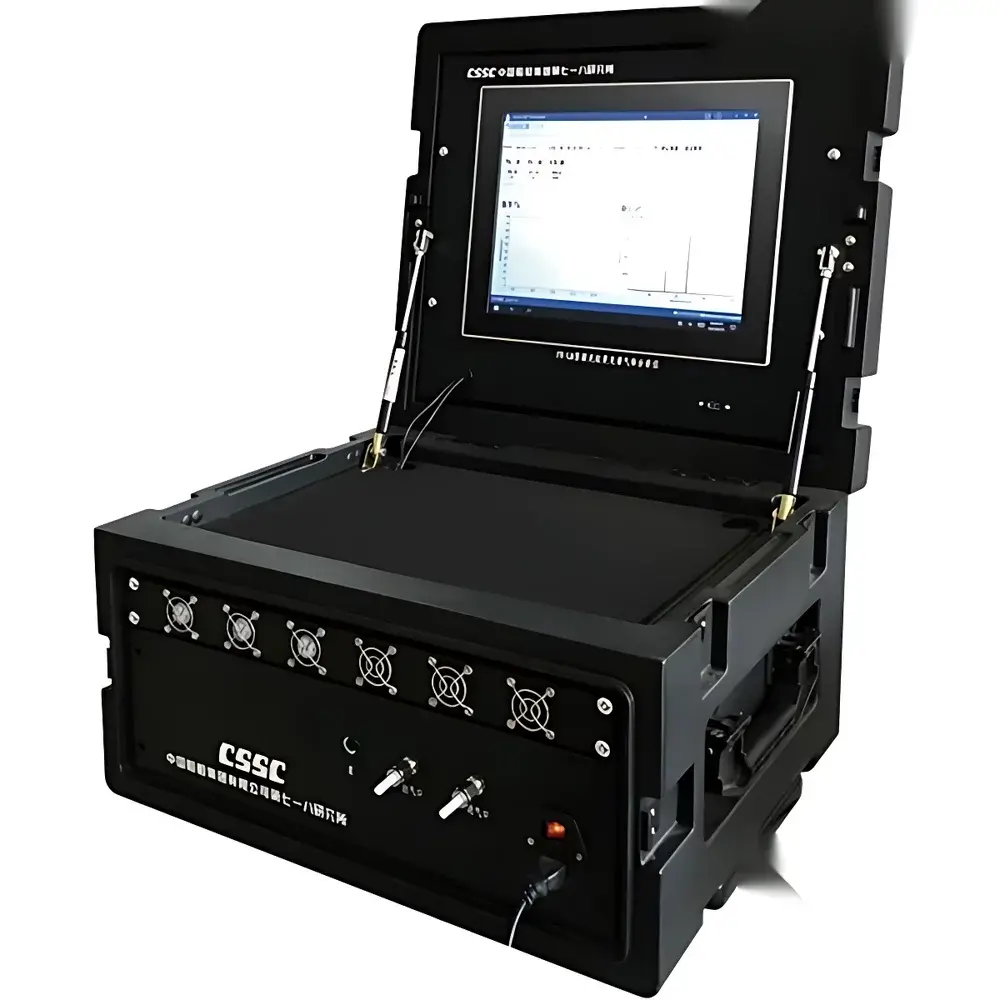
PERIC PR-LM Portable Laser Raman Spectrometer for Gas Analysis
| Brand | PERIC |
|---|---|
| Model | PR-LM |
| Type | Portable / Handheld Raman Spectrometer |
| Origin | Hebei, China |
| Manufacturer | PERIC Instrument Co., Ltd. |
| Measurement Range | 0–100% (v/v) |
| Detection Limit | 1 µmol/mol |
| Accuracy | ±0.1% (full scale) |
| Analysis Time | 1–300 s (user-configurable) |
| Sample Inlet | Integrated diaphragm pump |
| Dimensions (L×W×H) | 557 × 420 × 330 mm |
| Weight | <23 kg |
| Target Gases | H₂, N₂, O₂, CO, CO₂, CH₄, NH₃, H₂O, H₂S, C₂H₂, C₂H₄, C₂H₆, C₃H₆, and other hydrocarbons and inorganic gases |
Overview
The PERIC PR-LM Portable Laser Raman Spectrometer is an engineered solution for real-time, multi-component gas analysis based on spontaneous Raman scattering spectroscopy. Unlike chromatographic or mass spectrometric techniques, the PR-LM requires no carrier gas, no physical separation of components, and no vacuum system—enabling direct, in-situ quantification of gaseous mixtures under ambient or process conditions. Its optical architecture leverages a stabilized diode-pumped solid-state (DPSS) laser source, high-throughput transmission spectrograph, and thermoelectrically cooled CCD detector to resolve rotational-vibrational Raman shifts with high spectral fidelity. The instrument operates on the fundamental principle that molecular bonds scatter incident monochromatic light at characteristic frequency shifts—providing unambiguous identification and concentration-dependent intensity calibration for both organic and inorganic species, including gases transparent to infrared radiation (e.g., H₂, N₂, O₂). Validated in field deployments across upstream and midstream natural gas operations, the PR-LM delivers quantitative composition data for calorific value estimation, compositional tracking, and safety-critical monitoring without sample preconditioning.
Key Features
- True portable design: Integrated pump, battery-ready power management, and ruggedized chassis compliant with IP54 environmental rating for field deployment.
- Multi-gas simultaneous detection: Quantifies up to 15 gas species—including CH₄, C₂H₆, CO₂, H₂S, H₂, and C₃H₆—in a single 1–300 second acquisition cycle.
- Enhanced signal-to-noise architecture: Features dual-stage Raman signal enhancement via optimized excitation geometry, background-rejecting notch filtering, and real-time cosmic ray removal during spectral integration.
- Calibration traceability: Factory-calibrated using NIST-traceable gas standards; supports user-defined calibration curves per ISO 6142 and ASTM D1945 protocols.
- Robust thermal and mechanical stability: Active temperature stabilization of optical path (<±0.1 °C) ensures long-term reproducibility (RSD <1.2% over 8 h).
Sample Compatibility & Compliance
The PR-LM accepts gaseous samples via integrated diaphragm pump aspiration (flow rate: 0.1–2 L/min) with optional heated sample line and particulate filter for humid or dirty stream applications. It is compatible with pressurized (up to 5 bar abs) and atmospheric sampling configurations. All internal wetted materials comply with ASTM F2212 (elastomer compatibility for hydrocarbon service). The instrument meets electromagnetic compatibility requirements per EN 61326-1:2013 and safety standards per IEC 61010-1:2010. For regulated environments, firmware supports audit-trail logging and electronic signature capability aligned with FDA 21 CFR Part 11 Annex 11 principles—enabling use in GLP-compliant laboratories and GMP-aligned natural gas quality assurance workflows.
Software & Data Management
The PR-LM is operated via PERIC RamanView™ v4.2—a Windows-based application supporting real-time spectral visualization, multivariate curve resolution (MCR), and partial least squares (PLS) regression modeling. Raw spectra are stored in HDF5 format with embedded metadata (timestamp, pressure, temperature, laser power, integration time). The software includes built-in libraries for >40 gases and allows creation of custom spectral libraries using reference measurements. Data export options include CSV, XML, and PDF reports conforming to ISO/IEC 17025 reporting requirements. Remote diagnostics and firmware updates are supported over Ethernet or Wi-Fi (WPA2-Enterprise); optional OPC UA server module enables seamless integration into SCADA and DCS platforms (e.g., Siemens PCS7, Emerson DeltaV).
Applications
- Natural gas and shale gas compositional analysis during wellsite logging, core analysis, and pipeline custody transfer.
- Thermal value (HHV/LHV) prediction in real time using ASTM D3588-derived correlations from measured hydrocarbon fractions.
- Ceramic and glass kiln atmosphere optimization via continuous monitoring of combustion gases (CO, CO₂, O₂, CH₄) to control stoichiometry and energy efficiency.
- Hazardous gas screening in confined spaces—such as utility tunnels, mine shafts, and LNG bunkering zones—for simultaneous detection of H₂S, NH₃, C₂H₂, and explosive limits (LEL) estimation.
- Process validation in hydrogen production facilities (electrolysis, SMR) and carbon capture units where rapid CO₂/H₂ ratio verification is critical.
FAQ
Does the PR-LM require external calibration gases for routine operation?
No—factory-installed primary calibrations remain stable for ≥6 months under normal use; however, periodic verification using certified standard gas mixtures (per ISO 6141) is recommended every 90 days for regulatory compliance.
Can the instrument quantify isotopic species such as ¹³CH₄ or D₂?
Not natively—the current spectral resolution (≤4 cm⁻¹) does not resolve isotopic Raman shifts; isotopic analysis requires higher-resolution instrumentation (e.g., FT-Raman with interferometric detection).
Is the PR-LM suitable for high-humidity gas streams?
Yes—optional heated sample line (up to 120 °C) and Nafion™ dryer integration prevent condensation; water vapor is simultaneously quantified and mathematically compensated in multicomponent models.
What maintenance is required beyond routine optical cleaning?
Annual verification of laser wavelength stability and detector quantum efficiency; no consumables or replaceable optics are required within the first 5 years of operation.
How is measurement uncertainty reported in compliance documentation?
Uncertainty budgets follow EURACHEM/CITAC Guide CG4 methodology, incorporating contributions from calibration gas uncertainty, spectral fitting residuals, pressure/temperature transducer error, and repeatability—fully documented in the instrument’s Certificate of Conformance.




