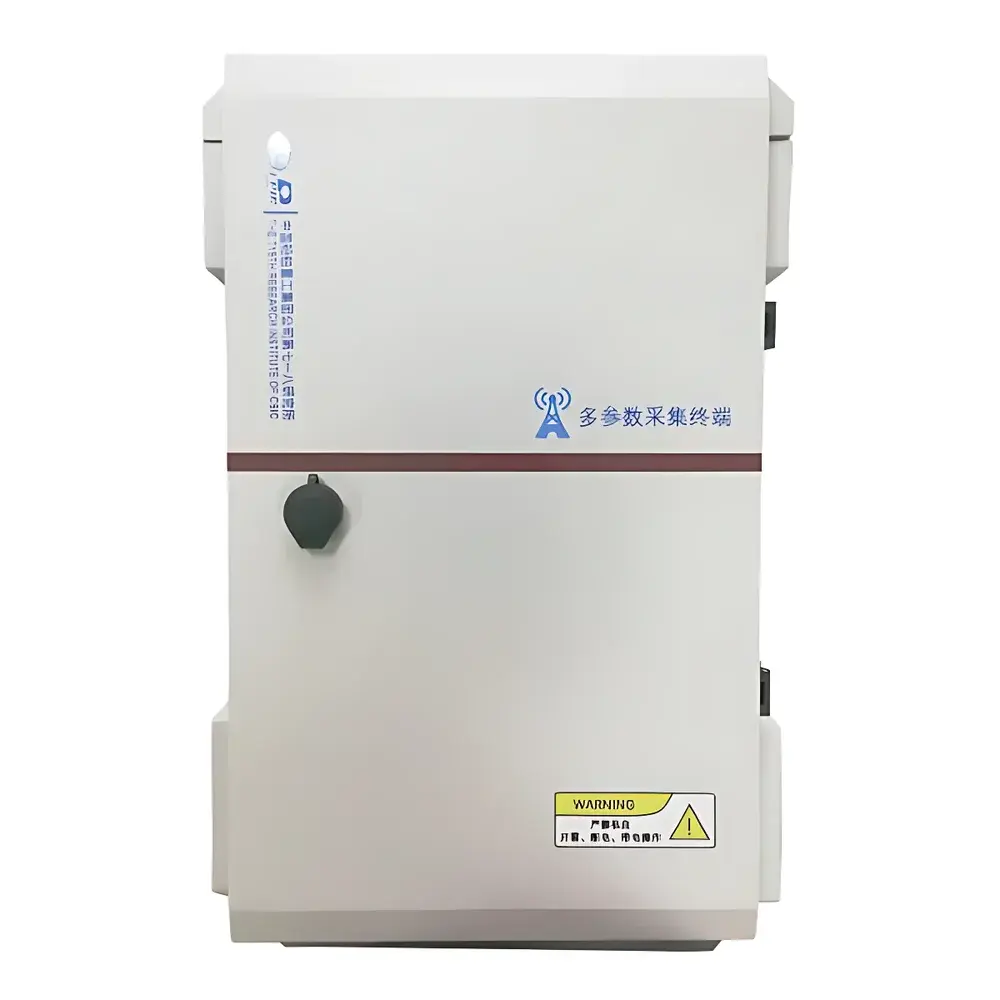
NL Series Multi-Parameter Data Acquisition Terminal
| Brand | PERIC |
|---|---|
| Origin | Hebei, China |
| Manufacturer Type | OEM/ODM Manufacturer |
| Country of Origin | China |
| Model | NL |
| Pricing | Available Upon Request |
| Power Supply | AC 220 V ±15%, with Li-ion backup battery (≥6 h runtime during mains failure) |
| Operating Temperature | −30 °C to +70 °C |
| Communication Interface | RS485 (custom protocol support available) |
| Data Upload Protocol | HJ212 (customizable, e.g., MQTT, Modbus TCP, HTTP RESTful APIs) |
| Digital Inputs | 1 channel |
| Digital Outputs | 1 channel |
| Analog Inputs | 4 channels (0–5 V / 0–20 mA configurable) |
| Local Storage | MicroSD card (up to 32 GB, FAT32 formatted) |
| Network Connectivity | LTE Cat 1 / Cat 4 (4G), with fallback to SMS-based alarm notification |
| Special Functions | Power-loss detection & logging, enclosure tamper detection (door open/close event), automatic battery charging and state-of-charge monitoring |
| Compliance | Meets GB/T 17626 ESD/Surge immunity requirements |
Overview
The NL Series Multi-Parameter Data Acquisition Terminal is an industrial-grade edge data concentrator engineered for reliable, long-term deployment in harsh field environments. It operates on the principle of distributed sensor fusion—aggregating heterogeneous analog, digital, and serial-based measurements from legacy and modern field instruments via standardized physical interfaces (RS485, analog voltage/current inputs) and transforming them into time-synchronized, protocol-compliant telemetry streams for cloud or SCADA-level systems. Unlike generic DAQ modules, the NL terminal integrates power resilience, embedded storage, and cellular telemetry into a single ruggedized unit—eliminating dependency on external UPS, local PCs, or gateway hardware. Its architecture follows IEC 61131-3-aligned logic execution for deterministic input sampling, timestamping (RTC with ±2 ppm accuracy), and pre-processing (e.g., scaling, linearization, min/max/average calculation per channel), ensuring measurement integrity prior to transmission.
Key Features
- Redundant dual-power architecture: AC 220 V primary supply with automatic switchover to internal rechargeable lithium-ion battery (≥6 h continuous operation at full channel load during mains outage)
- Local data persistence: Built-in microSD slot supporting up to 32 GB FAT32-formatted cards for buffered storage of raw and processed time-series data—critical for offline operation or intermittent connectivity scenarios
- Protocol-flexible communication stack: Native support for China’s environmental monitoring standard HJ212-2017; firmware extensible to MQTT, Modbus TCP, HTTP(S) POST/GET, and custom binary protocols via vendor-provided SDK
- Remote lifecycle management: Over-the-air (OTA) firmware updates, configuration reprogramming, and real-time diagnostics via secure TLS-encrypted channel—enabling zero-touch maintenance across geographically dispersed deployments
- Robust data continuity: Intelligent breakpoint resume mechanism ensures no data loss during network handover, signal dropout, or server unavailability; locally queued records are transmitted in chronological order upon recovery
- Field-adaptable I/O design: Four configurable analog inputs (voltage or current mode), one isolated digital input for status monitoring (e.g., pump run signal), one digital output for local actuation (e.g., alarm relay), and hardware-triggered event logging for power interruption and enclosure intrusion
Sample Compatibility & Compliance
The NL terminal interfaces seamlessly with common industrial sensors and meters compliant with IEC 60079 (explosion-proof zones), GB/T 18487 (EV charging infrastructure), and CJJ/T 151 (urban water/gas metering). It supports Modbus RTU, DL/T645, and proprietary protocols used by electricity meters, ultrasonic flowmeters, pressure transmitters, and RTD/thermocouple conditioners. Electromagnetic compatibility adheres to GB/T 17626.2 (ESD), GB/T 17626.4 (EFT), and GB/T 17626.5 (surge), validated under industrial environment Class A per IEC 61000-6-2. While not certified for SIL2 or ATEX Zone 0, it is rated IP54 for dust and splash resistance and qualified for continuous operation across −30 °C to +70 °C ambient range—making it suitable for outdoor metering kiosks, substation auxiliary monitoring, and district energy metering nodes.
Software & Data Management
Firmware is developed in accordance with IEC 62443-4-1 security development lifecycle principles. Each device features unique X.509 certificate-based authentication for TLS 1.2+ server handshake, AES-128 encrypted local SD storage (optional), and write-protected configuration partitions. The embedded web interface (HTTPS only) provides role-based access control (admin/operator), audit logs for all parameter changes, and GLP/GMP-relevant metadata tagging (operator ID, timestamp, change reason). Data export supports CSV and JSON formats with ISO 8601 timestamps and UTC synchronization via NTP or cellular time broadcast. For regulatory traceability, firmware version, configuration hash, and last successful upload timestamp are logged and retrievable via CLI or API.
Applications
- Sub-metering in industrial parks: Real-time aggregation of branch-circuit power consumption (kWh, kW, PF), enabling demand response and loss analysis per GB/T 31960
- Environmental compliance monitoring: Continuous emission monitoring system (CEMS) auxiliary data collection—flue gas temperature, static pressure, O₂ concentration—from analyzers using HJ212-compliant uplink
- Smart utility infrastructure: Integration with AMI-enabled water/gas meters for remote reading, leak detection analytics, and tariff-based billing cycles
- Energy Internet of Things (EIOT): Edge preprocessing node in distributed energy resource (DER) monitoring—solar inverter output, battery SOC, grid tie status—for dispatch optimization
- Preventive maintenance triggers: Correlation of vibration proxy signals (via analog input), temperature drift, and power anomaly events to generate maintenance work orders via integrated MQTT-to-ERP bridging
FAQ
Does the NL terminal support TLS 1.3 and certificate pinning for secure data transmission?
Yes—firmware v2.3.0 and later implement TLS 1.3 with configurable root CA trust anchors and optional certificate pinning to prevent MITM attacks during OTA or data upload.
Can analog input channels be calibrated individually per channel using NIST-traceable references?
Yes—each analog input supports two-point field calibration (zero/span) via CLI or web interface, with calibration coefficients stored in non-volatile memory and applied in real time during acquisition.
Is there a built-in watchdog timer and hardware reset circuit to recover from firmware hangs?
Yes—the device includes an independent hardware watchdog IC with 30-second timeout, triggering a cold reboot if application layer fails to service it; all critical registers retain state across reset.
How is time synchronization maintained during extended cellular outages?
The onboard RTC maintains timekeeping within ±2 ppm accuracy over temperature; when connectivity resumes, NTP sync corrects drift without affecting historical timestamp integrity.
Are firmware update packages cryptographically signed, and can signature verification be enforced?
Yes—all OTA firmware images are signed with ECDSA secp256r1; signature verification is mandatory and cannot be disabled in production firmware builds.