
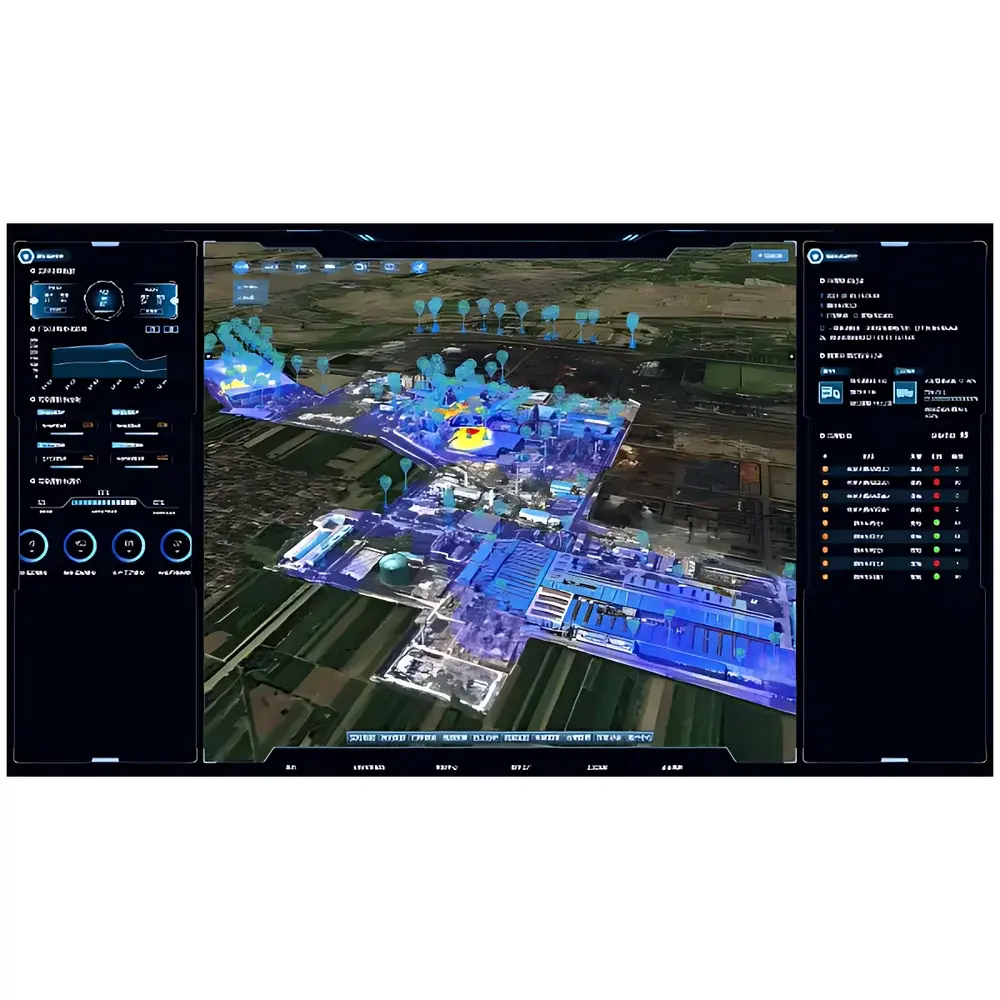
PERIC Ultra-Low Emission Intelligent Management Platform
| Brand | PERIC |
|---|---|
| Origin | Hebei, China |
| Manufacturer Type | Direct Manufacturer |
| Regional Classification | Domestic (China) |
| Model | Custom-Built |
| Pricing | Available Upon Request |
Overview
The PERIC Ultra-Low Emission Intelligent Management Platform is an industrial-grade environmental intelligence system engineered for continuous compliance monitoring and emission optimization in heavy-emission industries. Built on a foundation of real-time multi-source data ingestion, edge-to-cloud architecture, and rule-based emission analytics, the platform implements a physics-informed, data-driven approach to regulatory adherence—specifically targeting the stringent ultra-low emission thresholds defined under China’s Ministry of Ecology and Environment (MEE) Document No. 31 (2020) and supplementary technical guidelines for iron & steel, coking, foundry, and cement sectors. Unlike conventional SCADA or EMS systems, this platform integrates process-level operational parameters (e.g., sintering bed temperature, coke oven flue gas O₂ concentration, clinker cooler air flow) with environmental sensor outputs (CEMS, dust monitors, VOC analyzers, meteorological stations) and logistics telemetry (truck GPS, weighing bridge logs, fuel consumption records), enabling causal inference between production behavior and emission outcomes.
Key Features
- Three-Dimensional Emission Governance Framework: Structured around three legally mandated control domains—organized point sources (stacks with CEMS), unorganized emissions (dust dispersion from stockyards, transfer points, and material handling), and clean transportation (electrified/fuel-efficient vehicle scheduling, green logistics certification tracking).
- Unified Data Fabric Architecture: Aggregates heterogeneous time-series data streams via standardized OPC UA, Modbus TCP, and MQTT protocols; normalizes units and timestamps using ISO 8601-compliant temporal alignment and SI-unit conversion engines.
- Dynamic Compliance Dashboard: Visualizes real-time emission intensity (kg/t-product), deviation alerts against hourly/daily/monthly MEE benchmarks, and root-cause heatmaps linking abnormal spikes to upstream process events (e.g., blast furnace tuyere pressure fluctuation → increased NOₓ at sintering exhaust).
- AI-Augmented Anomaly Detection: Deploys unsupervised learning models (Isolation Forest, LSTM-based residual forecasting) trained on historical plant-specific baselines to flag non-compliant patterns prior to regulatory reporting cycles—supporting proactive corrective action rather than reactive reporting.
- Regulatory Reporting Engine: Auto-generates MEE Form 1–4 reports, provincial environmental supervision summaries, and self-declaration documents compliant with GB/T 31962–2015 (wastewater) and GB 16297–1996 (atmospheric pollutants), including audit-ready metadata logs.
Sample Compatibility & Compliance
The platform interfaces natively with certified Chinese environmental monitoring equipment meeting HJ 75–2017 (CEMS performance specification) and HJ 76–2017 (data acquisition requirements). It supports integration with third-party analyzers (e.g., Thermo Fisher 42i-NOₓ, Horiba PG-300 series, Siemens Ultramat 23) via analog 4–20 mA, RS-485, or Ethernet/IP. All data handling complies with China’s Cybersecurity Law (Article 37), PIPL (Personal Information Protection Law), and GB/T 22239–2019 (Information Security Technology – Basic Requirements for Cybersecurity Level Protection). The system architecture enables GLP-aligned data integrity: full audit trail, electronic signature support (per GB/T 19001–2016 Annex A.5), and immutable storage of raw sensor frames for forensic traceability.
Software & Data Management
Deployed as a containerized application suite (Docker/Kubernetes) on-premises or in hybrid cloud environments, the software stack includes a PostgreSQL 14 database with TimescaleDB extension for time-series scalability, Apache Kafka for high-throughput ingestion (>50,000 events/sec), and a Vue.js-based web interface accessible via role-based access control (RBAC). Data retention policies adhere to MEE’s minimum 5-year archival mandate; encrypted backups follow GB/T 22239–2019 Tier III requirements. All user actions—including report generation, parameter modification, and alarm acknowledgment—are logged with ISO 8601 timestamps, operator ID, and IP geolocation for regulatory audits. Optional FDA 21 CFR Part 11 compliance module available for multinational subsidiaries requiring electronic record validation.
Applications
- Real-time compliance assurance for integrated steelworks (sintering plants, blast furnaces, BOF/LF/VD facilities)
- Emission source attribution modeling in coke oven battery operations under varying heating regimes
- Dust dispersion simulation and mitigation planning for open-air stockyards using integrated LIDAR + meteorological boundary conditions
- Green logistics KPI tracking: EV fleet utilization rate, diesel truck emission factor reduction, and rail transport modal shift quantification
- Cross-departmental energy-emission correlation analysis (e.g., coke ratio vs. CO₂ intensity; kiln thermal efficiency vs. NOₓ formation)
FAQ
Is the platform certified by Chinese environmental authorities for official compliance reporting?
Yes—the platform’s data acquisition, processing, and reporting modules have been validated per HJ 212–2017 communication protocol standards and are deployed in over 20 MEE-supervised pilot projects across Hebei, Shanxi, and Shandong provinces.
Can it integrate with existing DCS/PLC systems from Siemens, Honeywell, or SUPCON?
Yes—native drivers support Siemens S7-1200/1500, Honeywell Experion PKS, and SUPCON JX-300XP via OPC UA, Modbus TCP, and proprietary SDKs; engineering commissioning includes protocol mapping and tag validation.
What level of customization is supported for industry-specific emission calculation methodologies?
The platform provides configurable emission factor libraries aligned with MEE Technical Guidelines for Emission Calculation (2022 Edition), and supports client-defined mass-balance equations, stoichiometric models, and empirical correlations through its embedded Python scripting engine.
Does it support multi-site deployment with centralized oversight?
Yes—distributed edge nodes collect local data with synchronized time stamps (PTP IEEE 1588 v2), while a central analytics hub performs cross-site benchmarking, best-practice sharing, and aggregated regional emission inventory reporting.
Related Products







