
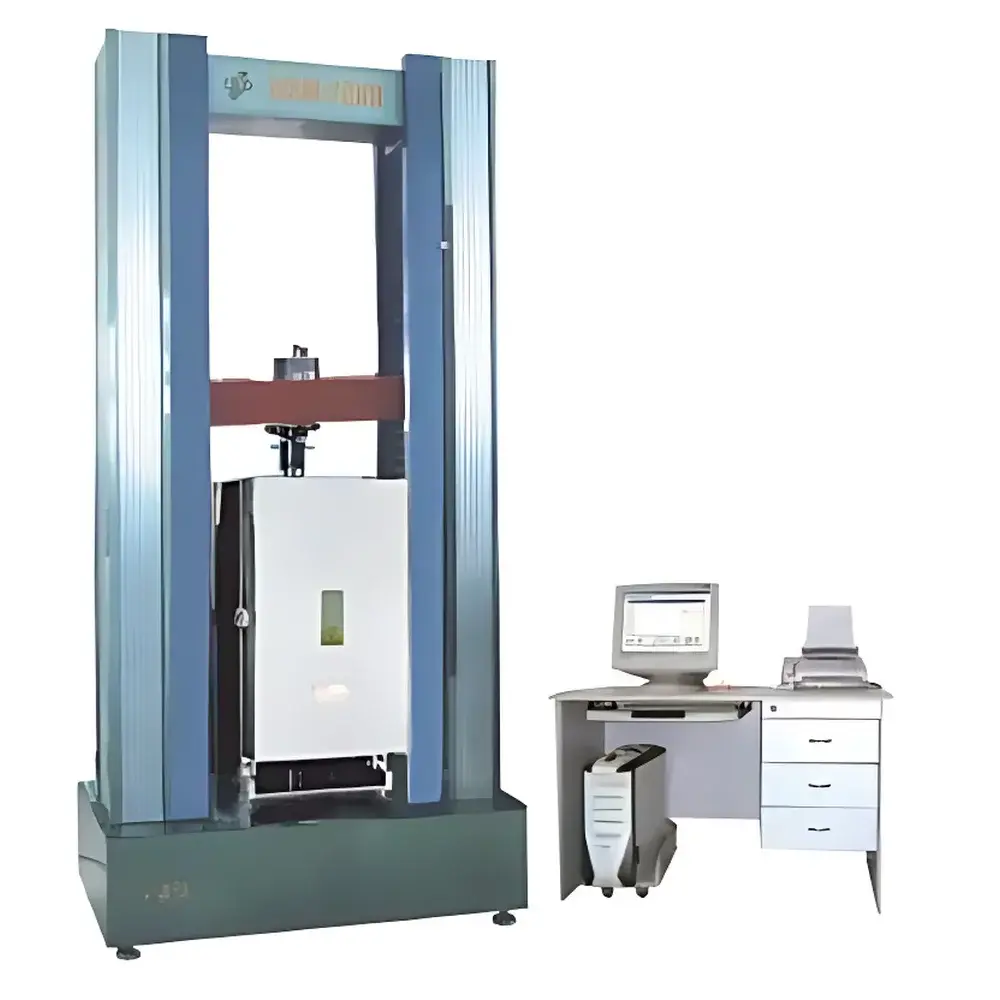
English Product Name
| Origin | Jilin, China |
|---|---|
| Manufacturer Type | Authorized Distributor |
| Origin Category | Domestic (China) |
| Model | WSM-20KN |
| Maximum Test Load | 20 kN |
| Load Cell Accuracy | ±0.5% FS |
| Force Measurement Accuracy | ±0.5% |
| Speed Accuracy | ±0.5% |
| Speed Range | 0.05–500 mm/min |
| Displacement/Strain Accuracy | ±0.5% |
| Extensometer Range | 10–1000 mm |
| Crosshead Travel (Effective) | 1160 mm |
| Test Width | 420 mm |
| Distance Between Grips (Effective) | 860 mm |
| Temperature Chamber Range | −40 °C to +150 °C |
Overview
The Instron WSM-20KN High-Low Temperature Universal Testing Machine is a precision electromechanical system engineered for static mechanical property characterization under controlled thermal environments. It operates on the principle of servo-controlled axial loading—applying uniaxial tensile, compressive, or flexural forces to specimens while continuously measuring load, displacement, and strain. Integrated with a certified −40 °C to +150 °C environmental chamber, the system enables standardized evaluation of material behavior across extreme thermal conditions, supporting critical R&D and quality assurance workflows in aerospace, automotive, polymer science, and biomedical device manufacturing. Its dual-circuit control architecture ensures high reproducibility in force application and positional feedback, meeting the fundamental requirements for ISO 527, ASTM D638, ASTM D790, ASTM D3410, and GB/T 1040 series test protocols.
Key Features
- Precision ball-screw-driven crosshead actuation with synchronous timing belt transmission—minimizing mechanical backlash and acoustic emission during low-speed testing.
- Imported high-resolution digital speed controller enabling stable velocity regulation across the full 0.05–500 mm/min range, compliant with ASTM E4 requirements for rate-of-loading consistency.
- Integrated high-stability load cell (manufactured by Transducer Techniques, USA) with ±0.5% full-scale accuracy and automatic electrical calibration support for force channel traceability.
- Dual-mode deformation measurement: standard encoder-based crosshead displacement plus optional clip-on extensometer or video-based non-contact strain tracking for high-fidelity elongation analysis.
- Real-time multi-curve plotting—including stress–strain, force–displacement, strength–time, and strain–time—with customizable axis scaling, region zooming, and overlay comparison of up to 16 concurrent test records.
- Comprehensive hardware safety suite: overload cutoff, overcurrent/overvoltage protection, thermal interlock from chamber subsystem, dual mechanical limit switches, and programmable upper/lower position boundaries.
- Digital crosshead position readout with optical scale reference—enabling sub-millimeter repeatability in specimen alignment and pre-load setup.
Sample Compatibility & Compliance
The WSM-20KN accommodates specimens ranging from thin polymer films (≥0.1 mm thickness) to structural metal rods (≤Φ25 mm), including thermoplastics, elastomers, composites, ceramics, wire-and-cable assemblies, and fiber-reinforced laminates. Standard wedge-action, pneumatic, and hydraulic grips ensure secure clamping without slippage or premature failure at interfaces. All test sequences adhere to internationally recognized standards including ISO 527-2 (plastics), ASTM D638 (tensile properties), ASTM D790 (flexural properties), ASTM D3410 (compressive properties of CFRP), and GB/T 1040.1–2018 (Chinese national standard for tensile testing). Data acquisition and reporting modules support audit-ready documentation aligned with GLP and GMP environments, including user-defined electronic signatures and 21 CFR Part 11–compliant audit trails when paired with optional validated software packages.
Software & Data Management
The embedded Windows-based control interface supports real-time parameter monitoring, automated test sequencing, and post-test curve annotation. Raw data streams are stored in ASCII-delimited format (.csv) and native binary (.tdms) for long-term archival integrity. Export options include direct generation of Microsoft Excel-compatible reports, Word-formatted certificates, and vector-based PDF plots with embedded metadata (operator ID, timestamp, environmental setpoint, calibration certificate ID). All test conditions—including temperature ramp profiles, load-rate profiles, and grip separation parameters—are saved alongside results for full traceability. The system permits batch processing of multiple samples using identical protocols, with auto-recognition of valid failure events (e.g., sudden load drop >90% within 50 ms) triggering immediate test termination and data preservation.
Applications
This testing platform serves as a primary tool for mechanical validation in regulated and research-intensive sectors. Typical use cases include: evaluating low-temperature embrittlement thresholds of polyolefin piping materials per ASTM F1995; assessing high-temperature creep resistance of silicone elastomers used in medical seals; quantifying interlaminar shear strength degradation in carbon-fiber prepregs after thermal cycling; verifying tensile yield point stability of biodegradable PLA filaments across sterilization cycles; and benchmarking modulus retention in flame-retardant ABS blends subjected to UL94 V-0 qualification protocols. Its modular design also supports custom fixture integration for specialized geometries such as torsional couplings, peel adhesion jigs, or miniature compression platens.
FAQ
What temperature uniformity specifications does the integrated environmental chamber meet?
The chamber maintains ±1.5 °C temperature uniformity across the test zone at steady state, verified per IEC 60068-3-5 and calibrated annually using NIST-traceable PT100 probes.
Can the system perform closed-loop strain control during tensile testing?
Yes—when equipped with an active extensometer or digital image correlation (DIC) module, the controller executes real-time strain feedback with PID tuning optimized for ASTM E8/E8M compliance.
Is third-party calibration certification included with delivery?
A factory-issued calibration certificate covering force, displacement, and speed channels is provided; ISO/IEC 17025-accredited field calibration services are available upon request.
Does the software support automated pass/fail evaluation against user-defined limits?
Yes—threshold-based logic rules can be assigned to any measured parameter (e.g., “fail if ultimate tensile strength < 42 MPa”) with configurable alert outputs and report flagging.
What is the maximum specimen height accommodated within the chamber during elevated-temperature testing?
At +150 °C, the usable vertical clearance between platens is 620 mm—sufficient for ASTM D695-compliant compression specimens up to 120 mm in height.



