
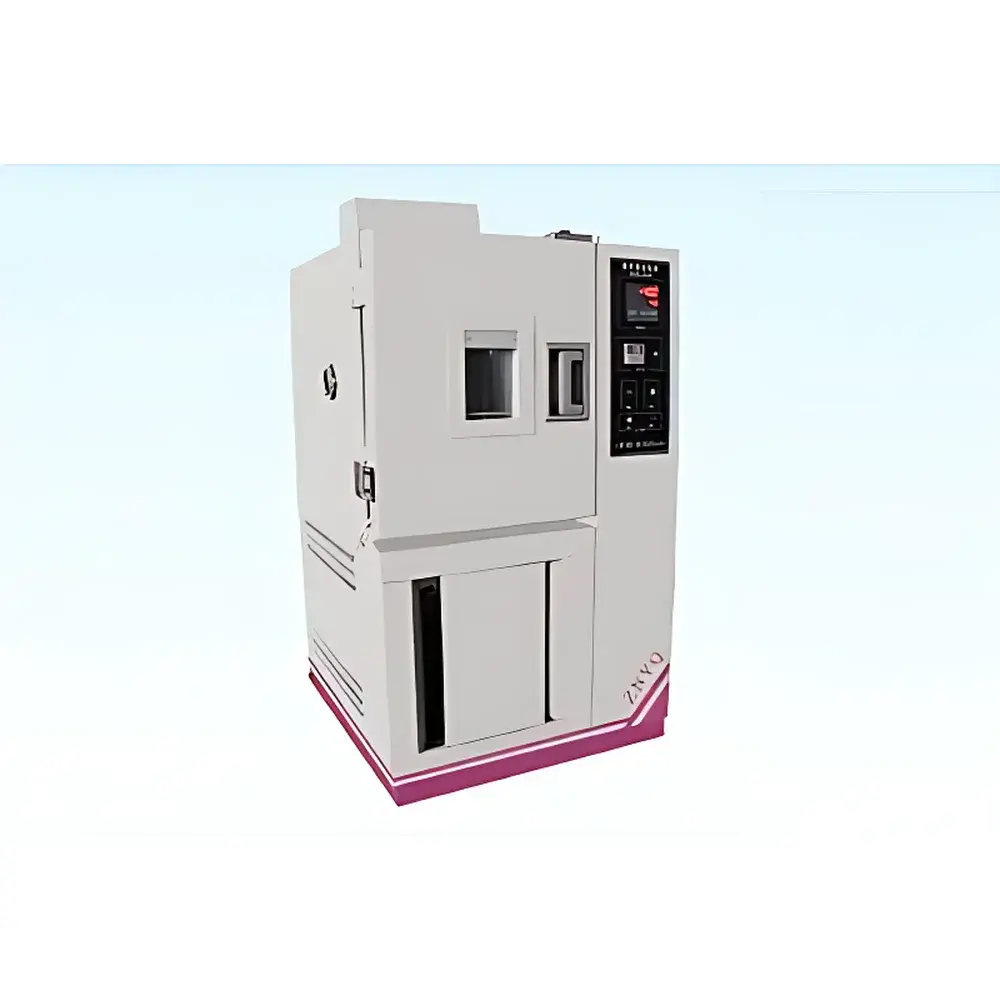
Changchun Intelligent GDW Series Temperature and Humidity Controlled Chamber
| Brand | Changchun Intelligent |
|---|---|
| Origin | Jilin, China |
| Manufacturer Type | Authorized Distributor |
| Country of Manufacture | China |
| Model | GDW Series |
| Temperature Range | −40 °C to +150 °C |
| Temperature Resolution | 0.1 °C |
| Humidity Range | 30–98 % RH |
| Temperature Control Accuracy | ±1 °C (typical measured deviation < 0.5 °C) |
| Temperature Uniformity | ≤2 °C (measured < 1 °C across working chamber) |
| Circulation Fan | 180 W, single-phase AC 220 V axial-flow |
| Interior Lighting | AC 12 V, 50 W |
Overview
The Changchun Intelligent GDW Series Temperature and Humidity Controlled Chamber is an engineered environmental test system designed for precise, repeatable simulation of thermal and hygrothermal conditions in laboratory and industrial quality assurance settings. It operates on a dual-control principle—simultaneous regulation of air temperature and relative humidity within a sealed, insulated chamber—using a combination of refrigeration, electric heating, steam humidification, and forced-air convection. The chamber employs a high-stability PID feedback loop integrated with digital microprocessor control, enabling stable setpoint maintenance across the full operational range. Its architecture supports both static and dynamic environmental profiling, making it suitable for accelerated aging, material stability testing, and pre-conditioning protocols required by polymer, elastomer, and composite manufacturers.
Key Features
- Wide operational envelope: −40 °C to +150 °C temperature range with 30–98 % RH humidity control, validated per IEC 60068-3-5 and ASTM D4332 test condition specifications.
- High-fidelity temperature uniformity: ≤2 °C spatial gradient across the working volume (verified per ISO 16750-4 Annex A), with typical in-chamber deviation below 1 °C at steady state.
- Digital PID controller with real-time monitoring: Imported programmable logic controller (PLC) interface enables ramp-soak profiles, multi-step cycling, and event-triggered logging.
- Safety-critical protection suite: Independent over-temperature, under-temperature, over-humidity, and over-pressure cutoffs, each linked to audible/visual alarm outputs compliant with EN 61000-6-2 EMC requirements.
- Robust internal circulation: 180 W axial-flow fan ensures homogeneous air distribution without turbulence-induced sample disturbance; fan speed is modulated to maintain laminar flow during low-temperature operation.
- Integrated low-voltage lighting: 12 V, 50 W halogen illumination provides safe, non-heat-generating visibility during chamber access or visual inspection without affecting thermal equilibrium.
Sample Compatibility & Compliance
The GDW chamber accommodates standard ISO 16750-4-compliant test specimens—including molded plastic coupons (ASTM D638), vulcanized rubber strips (ISO 37), and coated substrates—within its internal workspace (dimensions vary by GDW submodel; consult dimensional drawings). Chamber construction meets IP54 ingress protection for internal components and conforms to UL 61010-1 safety standards for laboratory equipment. All control firmware supports audit-ready operation: time-stamped setpoint changes, alarm logs, and sensor calibration records are retained internally for ≥30 days. Optional RS485/Modbus RTU or Ethernet TCP/IP interfaces enable integration into GLP/GMP environments requiring 21 CFR Part 11-compliant electronic record systems when paired with validated third-party data acquisition software.
Software & Data Management
The embedded controller supports up to 99 programmable test steps per profile, including ramp rates (°C/min), dwell durations (min), and humidity transition limits. Data output includes real-time temperature/humidity curves, deviation alarms, and cycle completion reports exported via USB flash drive in CSV format. For enterprise deployment, optional PC-based supervision software (GDW-Link v3.x) provides remote monitoring, multi-chamber synchronization, automated report generation (PDF/Excel), and configurable email/SNMP alerts. All logged parameters include traceable timestamps synchronized to NTP servers, supporting ISO/IEC 17025 documentation requirements for accredited testing laboratories.
Applications
- Thermal aging of thermoplastics and thermosets per ASTM D3045 and ISO 2578.
- Humidity-induced stress cracking evaluation of polyethylene and PVC pipes (ASTM F1473).
- Pre-conditioning of adhesives and sealants prior to peel/tensile testing (ISO 4618, ASTM D897).
- Stability assessment of packaging materials under tropical (40 °C/75 % RH) and desert (60 °C/20 % RH) climatic profiles.
- Validation of storage conditions for medical device components subject to ISO 11607-1 accelerated shelf-life protocols.
- Calibration verification of hygrometers and thermistors using NIST-traceable reference sensors mounted in designated ports.
FAQ
What is the maximum allowable load volume inside the GDW chamber without compromising temperature uniformity?
The recommended maximum sample volume is 30 % of the nominal chamber capacity to maintain specified uniformity and recovery times. Load configuration must avoid obstruction of air inlet/outlet grilles.
Does the GDW series support continuous operation at −40 °C with 30 % RH?
Yes—low-temperature dehumidification is achieved via refrigerant-based condensation combined with desiccant-assisted drying, validated for uninterrupted 72-hour operation at −40 °C/30 % RH.
Can the controller be calibrated onsite by the user?
Field calibration is supported via two-point adjustment (span and offset) using certified reference probes; full metrological calibration requires factory service with traceable documentation per ISO/IEC 17025.
Is the chamber compatible with external data acquisition systems?
Yes—standard Modbus RTU over RS485 allows direct integration with LabVIEW, MATLAB, or SCADA platforms; optional Ethernet module supports OPC UA and MQTT protocols.
What maintenance intervals are recommended for long-term reliability?
Compressor oil and refrigerant levels should be verified annually; condenser coils require cleaning every 6 months in non-cleanroom environments; humidity generator water reservoir must be refilled daily during extended humidification cycles.



