
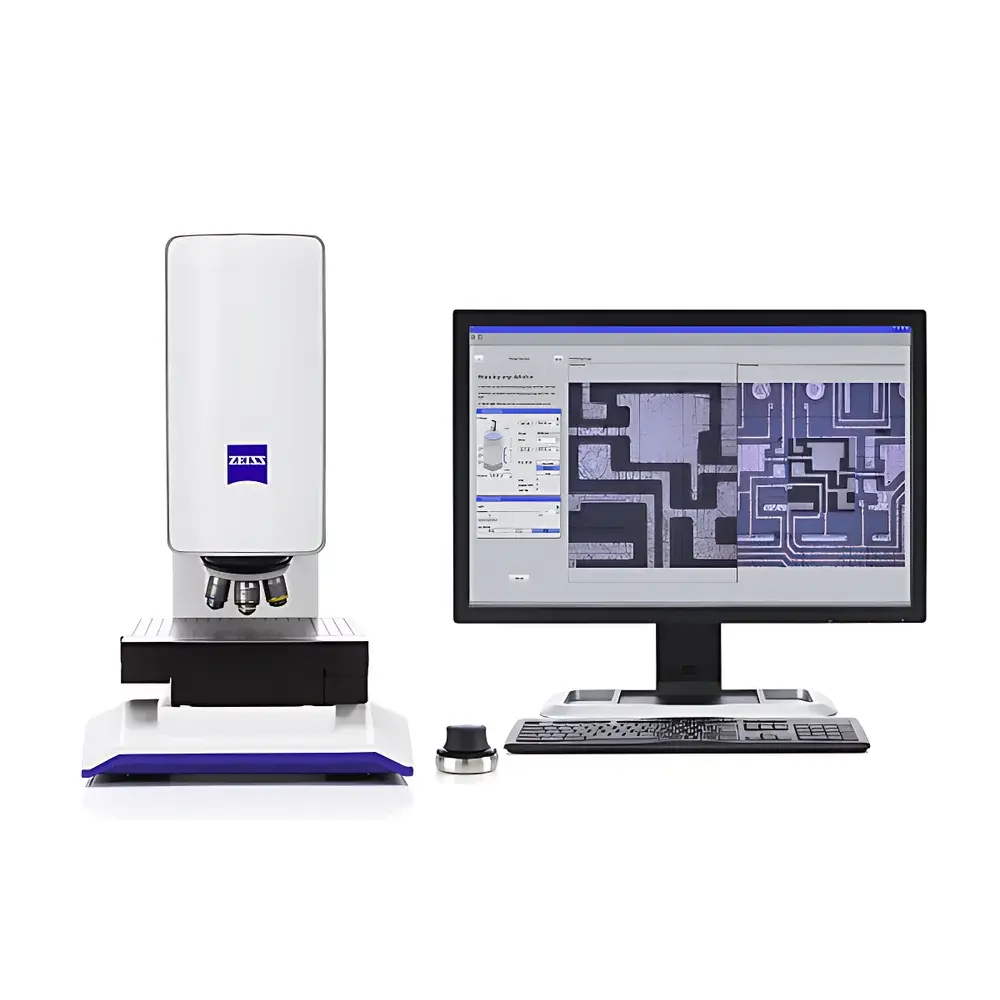
ZEISS Smartproof 5 High-Speed Spinning-Disk Confocal Microscope
| Brand | ZEISS |
|---|---|
| Origin | Germany |
| Model | Smartproof 5 |
| Wavelength | 405 nm |
| Lateral Resolution (XY) | 120 nm |
| Z-Axis Minimum Step Size | 1 nm |
| Imaging Speed | >50 fps (2048 × 2048 resolution) |
| Objective Magnification Range | 2.5×–100× |
| Maximum Height Scan Range | 5 mm |
| Stage Travel | 150 mm × 150 mm |
| Software | Smartproof 5 Application Suite |
| Surface Roughness Standards Compliance | ISO 4287 (2D), ISO 25178 (3D) |
| Illumination | Tri-color LED (RGB) for True-Color Surface Rendering |
Overview
The ZEISS Smartproof 5 is a high-speed spinning-disk confocal microscope engineered for industrial surface metrology and non-contact 3D topography analysis. Unlike conventional point-scanning confocal systems, the Smartproof 5 employs a patented rotating Nipkow disk optical architecture to simultaneously illuminate and detect multiple spatial points across the field of view. This design leverages the fundamental principle of optical sectioning—where only in-focus light from a defined axial plane passes through the confocal pinhole array—while eliminating the time penalty associated with serial point-by-point raster scanning. The result is a robust, vibration-insensitive platform capable of delivering sub-120 nm lateral resolution and 1 nm Z-axis step precision without requiring active anti-vibration tables. Its integrated mechanical and optical architecture enables stable operation in factory-floor environments, making it suitable for both R&D laboratories and production-integrated quality control stations.
Key Features
- High-resolution optical sectioning: Achieves 120 nm XY resolution via 405 nm laser illumination and optimized confocal aperture geometry—1.4× improvement over conventional widefield microscopy.
- Nanometric Z-axis precision: Motorized objective drive with closed-loop feedback ensures repeatable 1 nm vertical stepping, enabling traceable height metrology compliant with ISO 25178-601 (areal surface texture) and ISO 25178-602 (instrument calibration).
- Real-time imaging throughput: Spinning-disk architecture delivers >50 full-frame images per second at 2048 × 2048 pixel resolution—2–3× faster than standard laser-scanning confocal microscopes—reducing cycle time for batch inspection tasks.
- True-color surface visualization: Integrated tri-color LED illumination (RGB) preserves native chromatic information during acquisition, supporting material identification, coating assessment, and visual correlation with optical inspection standards.
- Industrial-grade mechanical stability: Monolithic baseplate, rigid kinematic stage mounting, and thermal mass optimization minimize drift and environmental sensitivity—no external vibration isolation required for operation in ISO Class 7 cleanrooms or controlled manufacturing areas.
- Operator-mode workflow integration: Preconfigured measurement templates, one-click report generation, and password-protected user roles support GMP-aligned SOP execution and audit-ready documentation.
Sample Compatibility & Compliance
The Smartproof 5 accommodates a broad range of reflective and semi-reflective industrial specimens—including metallic alloys, ceramics, polymers, coated substrates, and optically polished optics—without conductive coating or vacuum requirements. Its large 150 mm × 150 mm motorized stage supports macro-to-micro scale transitions, while objective lenses (2.5×–100×) enable seamless switching between overview survey and localized nanotopography analysis. All surface roughness calculations adhere strictly to ISO 4287 (profile-based parameters) and ISO 25178-2 (areal parameters), with built-in filters (Gaussian, S-filter, robust Gaussian) and cut-off definitions aligned with international calibration protocols. System validation includes NIST-traceable step-height standards (e.g., certified 1.777 ± 0.011 mm台阶) and Ra reference samples (e.g., Ra = 2.97 µm), with documented measurement uncertainty budgets available upon request.
Software & Data Management
The Smartproof 5 Application Suite provides a deterministic, auditable software environment designed for regulated environments. It features embedded GLP/GMP functionality including electronic signatures (21 CFR Part 11 compliant), full audit trail logging (user actions, parameter changes, calibration events), and immutable raw data storage in vendor-neutral TIFF/OME-TIFF formats. Measurement workflows are scriptable via Python API for integration into automated test benches or MES systems. Quantitative outputs include 2D profile metrics (distance, angle, slope, constructed elements) and 3D areal parameters (Sa, Sq, Sz, Sdr, Vmp), all computed using ISO 25178-2–validated algorithms. Reporting modules generate PDF/HTML reports with embedded metadata, image thumbnails, statistical summaries, and pass/fail thresholds based on user-defined specification limits.
Applications
- Automotive engineering: Quantitative wear mapping of piston rings, contour analysis of weld seams, and ISO-compliant roughness evaluation of cylinder bores and bearing surfaces.
- Aerospace components: Seal integrity assessment of elastomeric gaskets, surface degradation tracking of turbine blade coatings, and geometric fidelity verification of additive-manufactured parts.
- Medical device manufacturing: Surface texture characterization of orthopedic implants (e.g., Ti-6Al-4V porous scaffolds), scratch detection on intraocular lenses, and coating uniformity verification for drug-eluting stents.
- Micro-optics and MEMS: Wavefront error mapping of diffractive optical elements (DOEs), sidewall angle measurement of etched silicon structures, and flatness verification of aspheric lens molds.
- Electronics packaging: Solder joint coplanarity assessment, wire bond height profiling, and conformal coating thickness mapping on PCB assemblies.
- Paper & printing: Basis weight uniformity analysis, ink penetration depth quantification, and embossing pattern fidelity evaluation under ambient lighting conditions.
FAQ
Does the Smartproof 5 require external vibration isolation?
No. Its monolithic mechanical design and optimized mass distribution allow stable operation on standard optical tables or factory floors without active or passive anti-vibration systems.
Can the system perform measurements traceable to national standards?
Yes. Calibration routines include NIST-traceable step-height and roughness reference standards, with uncertainty budgets documented per ISO/IEC 17025 guidelines.
Is the software validated for use in FDA-regulated environments?
The Smartproof 5 Application Suite supports 21 CFR Part 11 compliance through electronic signatures, audit trails, and role-based access control—validated per internal IQ/OQ protocols.
What surface materials can be measured without sample preparation?
Metals, ceramics, plastics, glass, and coated substrates—both polished and matte—can be analyzed directly; no sputter coating or vacuum chamber is required.
How does the spinning-disk architecture improve signal-to-noise ratio compared to point-scanning systems?
By parallelizing illumination and detection across thousands of pinholes, the spinning-disk design increases photon collection efficiency per unit time while maintaining optical sectioning capability—reducing photobleaching and thermal drift in extended acquisitions.





