
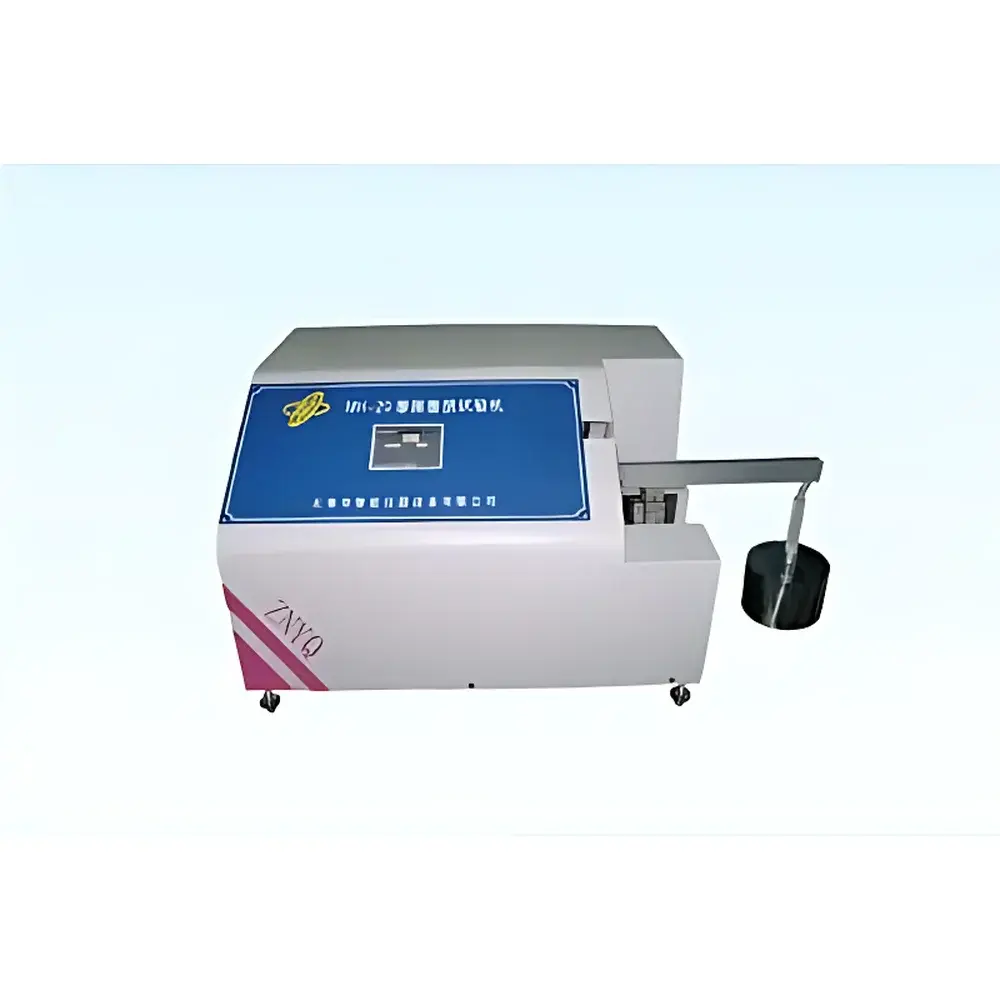
MH-20 Tribological Tester for Plastic and Rubber Friction & Wear Testing
| Origin | Jilin, China |
|---|---|
| Manufacturer Type | Authorized Distributor |
| Origin Category | Domestic (PRC) |
| Model | MH-20 |
| Pricing | Available Upon Request |
| Specimen Dimensions | 30.5 × 6.8 × 5.8–6.2 mm |
| Rotational Speed | 200 rpm ±5% |
| Applied Load | 20 kgf ±1% |
| Friction Ring | Ø40 × 10 mm, 45# Steel, HRC 40–45, Chamfer 0.5 × 45°, Concentricity < 0.01 mm |
| Friction Torque Range | 0–4 N·m ±2% |
| Counter Range | 0–10⁵ cycles |
| Control System | Microprocessor-based with Integrated Data Acquisition and Thermal Microprinter |
Overview
The MH-20 Tribological Tester is a precision-engineered benchtop instrument designed to quantify frictional behavior and wear resistance of polymeric and elastomeric materials under controlled sliding contact conditions. It operates on the principle of pin-on-disk (or ring-on-disk) tribometry, where a standardized test specimen—typically a rectangular block—is pressed against a rotating hardened steel friction ring under constant normal load. The resulting tangential friction force is measured via a calibrated torque sensor, enabling direct calculation of the coefficient of friction (μ = Ff/Fn) and cumulative wear volume through mass loss or dimensional analysis post-test. Conforming strictly to GB/T 3960–2016 (“Determination of the Coefficient of Friction and Wear Rate of Plastics under Sliding Conditions”), the MH-20 delivers repeatable, traceable data suitable for material qualification, formulation screening, and QC release testing in polymer manufacturing, R&D laboratories, and third-party certification facilities.
Key Features
- Microprocessor-controlled closed-loop operation with real-time torque acquisition and rotational speed stabilization at 200 rpm ±5%, ensuring consistent shear rate across test durations.
- High-stiffness mechanical frame with precision-ground linear guides and adjustable lever-arm loading system, delivering stable 20 kgf (196.2 N) normal force with ±1% accuracy over extended cycles.
- Calibrated torsional load cell (0–4 N·m range, ±2% full-scale accuracy) integrated into the specimen holder assembly, minimizing signal drift and mechanical hysteresis.
- Dedicated friction ring manufactured from normalized 45# carbon steel (HRC 40–45), machined to strict geometric tolerances: outer/inner concentricity < 0.01 mm, chamfered edge (0.5 × 45°) to prevent stress concentration and edge chipping during initial run-in.
- Onboard cycle counter (0–105) synchronized with motor encoder feedback, supporting pre-set test termination by cycle count or time—critical for comparative wear studies per ISO 7148-1 and ASTM G99 protocols.
- Integrated thermal microprinter enables immediate hard-copy output of raw torque values, calculated μ, elapsed cycles, and timestamp without external PC dependency—enhancing GLP-compliant record integrity.
Sample Compatibility & Compliance
The MH-20 accepts standard GB/T 3960 specimens measuring 30.5 mm (L) × 6.8 mm (W) × 5.8–6.2 mm (H), with dimensional tolerances of ±0.1 mm in length, −0.2/+0.0 mm in width, and ±0.2 mm in thickness. It accommodates rigid thermoplastics (e.g., PA6, POM, PTFE), thermoset composites (epoxy-glass, phenolic), and vulcanized rubbers (NR, SBR, EPDM). All mechanical components comply with GB/T 2611–2007 (General Requirements for Testing Machines) and GB/T 16825.1–2008 (Verification of Force Measuring Systems). While not certified to ISO/IEC 17025, its measurement chain—including torque transducer calibration certificate, load verification report, and ring surface roughness documentation (Ra ≤ 0.8 µm)—supports internal method validation per ISO 17025 Clause 7.7.
Software & Data Management
The MH-20 operates autonomously via embedded firmware; no proprietary software installation is required. All acquired data—including instantaneous torque, calculated friction coefficient, cycle count, and test duration—are stored in non-volatile memory and exported via RS-232 interface (optional USB adapter available) for CSV import into LIMS or statistical analysis platforms (e.g., JMP, Minitab). The microprinter output includes machine ID, operator code (manually entered), date/time stamp, and calibration validity period—satisfying basic audit trail requirements under GLP (OECD Principles) and internal QA procedures. For regulated environments requiring electronic signatures and 21 CFR Part 11 compliance, integration with validated third-party data acquisition software is recommended.
Applications
- Comparative wear ranking of filled vs. unfilled polymer grades under identical load/speed conditions.
- Screening lubricant additives in rubber compounds for automotive bushings and seals.
- Validating surface modification efficacy (e.g., plasma treatment, fluorination) on UHMWPE orthopedic bearing materials.
- Supporting ASTM D3702 (Plastic Bearing Materials) and ISO 683-17 (Heat-Treated Steels for Bearings) cross-material tribological benchmarking.
- Generating input parameters for finite element wear simulation models (e.g., Archard’s law coefficients).
FAQ
What standards does the MH-20 directly support?
GB/T 3960–2016 is the primary reference standard; supplementary alignment exists with ASTM G99 (pin-on-disk) and ISO 7148-1 (wear testing of plastics) for methodology adaptation.
Can the MH-20 test non-standard specimen geometries?
Only within mechanical constraints: maximum specimen height 12 mm, base contact area ≥ 100 mm², and flatness tolerance ≤ 0.02 mm to ensure uniform pressure distribution.
Is calibration traceability provided with the instrument?
Yes—each unit ships with NIST-traceable calibration certificates for the torque sensor and deadweight load verification kit, valid for 12 months from commissioning.
What maintenance is required for long-term torque accuracy?
Annual recalibration of the torsional load cell and biannual inspection of friction ring surface finish and concentricity using optical profilometry and V-block runout gauges.
Does the MH-20 meet FDA or EU regulatory requirements for medical device material testing?
It fulfills the instrumental capability requirements of ISO 10993-6 (biological evaluation of medical devices—part 6: tests for local effects after implantation), though final test protocol validation remains the responsibility of the user laboratory.



