
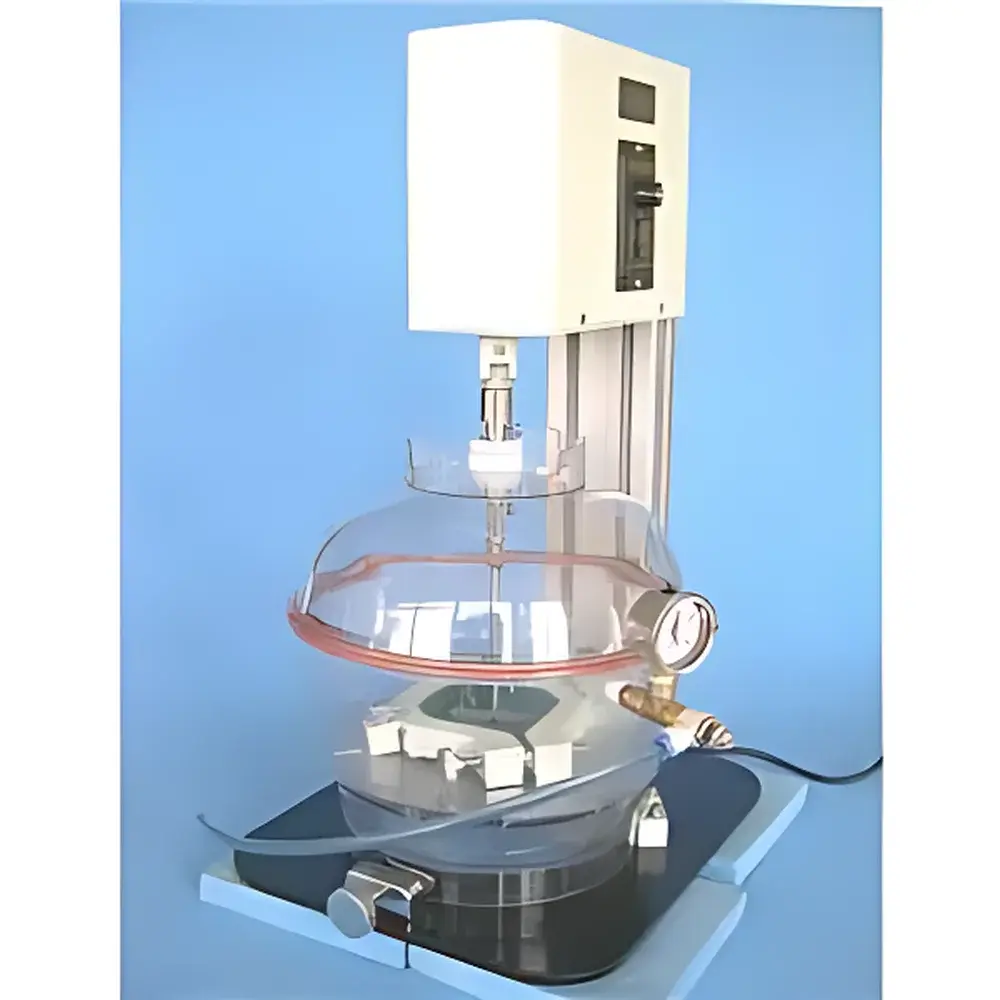
Truelab ZJ-250 Benchtop Vacuum Stirrer with Temperature Control
| Brand | Truelab |
|---|---|
| Origin | Shanghai, China |
| Model | ZJ-250 |
| Stirrer Type | Electric Vacuum Stirrer |
| Max. Mixing Volume | 1000 mL |
| Speed Range | 12–1735 rpm (3 selectable ranges with mechanical gear reduction) |
| Temperature Control Range | −25 °C to 120 °C |
| Power Options | 40 W / 60 W / 90 W |
| Torque Output | Up to 32.5 kg·cm (at 12 rpm, 90 W variant) |
| Dimensions | 380 × 290 × 580 mm |
| Net Weight | 13.5 kg |
| Input | 220 V~, 50 Hz |
| Sample Capacity | 50–1000 mL |
Overview
The Truelab ZJ-250 Benchtop Vacuum Stirrer is an engineered solution for precision mixing, degassing, and inert-atmosphere processing of sensitive, high-viscosity, or oxidation-prone materials in research and quality control laboratories. Designed around a dual-function architecture—integrating vacuum-assisted deaeration with temperature-controlled magnetic or overhead mechanical stirring—the ZJ-250 enables reproducible homogenization under controlled environmental conditions. Its core operation relies on simultaneous vacuum application (typically via external vacuum pump connection, ≤10 mbar) and regulated rotational agitation, minimizing entrapped air bubbles in viscous formulations such as silicone gels, pharmaceutical ointments, battery slurries, and UV-curable adhesives. Unlike standard stirrers, the ZJ-250 supports active thermal management across a wide range—from sub-zero cryogenic stabilization to elevated thermal activation—making it suitable for reaction monitoring, solvent evaporation control, and rheologically complex dispersion protocols.
Key Features
- Triple-range speed control with mechanical gear reduction: Selectable intervals (12–1735 rpm) ensure optimal torque delivery across viscosity gradients—from low-shear gentle blending to high-torque dispersion of fillers or nanoparticles.
- Integrated Peltier-based temperature regulation: Achieves precise setpoint control from −25 °C to +120 °C with ±0.5 °C stability, enabling cold-set polymerization or heat-assisted solubilization without external chillers or oil baths.
- Vacuum-compatible sealed chamber design: Accommodates standard glass vessels (e.g., jacketed flasks, round-bottom reactors) with O-ring-sealed lid ports for vacuum line and inert gas inlet (N₂, Ar), supporting ASTM D1654-compliant corrosion-inhibitor formulation and USP particulate matter studies.
- Modular power configuration: Field-selectable motor options (40 W / 60 W / 90 W) allow matching of mechanical load requirements—critical for GLP-regulated QC workflows where torque consistency directly impacts batch-to-batch repeatability.
- Ergonomic benchtop footprint (380 × 290 × 580 mm) with reinforced aluminum alloy housing and anti-vibration feet—designed for long-duration unattended operation in ISO 17025-accredited labs.
Sample Compatibility & Compliance
The ZJ-250 accommodates sample volumes from 50 mL to 1000 mL in borosilicate glass or stainless-steel containers rated for vacuum and thermal cycling. It supports both magnetic stir bars (for low-viscosity liquids) and overhead impeller assemblies (for pastes, gels, and suspensions up to 500,000 cP). The system complies with IEC 61010-1:2010 safety standards for laboratory electrical equipment and meets EMC Class B emission limits per EN 61326-1. When operated with validated vacuum pumps and calibrated temperature sensors, it satisfies data integrity requirements under FDA 21 CFR Part 11 when paired with compliant third-party logging software—supporting audit trails for GMP manufacturing environments.
Software & Data Management
While the ZJ-250 operates via intuitive front-panel controls (digital LED display, rotary encoder, and dedicated vacuum/temperature/stirring function keys), optional RS-485 or USB-C interface modules enable integration with LabVIEW™, MATLAB®, or custom SCADA platforms. Real-time logging of rpm, temperature, vacuum level (via external sensor), and runtime duration is achievable using vendor-supplied CSV export utilities. All parameter settings—including ramp profiles, hold times, and safety cutoff thresholds—are stored in non-volatile memory and support password-protected user groups for multi-operator labs operating under ISO/IEC 17025 documentation frameworks.
Applications
- Pharmaceutical development: Degassing of ophthalmic gels and transdermal patches prior to sterilization; oxygen-sensitive API blending under nitrogen blanket.
- Advanced materials R&D: Homogenization of cathode/anode slurries for Li-ion battery electrodes; dispersion of graphene or CNTs in polymer matrices without re-agglomeration.
- Cosmetic formulation: Bubble-free emulsification of silicone-based serums and hydrophobic sunscreens; cold-phase wax structuring below 30 °C.
- Electronics manufacturing: Void-free mixing of conductive silver pastes and die-attach adhesives; moisture-sensitive epoxy curing under dry nitrogen.
- Academic research: In situ viscosity evolution studies during photopolymerization under vacuum; cryo-mixing of thermoresponsive hydrogels.
FAQ
What vacuum level can the ZJ-250 achieve?
The unit itself does not include a built-in vacuum pump; it features a standardized 6 mm vacuum port compatible with external diaphragm or scroll pumps capable of reaching ≤10 mbar (≤7.5 Torr) base pressure.
Is the temperature control refrigerated or only heating?
Yes—the integrated Peltier module provides active cooling down to −25 °C and heating up to 120 °C without auxiliary chillers or external heating mantles.
Can the ZJ-250 be used with corrosive solvents?
When fitted with chemically resistant sealing materials (e.g., Viton® or Kalrez® O-rings, optional), and paired with appropriate vessel materials (e.g., HF-resistant glass or Hastelloy® impellers), it supports handling of moderately aggressive media including DMF, THF, and dilute acids—subject to compatibility verification per manufacturer’s chemical resistance chart.
Does the system support validation documentation (IQ/OQ/PQ)?
Truelab provides factory calibration certificates traceable to NIST standards and offers optional IQ/OQ protocol templates aligned with ISO 9001 and ASTM E2500 guidelines; PQ execution requires site-specific operational qualification under user-defined process parameters.
What safety interlocks are included?
Over-temperature cutoff (±5 °C deviation), motor stall detection, vacuum loss alarm, and lid-open emergency stop—all hardware-enforced and logged in internal event memory.



