
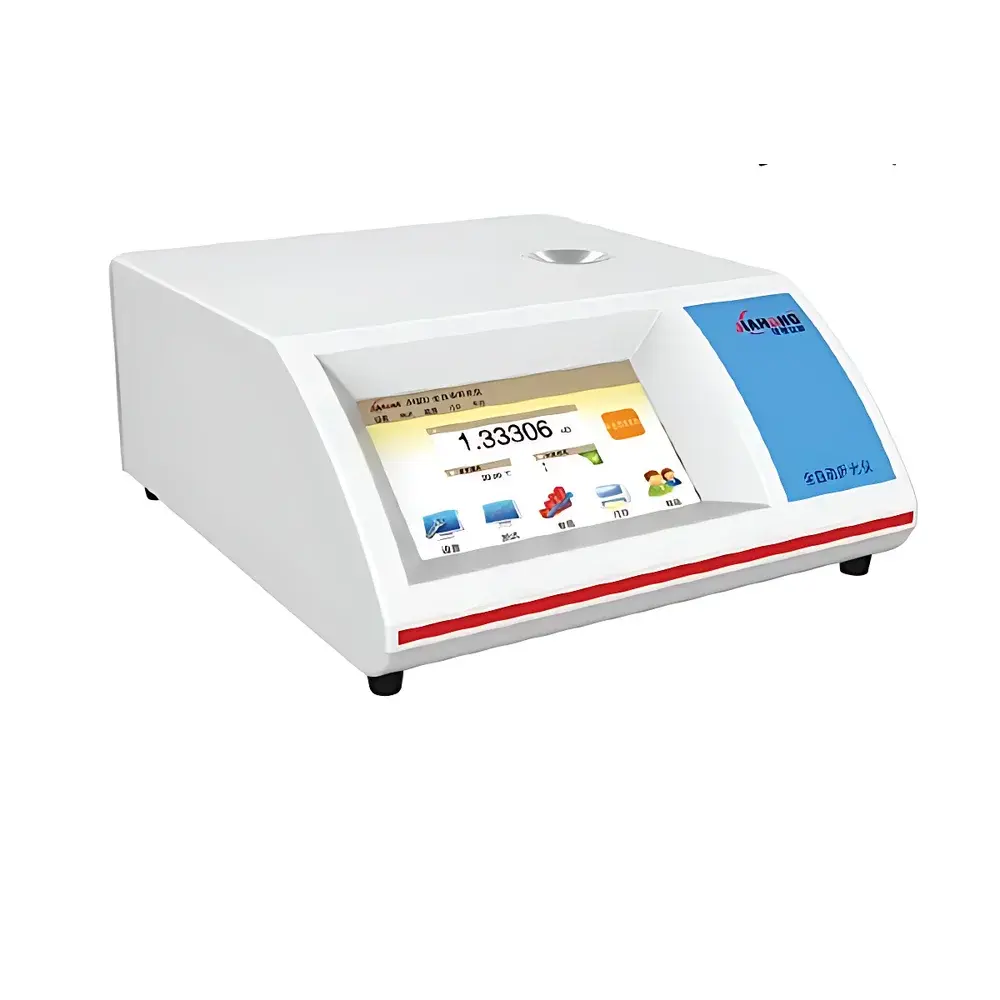
J500 Automated Digital Refractometer
| Origin | Shanghai, China |
|---|---|
| Manufacturer Type | Authorized Distributor |
| Origin Category | Domestic (China) |
| Model | J500 |
| Price Range | USD 2,100–7,000 |
| Instrument Type | Benchtop Refractometer |
| Temperature Control | Peltier-based |
| Digital Display | Yes |
| Refractive Index Range | 1.30000–1.70000 (nD) |
| Refractive Index Accuracy | ±0.00003 |
| Brix Range | 0–100% |
| Brix Accuracy | ±0.1% |
| Temperature Control Range | 5–65 °C |
| Temperature Stability | ±0.02 °C |
| Light Source | LED (589 nm) |
| Prism Material | Sapphire-grade |
| Sample Cell | Stainless Steel |
| Detector | High-resolution linear CCD array |
| Display | 7-inch TFT color touchscreen |
| Interface | USB + RS-232 |
| Power Supply | 220 V / 50 Hz |
Overview
The J500 Automated Digital Refractometer is a precision benchtop optical instrument engineered for high-accuracy, temperature-controlled measurement of refractive index (nD) and related derived parameters—including Brix concentration—across a broad spectrum of liquid samples. It operates on the principle of total internal reflection at the prism–sample interface, with angular detection performed via a high-resolution linear CCD sensor array. The instrument employs a monochromatic 589 nm LED light source—aligned to the sodium D-line standard—ensuring metrological consistency with international refractometric conventions (ISO 21745, ASTM D1218, USP ). Integrated Peltier thermoelectric control maintains sample temperature within ±0.02 °C across a 5–65 °C range, eliminating thermal drift and enabling strict compliance with temperature-dependent test protocols required in QC laboratories.
Key Features
- Sapphire-grade prism surface: Exceptional hardness (Mohs 9), chemical inertness, and scratch resistance ensure long-term optical integrity and reproducibility across aggressive solvents, viscous oils, and abrasive suspensions.
- High-resolution linear CCD detector: Captures full critical-angle profiles with sub-pixel interpolation, supporting refractive index resolution down to 0.00001 and accuracy certified at ±0.00003 nD.
- Dual-zone Peltier thermal management: Independently regulates both prism block and sample chamber temperature, enabling rapid equilibration (<90 s from 20 °C to 40 °C) and minimizing thermal gradients during measurement.
- 7-inch capacitive TFT touchscreen interface: Intuitive GUI with multilingual support (English, German, French, Spanish), real-time curve visualization, and on-device data logging (up to 1,000 records).
- Benchtop architecture with stainless-steel sample cell: Designed for robust daily operation in regulated environments; compatible with automated sample changers (optional) and compliant with IP20 ingress protection.
Sample Compatibility & Compliance
The J500 accommodates transparent, translucent, deeply colored, and highly viscous liquids—including crude oil fractions, polymer solutions, pharmaceutical syrups, fruit concentrates, and essential oils—without dilution or filtration. Its wide nD range (1.30000–1.70000) supports applications from hydrocarbon distillates to dense sucrose matrices. The instrument meets key regulatory expectations for analytical instrumentation: data integrity safeguards (audit trail enabled via optional software), temperature traceability (NIST-traceable calibration certificate available), and design conformity with IEC 61010-1 (safety) and ISO/IEC 17025:2017 (testing laboratory competence). It is routinely deployed in GLP-compliant R&D labs and GMP manufacturing sites where refractive index serves as a release parameter per USP , Ph. Eur. 2.2.6, and ISO 21527-1.
Software & Data Management
The J500 supports bidirectional communication via USB and RS-232 interfaces, enabling seamless integration into LIMS and ELN platforms. Optional PC software provides advanced functionality: multi-point calibration validation, statistical process control (SPC) charting, export to CSV/PDF/XML, and electronic signature-enabled report generation compliant with FDA 21 CFR Part 11 requirements. All measurement metadata—including timestamp, temperature, operator ID, calibration status, and raw CCD intensity profile—is embedded in each exported record. Internal flash memory retains full audit trails for ≥12 months without external dependency.
Applications
- Petrochemical QA/QC: Determination of hydrocarbon composition, aromaticity index, and solvent purity per ASTM D1218 and IP 170.
- Food & Beverage: Brix quantification in juices, jams, dairy products, and fermentation broths; verification of sugar-to-water ratios per AOAC 932.12.
- Pharmaceutical Manufacturing: Excipient concentration monitoring (e.g., glycerin, propylene glycol), syrup density verification, and cleaning validation residue checks.
- Chemical Synthesis: Real-time reaction progress tracking via refractive index shifts during esterification, polymerization, or condensation processes.
- Academic Research: Teaching optical property fundamentals; method development for non-destructive compositional analysis in material science and colloid chemistry.
FAQ
What calibration standards are recommended for routine verification?
Certified NIST-traceable refractive index standards (e.g., deionized water at 20 °C: nD = 1.33300; bromonaphthalene: nD = 1.65800) are advised for daily system suitability checks.
Can the J500 measure opaque or particulate-laden samples?
Yes—its high-sensitivity CCD and optimized illumination path enable reliable measurements on turbid emulsions and suspensions, provided the sample wets the sapphire prism uniformly.
Is temperature calibration traceable to national standards?
The integrated Pt100 sensor is factory-calibrated against ISO/IEC 17025-accredited references; optional annual recalibration with uncertainty reporting is available.
Does the instrument support custom concentration curves beyond Brix?
Yes—users may define up to 10 user-specific calibration tables (nD vs. concentration) for solutes including NaCl, ethanol, glycerol, and H2SO4.
What maintenance is required for long-term stability?
Routine prism cleaning with lint-free wipes and spectroscopic-grade isopropanol; biannual verification of Peltier thermal performance and CCD linearity using supplied diagnostic routines.



