
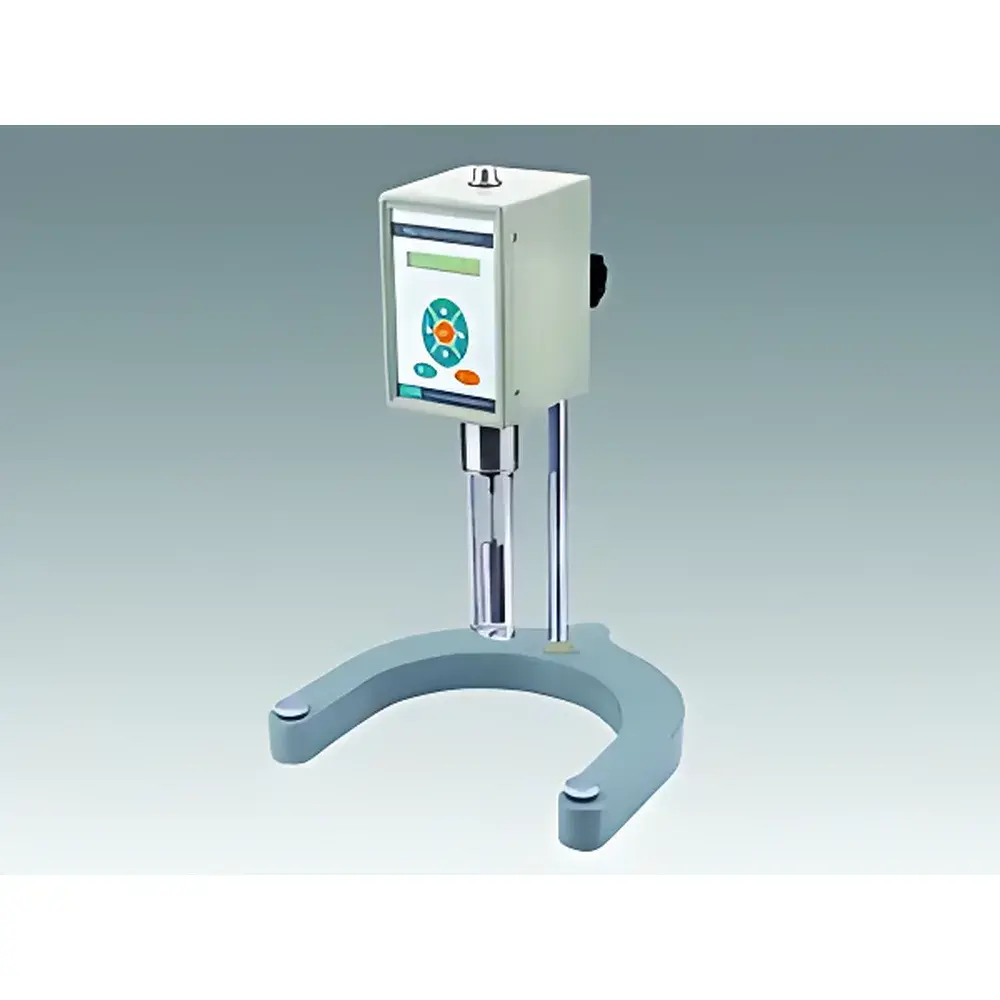
Truelab SNB-1 Digital Rotational Viscometer
| Brand | Truelab |
|---|---|
| Origin | Shanghai, China |
| Manufacturer Type | Authorized Distributor |
| Instrument Type | Benchtop Rotational Viscometer |
| Operating Environment | Ambient Temperature (15–30 °C) |
| Viscosity Range | 0.1–2,000,000 mPa·s |
| Speed Settings | 6 / 12 / 30 / 60 rpm |
| Rotor Set | L1–L4 (ISO/DIN-compatible spindles) |
| Display | Digital LCD with Dual-Language UI (English/Chinese) |
| Power Input | 110–240 V AC, 50/60 Hz |
| Accuracy (Newtonian Fluids) | ±2% of full scale |
| Viscosity Measurement Principle | Couette flow via rotating spindle in stationary sample cup |
| Compliance | Designed to meet ISO 2555, ASTM D2196, and GB/T 2794 standards for rotational viscosity testing |
Overview
The Truelab SNB-1 Digital Rotational Viscometer is a benchtop instrument engineered for precision measurement of dynamic (kinematic) viscosity in Newtonian and near-Newtonian fluids under controlled ambient conditions. It operates on the classical Couette principle: a motor-driven spindle rotates at defined angular velocities within a stationary sample container, generating shear stress proportional to fluid resistance. The resulting torque is transduced into viscosity values (mPa·s) using calibrated spindle geometry and rotational speed. Unlike capillary or falling-ball viscometers, the SNB-1 delivers direct, real-time digital readouts without time-based extrapolation—making it suitable for routine QC in production labs and method development in R&D settings where reproducibility across operator shifts is critical. Its fixed-speed configuration (6/12/30/60 rpm) eliminates variability from manual speed adjustment, while the microprocessor-controlled stepper motor ensures stable rotational output independent of line-frequency fluctuations—a key advantage in global laboratory environments with unstable grid supply.
Key Features
- Benchtop design with integrated digital LCD display supporting English and Chinese interface languages for multilingual lab operations
- Four standard L-series spindles (#1–#4) compliant with ISO 3219 and DIN 53019 geometries, enabling coverage across low- to ultra-high-viscosity ranges (0.1–2,000,000 mPa·s)
- Wide-input power supply (110–240 V AC, 50/60 Hz) certified to IEC 61010-1 for electrical safety in international laboratories
- Programmable speed selection with four discrete RPM settings optimized for standard test protocols per ASTM D1200 (for coatings) and USP (for pharmaceutical suspensions)
- Robust mechanical architecture with sealed bearing assembly and thermal-stable aluminum housing to minimize drift during extended measurements
- No built-in temperature control—intended for use with external thermostatic baths or Peltier-based immersion systems (e.g., Truelab TC-200 series) when temperature-dependent rheology studies are required
Sample Compatibility & Compliance
The SNB-1 is validated for homogeneous, non-aerated Newtonian liquids including mineral oils, polymer solutions, food emulsions (e.g., mayonnaise, sauces), pharmaceutical gels, solvent-based paints, and adhesive formulations. It is not recommended for highly thixotropic, yield-stress, or particulate-laden suspensions without prior shear-history conditioning. All measurement procedures align with ISO 2555 (plastics), ASTM D2196 (paints and related materials), and GB/T 2794 (adhesives). While the instrument itself does not provide GLP audit trails or electronic signatures, its analog torque-sensing architecture supports manual data recording traceable to calibrated reference oils (e.g., Cannon-Manning Standard Viscosity Oils, NIST-traceable).
Software & Data Management
The SNB-1 operates as a standalone instrument without proprietary software dependency. All readings are displayed and held on-screen for manual transcription. For automated data capture, users may integrate optional RS-232 or USB-to-serial adapters (sold separately) to interface with third-party acquisition platforms such as LabVIEW, MATLAB, or Excel-based logging tools. No firmware updates or cloud connectivity are supported; calibration constants are stored in non-volatile memory and remain stable over 10,000 operational cycles. Calibration verification is performed using certified reference fluids per ISO 8503-2, with documentation retained per internal lab SOPs.
Applications
- Quality control of edible oils and lubricants in manufacturing plants
- Batch consistency verification of water-based architectural coatings before canning
- Stability assessment of topical pharmaceutical gels and ointments during formulation screening
- Routine viscosity checks of starch-based food thickeners in pilot-scale processing lines
- Educational demonstrations of Newton’s law of viscosity in university physical chemistry labs
FAQ
Does the SNB-1 support temperature-controlled measurements?
No—the SNB-1 lacks an integrated temperature sensor or Peltier module. For temperature-dependent viscosity profiling, it must be used in conjunction with an external thermostatic bath or immersion circulator.
Is calibration traceable to national standards?
Yes—calibration is performed using NIST-traceable reference oils (e.g., Cannon-Manning Series) and documented per ISO/IEC 17025-compliant internal procedures.
Can the SNB-1 measure non-Newtonian fluids?
It provides valid single-point viscosity values for pseudoplastic or dilatant fluids at each selected speed, but does not compute flow curves, yield stress, or viscoelastic moduli—capabilities reserved for advanced rheometers with controlled shear rate ramps.
What maintenance is required?
Routine cleaning of spindles and sample cup with appropriate solvents; annual verification of torque sensor linearity using certified reference oils; no scheduled lubrication or alignment required due to sealed bearing design.



