
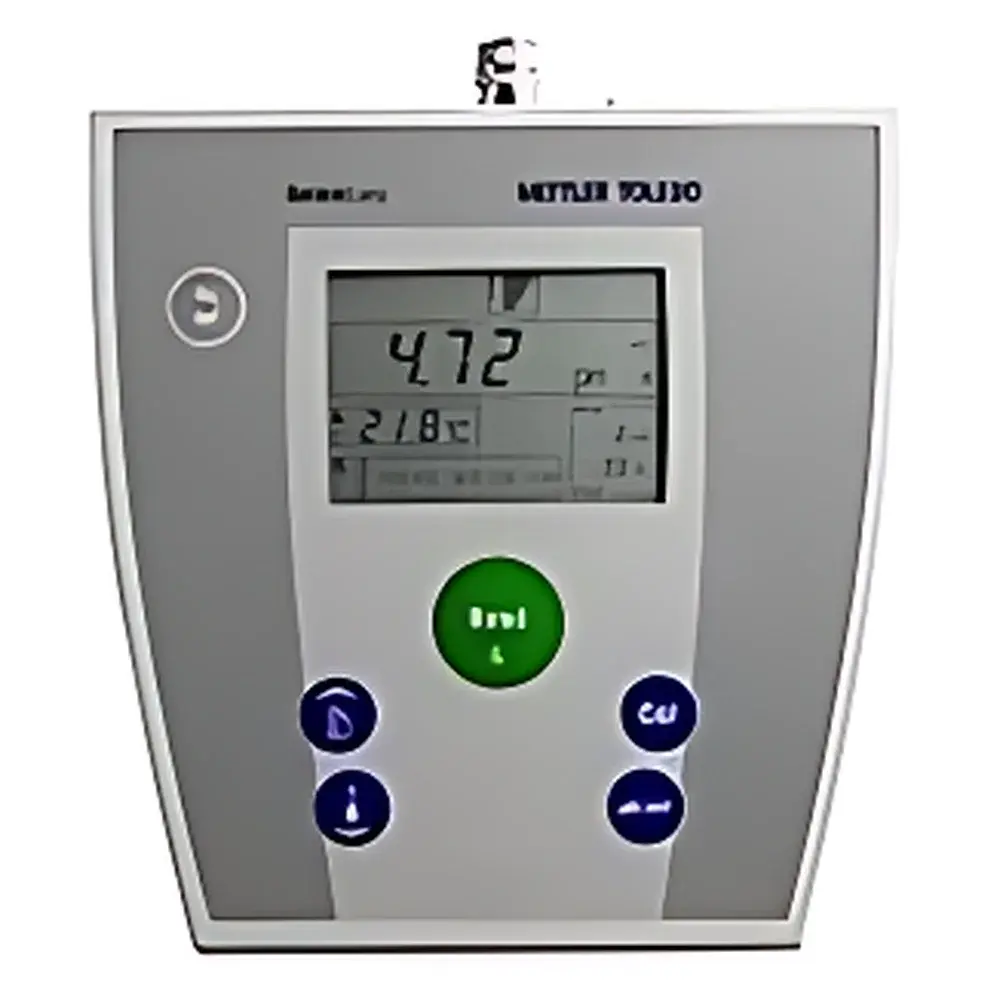
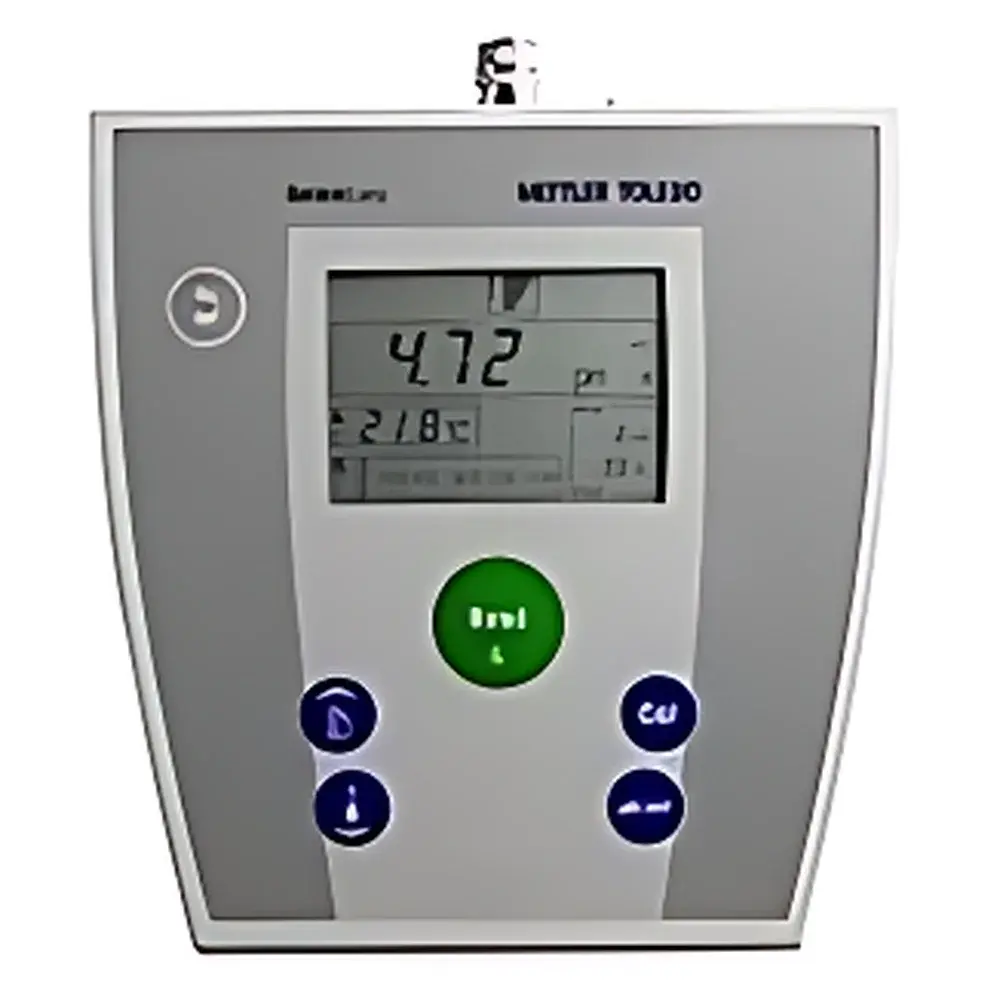
METTLER TOLEDO S30K Benchtop Conductivity Meter
| Brand | METTLER TOLEDO |
|---|---|
| Origin | Shanghai, China |
| Model | S30K (S30) |
| Conductivity Range | 0.01 µS/cm to 500 mS/cm (auto-ranging) |
| Temperature Range | –5.0 to 105.0 °C |
| Temperature Resolution | 0.1 °C |
| Temperature Accuracy | ±0.2 °C |
| Conductivity Accuracy | ±0.5% of reading |
| Salt Range | 0.00–80.00 ppt |
| TDS Range | 0.1 mg/L–500 g/L |
| Electrode Constant | User-definable |
| Display | LCD with multi-parameter readout |
| Power | External AC adapter or 4× AA (LR6) batteries |
| Auto-Temperature Compensation (ATC) | Yes |
| Endpoint Detection | Auto-hold with stability-based locking |
| Buffer Recognition | Automatic buffer ID during calibration |
| Compliance | Designed for GLP-compliant workflows |
Overview
The METTLER TOLEDO S30K Benchtop Conductivity Meter is a precision-engineered instrument for routine measurement of electrical conductivity, salinity, total dissolved solids (TDS), and resistivity in aqueous solutions. Based on the proven SevenEasy platform architecture, the S30K employs four-electrode or two-electrode conductivity sensing principles—depending on electrode configuration—to deliver stable, reproducible readings across a wide dynamic range (0.01 µS/cm to 500 mS/cm). Its integrated temperature sensor enables real-time automatic temperature compensation (ATC) using either linear or non-linear (e.g., NaCl-based) algorithms, ensuring traceable accuracy under variable thermal conditions. Designed for regulated laboratory environments, the S30K meets foundational requirements for data integrity in water quality analysis, environmental monitoring, and process validation workflows—particularly where adherence to ISO 7888, ASTM D1125, and USP is required.
Key Features
- Intuitive graphical LCD interface with simultaneous display of conductivity, temperature, salinity, TDS, and resistivity—no menu navigation required for primary parameters.
- Auto-hold endpoint detection based on signal stability criteria (configurable time window and deviation threshold), minimizing operator subjectivity and improving inter-operator reproducibility.
- Automatic buffer recognition during calibration: the instrument identifies standard conductivity solutions (e.g., KCl 0.01 mol/L, 0.1 mol/L, 1 mol/L) and applies corresponding cell constant correction factors without manual input.
- Dual power mode: operates continuously via external AC adapter or portably using four AA alkaline batteries (up to 2,000 hours typical runtime), supporting both benchtop QC and field-deployable sampling protocols.
- User-configurable cell constant (0.01–10 cm⁻¹) with built-in electrode diagnostics—including open-circuit, short-circuit, and coating-detection alerts—to ensure measurement validity before data capture.
- GLP-ready functionality: timestamped measurements, user ID entry, and calibration history storage (up to 200 entries) with editable comments—enabling basic audit trail documentation.
Sample Compatibility & Compliance
The S30K accommodates a broad spectrum of aqueous samples—from ultrapure water (e.g., pharmaceutical water for injection, WFI) to highly conductive industrial effluents and seawater analogs. When equipped with the InLab® 731 conductivity electrode (included in S30K kit 51302806), it maintains optimal performance across pH 0–14 and redox-stable matrices. The instrument complies with IEC 61010-1 safety standards and electromagnetic compatibility (EMC) requirements per IEC 61326-1. While the base S30K firmware does not include 21 CFR Part 11 electronic signature capabilities, its data export formats (CSV, TXT) are compatible with validated LIMS and LabX software deployments for full regulatory compliance in GMP/GLP settings.
Software & Data Management
Raw measurement data—including conductivity, temperature, date/time stamp, operator ID, and calibration metadata—are stored internally and exportable via USB interface to PC. The S30K supports direct integration with METTLER TOLEDO’s LabX™ PC software (sold separately), enabling centralized method management, automated report generation, electronic signatures, and full 21 CFR Part 11 compliance—including audit trails, role-based access control, and encrypted data archiving. All exported files retain native units and uncertainty annotations consistent with ISO/IEC 17025 reporting conventions.
Applications
- Environmental laboratories: Monitoring conductivity in surface water, groundwater, wastewater, and stormwater per EPA Method 120.1 and ISO 7888.
- Pharmaceutical manufacturing: Routine testing of purified water (PW) and water for injection (WFI) per USP and EU Ph. Eur. 2.2.38.
- Food & beverage QA/QC: Salinity verification in brines, sauces, and dairy processing streams; TDS estimation in brewing and bottling operations.
- Academic research: Teaching fundamental electrochemistry concepts including Kohlrausch’s law, ion mobility, and solution conductivity modeling.
- Power generation: Boiler feedwater and condensate purity assessment to prevent scaling and corrosion in steam cycles.
FAQ
Does the S30K support automatic calibration with multiple standard solutions?
Yes—the instrument recognizes up to three pre-programmed KCl standards (0.01 mol/L, 0.1 mol/L, and 1 mol/L) and auto-applies the appropriate cell constant during multi-point calibration.
Can the S30K measure resistivity directly, or is it calculated?
Resistivity is calculated in real time from measured conductivity and temperature, using ρ = 1/σ, and displayed alongside primary parameters without requiring manual conversion.
Is the InLab® 731 electrode suitable for high-salinity seawater applications?
Yes—the InLab® 731 features a robust platinum black sensor optimized for stability in ionic strengths up to 80 ppt and includes a built-in temperature sensor for accurate ATC in marine matrices.
How is calibration traceability maintained on the S30K?
Each calibration event records solution lot number (manually entered), expiration date, ambient temperature, and deviation from nominal value—supporting ISO/IEC 17025 traceability requirements when documented alongside certified reference materials.
What battery type is recommended for extended field use?
Alkaline AA (LR6) cells are specified; rechargeable NiMH batteries are not recommended due to voltage drift affecting low-power stability during high-resolution measurements.







