
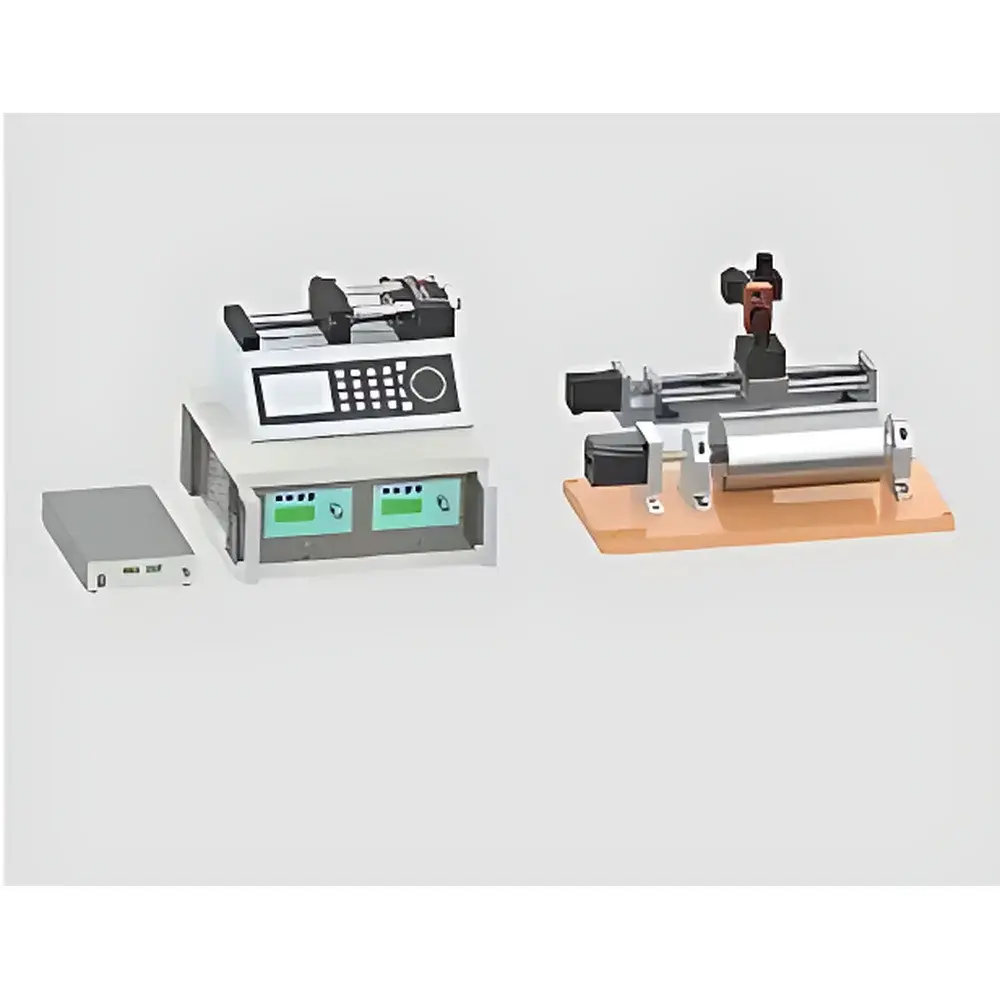
Truelab TES ONE Laboratory Electrospinning System
| Brand | Truelab |
|---|---|
| Origin | Shanghai, China |
| Manufacturer Type | Authorized Distributor |
| Country of Origin | China |
| Model | TES ONE |
| Pricing | Available Upon Request |
| Collection Subsystem Options | Rotating Drum (High-Speed & Low-Speed), Rod Collector, Disk Collector |
| Needle Translation Stage Options | Adjustable Stroke Length |
| Needle Holder Configurations | Single-Needle, Multi-Needle, Coaxial-Needle |
| Control Unit Models | K21, K22, K11, K12, K13 |
| High-Voltage Power Supply Options | +30 kV, +50 kV, +80 kV, −30 kV, −50 kV |
| Syringe Pump Configurations | Single-Channel, Dual-Channel, Multi-Channel with Independent Flow Control |
Overview
The Truelab TES ONE Laboratory Electrospinning System is a modular, research-grade electrospinning platform engineered for controlled nanofiber fabrication in academic laboratories, materials science R&D centers, and pharmaceutical development facilities. It operates on the principle of electrohydrodynamic jetting: a high-voltage electric field induces charge accumulation at the tip of a polymer solution-filled capillary, overcoming surface tension to generate a stable Taylor cone and continuous nanofibrous jet that solidifies upon solvent evaporation during flight toward a grounded collector. Unlike fixed-architecture systems, the TES ONE is purpose-built for experimental flexibility—enabling systematic investigation of fiber morphology, diameter distribution, alignment, and crystallinity across diverse polymeric systems (e.g., PCL, PLA, PAN, chitosan, gelatin-methacryloyl) and process variables including voltage polarity, flow rate, collector geometry, and ambient humidity.
Key Features
- Modular subsystem architecture supporting independent selection and future upgrade of collection geometry, needle motion control, high-voltage source, and fluid delivery modules.
- Precision motorized translation stage with programmable stroke length and velocity profiles, enabling controlled fiber alignment via synchronized needle oscillation relative to collector rotation or linear motion.
- Grounded collector options include high-speed rotating drums (up to 5,000 rpm), low-speed drums (10–500 rpm), conductive rod collectors, and planar disk collectors—each optimized for distinct fiber orientation and deposition density requirements.
- Configurable high-voltage power supply units offering both positive and negative polarity outputs (+30 kV to +80 kV; −30 kV to −50 kV), with current limiting, arc detection, and interlock-enabled safety shutdown compliant with IEC 61010-1.
- Multi-channel syringe pumps with independent per-channel flow rate control (range: 0.001–10 mL/h, resolution: 0.001 mL/h), integrated pressure monitoring, and programmable ramping profiles for multi-solution co-axial or side-by-side electrospinning.
- Dedicated control units (K-series) provide centralized synchronization of pump output, stage motion, HV activation timing, and real-time parameter logging—designed for reproducible method transfer and GLP-aligned documentation.
Sample Compatibility & Compliance
The TES ONE accommodates a broad spectrum of electrospinnable feedstocks, including aqueous and organic solvent-based polymer solutions (e.g., DMF, chloroform, HFIP), hydrogels, nanoparticle suspensions, and bioactive compound-loaded formulations. Its open-system design permits integration with environmental chambers (temperature/humidity control) and in-line characterization tools (e.g., laser diffraction monitors). The system complies with ISO 13849-1 (safety-related parts of control systems), meets CE marking requirements for laboratory equipment, and supports audit-ready operation under GLP and GMP frameworks when paired with validated software protocols and electronic logbook configurations.
Software & Data Management
Control firmware supports USB and RS-232 communication interfaces, enabling integration with third-party data acquisition platforms (e.g., LabVIEW, MATLAB). All K-series controllers record timestamped operational parameters—including applied voltage, flow rate, stage position, and runtime—into CSV-formatted logs with configurable sampling intervals. Optional firmware upgrades support 21 CFR Part 11-compliant user authentication, electronic signatures, and immutable audit trails for regulated environments. No cloud connectivity is embedded; all data remains locally stored unless explicitly exported by the user.
Applications
- Development of biomimetic scaffolds for tissue engineering (nerve, vascular, bone regeneration).
- Design of high-surface-area filtration membranes for air/water purification and virus capture.
- Formulation screening of sustained-release drug delivery matrices (e.g., antibiotic-eluting wound dressings, vaccine adjuvant carriers).
- Fundamental studies on jet instability mechanisms, solvent evaporation kinetics, and polymer chain entanglement thresholds.
- Hybrid fiber fabrication via co-axial electrospinning (core–shell structures) or tri-axial configurations for sequential release or barrier functionality.
FAQ
Can the TES ONE be used for coaxial electrospinning?
Yes—the system supports coaxial needle assemblies through compatible K-series control units and multi-channel syringe pumps with independently regulated inner/outer flow paths.
Is the high-voltage power supply certified for laboratory use?
All HV modules are CE-certified and incorporate over-current protection, ground-fault detection, and emergency stop circuitry aligned with IEC 61010-1 Class II safety standards.
What level of technical support is provided for method development?
Truelab offers application engineering consultation, including protocol optimization guides, material compatibility tables, and on-site or remote setup assistance for first-time users.
Are replacement parts and calibration services available internationally?
Yes—spare components (needle holders, drum shafts, HV cables) are stocked globally, and traceable calibration certificates for syringe pumps and HV meters are issued upon request.
Does the system meet FDA requirements for preclinical device manufacturing?
While the TES ONE itself is not an FDA-regulated medical device, its architecture and documentation features enable compliance with FDA expectations for equipment qualification (IQ/OQ) and process validation in early-stage biomaterial development.
Related Products



