
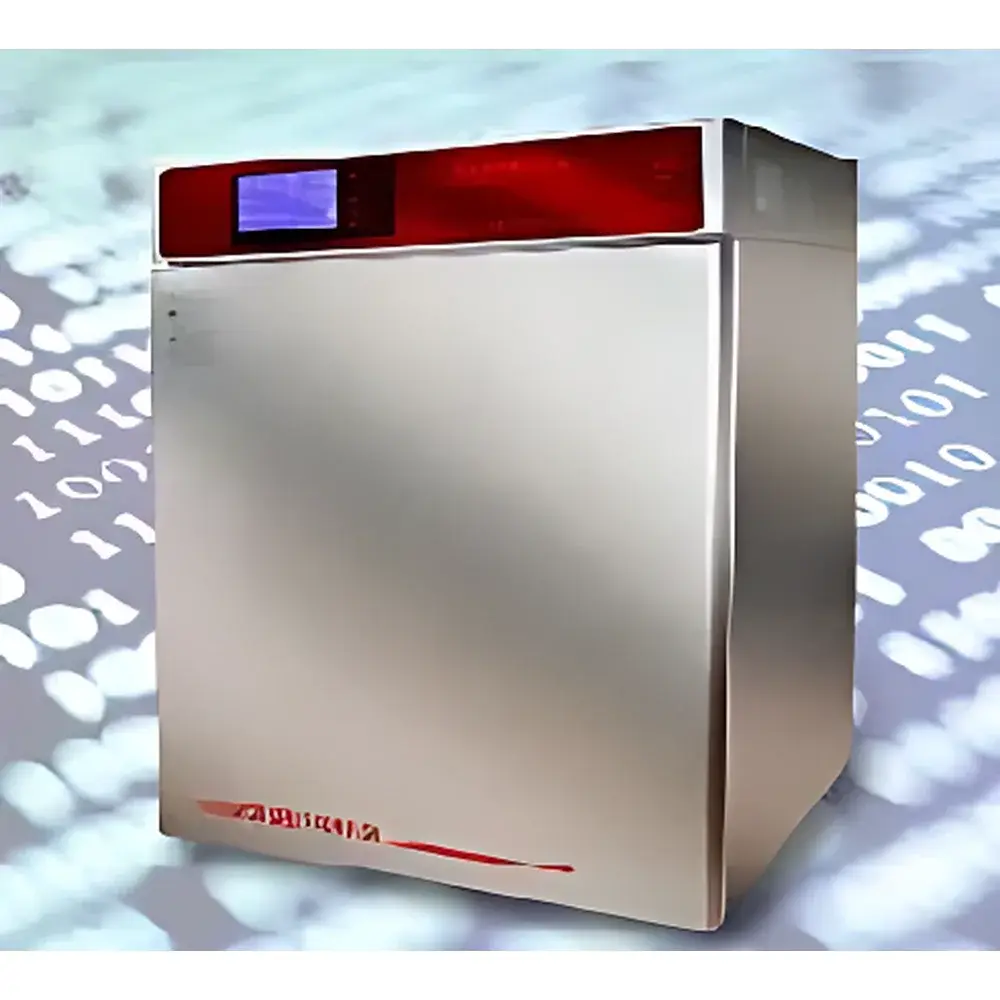
Truelab BC-J80S Water-Jacketed CO₂ Incubator with LCD Display
| Brand | Truelab |
|---|---|
| Origin | Shanghai, China |
| Model | BC-J80S with Pressure Relief Valve |
| Capacity | 80 L |
| Temperature Range | Ambient +2°C to 65°C |
| Temperature Uniformity | ±0.2°C |
| Temperature Resolution | 0.1°C |
| Temperature Stability (Fluctuation) | ±0.2°C |
| CO₂ Range | 0–20% (v/v) |
| CO₂ Sensor | Imported NDIR Infrared Sensor (Accuracy: ±0.1% FS) |
| Humidification Method | Natural Evaporation |
| Chamber Dimensions (W×D×H) | 460 × 530 × 645 mm |
| External Dimensions (W×D×H) | 550 × 510 × 830 mm |
| Power Supply | 220 V / 50 Hz |
| Input Power | 500 W |
| Standard Shelving | 2 Adjustable Stainless Steel Shelves |
| Interior Material | Mirror-Finish 304 Stainless Steel |
| Filtration | HEPA Filter (≥0.3 µm, Efficiency ≥99.998%) |
| Control Interface | LCD Display with Microprocessor-Based Dual-Loop Control |
| Communication Port | RS-485 (Standard), Compatible with Data Logging Systems |
| Sterilization | Built-in UV Lamp (254 nm) |
| Safety Features | Dual Independent Control Systems, Power-Outage Parameter Memory & Auto-Restore, Door-Open Compensation Algorithm |
Overview
The Truelab BC-J80S is a precision-engineered water-jacketed CO₂ incubator designed for reliable, long-term cell and tissue culture under physiologically relevant conditions. Unlike forced-air incubators, its water-jacketed thermal architecture provides exceptional thermal stability and uniformity by surrounding the inner chamber with a temperature-controlled water bath—minimizing temperature gradients and reducing sensitivity to ambient fluctuations. The system operates on the principle of maintaining a tightly regulated triad: CO₂ concentration (for pH control via bicarbonate buffering), temperature (for metabolic activity), and humidity (to prevent medium evaporation). It employs non-dispersive infrared (NDIR) sensing technology for continuous, drift-resistant CO₂ monitoring and feedback-controlled gas injection. This architecture meets fundamental requirements for GLP-compliant cell culture workflows in academic research, biopharmaceutical development, and clinical diagnostics laboratories.
Key Features
- Water-jacketed thermal design ensures ±0.2°C temperature uniformity and stability across the full 80 L working volume—critical for reproducible proliferation assays and sensitive primary cell cultures.
- Imported NDIR CO₂ sensor with ±0.1% full-scale accuracy enables precise regulation within 0–20% range; CO₂ recovery time ≤ (setpoint × 1.2) minutes after door opening.
- Dual independent microprocessor-based control systems provide redundancy: primary loop manages real-time setpoint regulation, while secondary loop continuously monitors critical parameters and triggers alarms or fallback protocols upon deviation.
- Mirror-finish 304 stainless-steel interior with rounded corners facilitates decontamination and reduces microbial retention; UV lamp (254 nm) supports routine chamber sterilization between runs.
- Integrated HEPA filtration (≥0.3 µm, ≥99.998% efficiency) maintains ISO Class 5-equivalent air quality inside the chamber during operation.
- LCD interface displays real-time values for temperature, CO₂ concentration, elapsed time, and alarm status; supports user-defined high/low limits and audible/visual alerts.
- RS-485 serial interface (standard) allows integration with laboratory information management systems (LIMS) or third-party data loggers for 21 CFR Part 11–compliant audit trails when paired with appropriate software.
Sample Compatibility & Compliance
The BC-J80S accommodates standard T-25, T-75, and multi-well plates on two adjustable stainless-steel shelves. Its natural evaporation humidification method sustains >95% RH at 37°C without condensation risk—ideal for extended culture periods (>72 h) of adherent mammalian lines (e.g., HeLa, HEK293, MCF-7) and stem cell monolayers. The unit complies with IEC 61010-1 (Safety Requirements for Electrical Equipment for Measurement, Control, and Laboratory Use) and incorporates safeguards aligned with ISO 13485–influenced quality system expectations for in vitro diagnostic support environments. While not certified for GMP manufacturing, its dual-control architecture, parameter memory, and traceable environmental logging capability support GLP-aligned documentation practices per OECD Principles of Good Laboratory Practice.
Software & Data Management
The incubator includes native RS-485 communication for bidirectional data exchange. When connected to a host PC running compliant data acquisition software (e.g., LabVIEW-based or vendor-neutral SCADA platforms), users can record timestamped temperature, CO₂, and alarm events at configurable intervals (1–60 s). The system retains all settings—including user-defined alarm thresholds and timer configurations—in non-volatile memory, ensuring restoration after power interruption without manual reconfiguration. Optional firmware updates may extend compatibility with centralized lab infrastructure, though no proprietary cloud platform is embedded. Audit-ready output files (CSV or XML) meet minimum requirements for internal QA review and regulatory pre-submission documentation.
Applications
This incubator serves core functions in academic and industrial life science laboratories: maintenance of immortalized and primary cell lines for drug screening; expansion of mesenchymal and induced pluripotent stem cells under hypoxic or normoxic conditions; co-culture experiments requiring stable pH and low shear stress; and preparation of inocula for microbiological assay validation. Its thermal robustness makes it suitable for shared-resource facilities where uptime and inter-user reproducibility are prioritized over ultra-high-throughput automation. It is routinely deployed in departments of oncology, immunology, regenerative medicine, and vaccine development—particularly where water-jacketed stability outweighs the footprint and fill-maintenance trade-offs of air-jacketed alternatives.
FAQ
What type of CO₂ sensor is used, and why is NDIR preferred?
The BC-J80S uses an imported non-dispersive infrared (NDIR) sensor. NDIR technology offers superior long-term stability, minimal calibration drift, and immunity to cross-sensitivity from water vapor or ethanol—making it ideal for demanding cell culture applications.
Does the incubator support humidity monitoring?
No integrated RH sensor is included; humidity is maintained passively via natural evaporation from a stainless-steel water pan. Relative humidity is inferred indirectly through temperature and chamber sealing integrity, consistent with ISO 13408-1 guidance for sterile processing environments.
Can the unit be validated for IQ/OQ/PQ protocols?
Yes—its stable thermal profile, documented sensor specifications, and RS-485 data export enable formal qualification using standardized test scripts (e.g., ASTM E2500, Annex M of EU GMP Annex 15). Calibration certificates for CO₂ and temperature sensors are available upon request.
Is the UV lamp cycle programmable?
UV irradiation is manually initiated via front-panel control; no timed or automated cycles are built into the base firmware. Users must adhere to institutional biosafety guidelines regarding exposure duration and PPE requirements.
What maintenance is required for the water jacket?
Deionized water must be refilled every 2–4 weeks depending on ambient temperature and usage frequency. Annual descaling with citric acid solution is recommended to prevent mineral buildup in the jacket cavity.





