
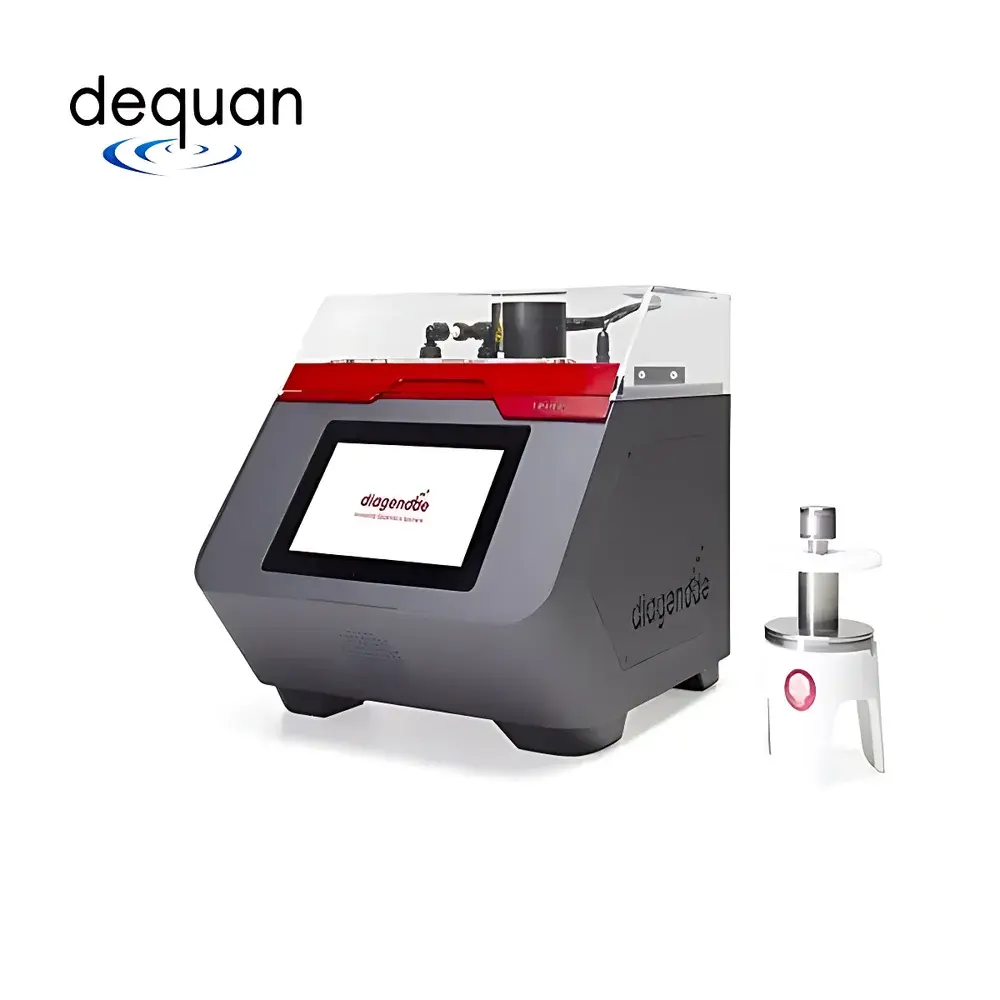
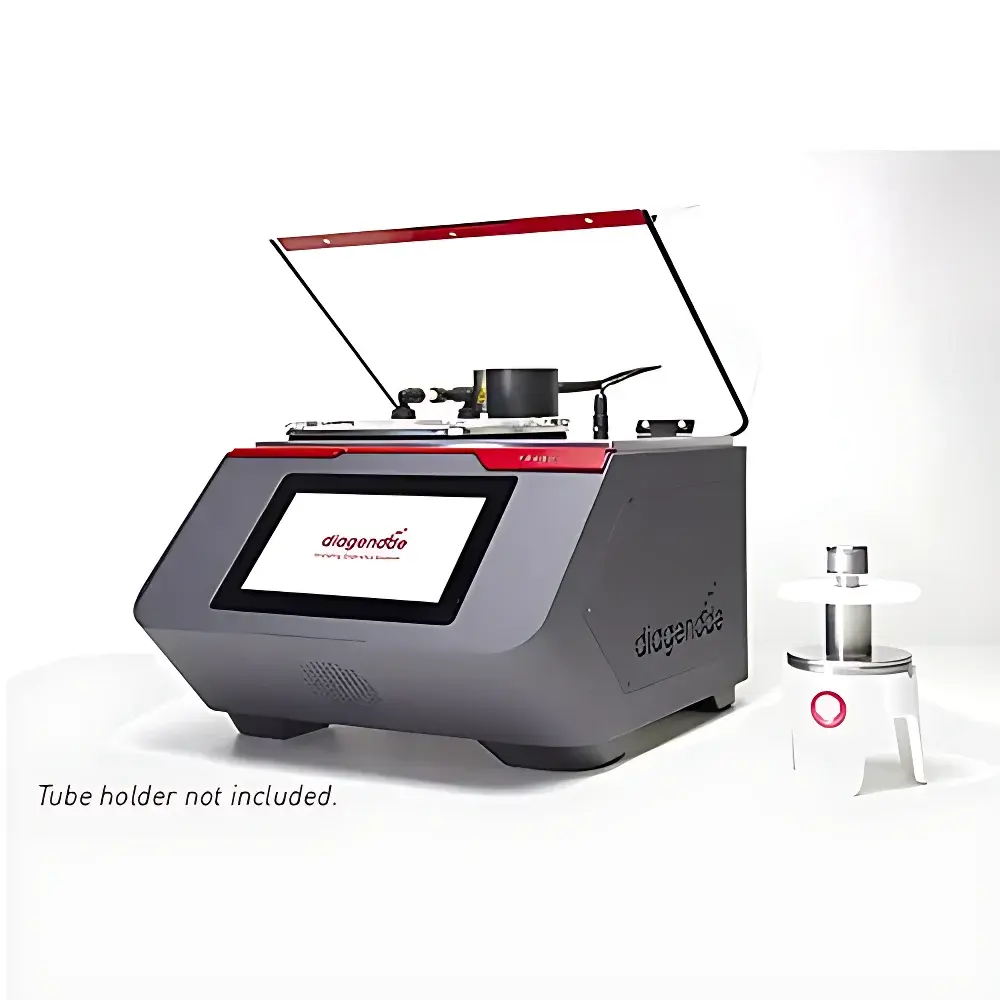
Diagenode BIORUPTOR® new pico Ultrasonic Cell Disruptor
| Brand | Diagenode |
|---|---|
| Origin | Belgium |
| Model | new pico |
| Instrument Type | Ultrasonic Cell Disruptor |
| Ultrasonic Power | 300 W |
| Operating Frequency | 40 kHz |
| Temperature Range | 4 °C to ambient |
| Maximum Sample Capacity | 16 tubes |
| Sample Volume Range | 20 µL – 2 mL |
| Cooling System | Integrated solenoid-valve-controlled recirculating chiller |
Overview
The Diagenode BIORUPTOR® new pico is a benchtop ultrasonic cell disruptor engineered for high-precision, reproducible nucleic acid shearing in epigenetic and next-generation sequencing (NGS) workflows. Unlike probe-based sonicators, it employs focused bath-type ultrasonication—where acoustic energy is transmitted through a temperature-controlled water bath into sealed microtubes—eliminating aerosol generation, cross-contamination risk, and operator exposure to biohazards. Its core mechanism relies on cavitation physics: at 40 kHz, controlled acoustic waves induce transient microbubble formation and collapse within the liquid medium, generating localized shear forces sufficient to fragment chromatin or genomic DNA without excessive heat-induced denaturation. Designed specifically for ChIP-seq, ATAC-seq, CUT&RUN, and library preparation protocols, the new pico delivers consistent fragment size distributions between 100 bp and 1 kb—critical for uniform adapter ligation and sequencing depth coverage.
Key Features
- Integrated 300 W ultrasonic generator with digitally stabilized 40 kHz frequency output for repeatable energy delivery
- Automated sample rotation via stepper-motor-driven rack—ensures uniform energy exposure across all 16 positions, minimizing positional bias
- Real-time thermal management: Peltier-cooled water bath (4–25 °C range) coupled with a solenoid-valve-controlled recirculating chiller; cooling activates only during sonication pauses to avoid acoustic interference and maintain cavitation efficiency
- Intuitive 7-inch color touchscreen interface with multilingual prompts (English, French, German, Spanish, Italian, Chinese) and dynamic LED status indicators for cycle progress, temperature, and fault diagnostics
- Sealed-tube processing: Compatible with standard 0.2 mL, 0.65 mL, 1.5 mL, and 15 mL tubes—no specialized consumables required
- Instrument health monitoring system logs cumulative sonication time and triggers alerts prior to scheduled maintenance; backed by a 5-year warranty or 210 hours of operational lifetime guarantee
- Robust monolithic chassis with integrated noise-dampening lid and ultrasonic water bath—designed for stable operation in shared laboratory environments
Sample Compatibility & Compliance
The BIORUPTOR new pico supports diverse biological matrices including crosslinked chromatin, native nuclei, whole-cell lysates, and purified nucleic acids. It accommodates tube formats from low-volume PCR strips (20 µL) to conical centrifuge tubes (2 mL), enabling scalable optimization—from single-cell epigenomic profiling to bulk tissue dissociation. All protocols are compatible with GLP-compliant documentation practices: audit trails for user actions, cycle parameters, and temperature logs can be exported in CSV format. The system meets IEC 61000-4 electromagnetic compatibility standards and conforms to ISO 13485 design controls for in vitro diagnostic support equipment. While not an FDA-cleared device, its performance aligns with USP Analytical Instrument Qualification guidelines for nucleic acid fragmentation instruments used in regulated NGS assay development.
Software & Data Management
No proprietary software installation is required—the new pico operates as a standalone instrument with embedded firmware. All method parameters (cycle duration, on/off intervals, amplitude level, temperature setpoint) are stored locally and recalled via touchscreen profile selection. Each run generates a timestamped metadata file containing start/end time, total sonication duration, average bath temperature, and error codes (if any). These logs are exportable via USB flash drive for integration into LIMS or electronic lab notebook (ELN) systems. For laboratories requiring 21 CFR Part 11 compliance, optional firmware upgrade enables electronic signatures, role-based access control, and immutable audit trails—supporting GMP-aligned QC/QA validation processes.
Applications
- Chromatin immunoprecipitation followed by sequencing (ChIP-seq): Controlled fragmentation of crosslinked chromatin to ~200–500 bp fragments for antibody enrichment fidelity
- ATAC-seq library preparation: Gentle nuclear membrane permeabilization and simultaneous transposase-accessible DNA fragmentation
- RNA shearing for RNA-seq: Preservation of transcript integrity while achieving uniform 200–500 nt fragments for stranded library synthesis
- Pre-analytical processing of FFPE-derived DNA: Recovery of fragmented but amplifiable templates from formalin-fixed archival samples
- Microbial cell lysis for metagenomic DNA extraction: Efficient disruption of Gram-positive and acid-fast bacterial walls without enzymatic pretreatment
- Protein–nucleic acid complex isolation: Maintaining native interactions during co-immunoprecipitation workflows
FAQ
Does the BIORUPTOR new pico require calibration certificates or annual servicing?
Yes—Diagenode recommends biannual verification of ultrasonic output power and temperature accuracy using traceable NIST-calibrated sensors. Full service contracts include firmware updates, hardware diagnostics, and replacement of wear components (e.g., transducer coupling gel, chiller filters).
Can I use non-Diagenode tubes or adapters?
While third-party polypropylene tubes may physically fit, Diagenode validates performance only with certified adapters (0.2/0.65/1.5/15 mL); deviations in wall thickness or material damping may reduce cavitation efficiency and fragment size reproducibility.
How does the solenoid-valve chiller improve data consistency compared to continuous-flow chillers?
By synchronizing coolant circulation exclusively during sonication pauses, the system prevents standing-wave interference in the water bath—preserving optimal acoustic coupling and eliminating thermal drift-induced variability across multi-cycle runs.
Is the instrument suitable for CLIA-certified or CAP-accredited laboratories?
Yes—when deployed with documented IQ/OQ/PQ protocols and integrated into validated SOPs, the new pico meets technical requirements for pre-analytical sample processing in clinical genomics workflows under CLIA §493.1253 and CAP GEN.40500 standards.
Related Products




