
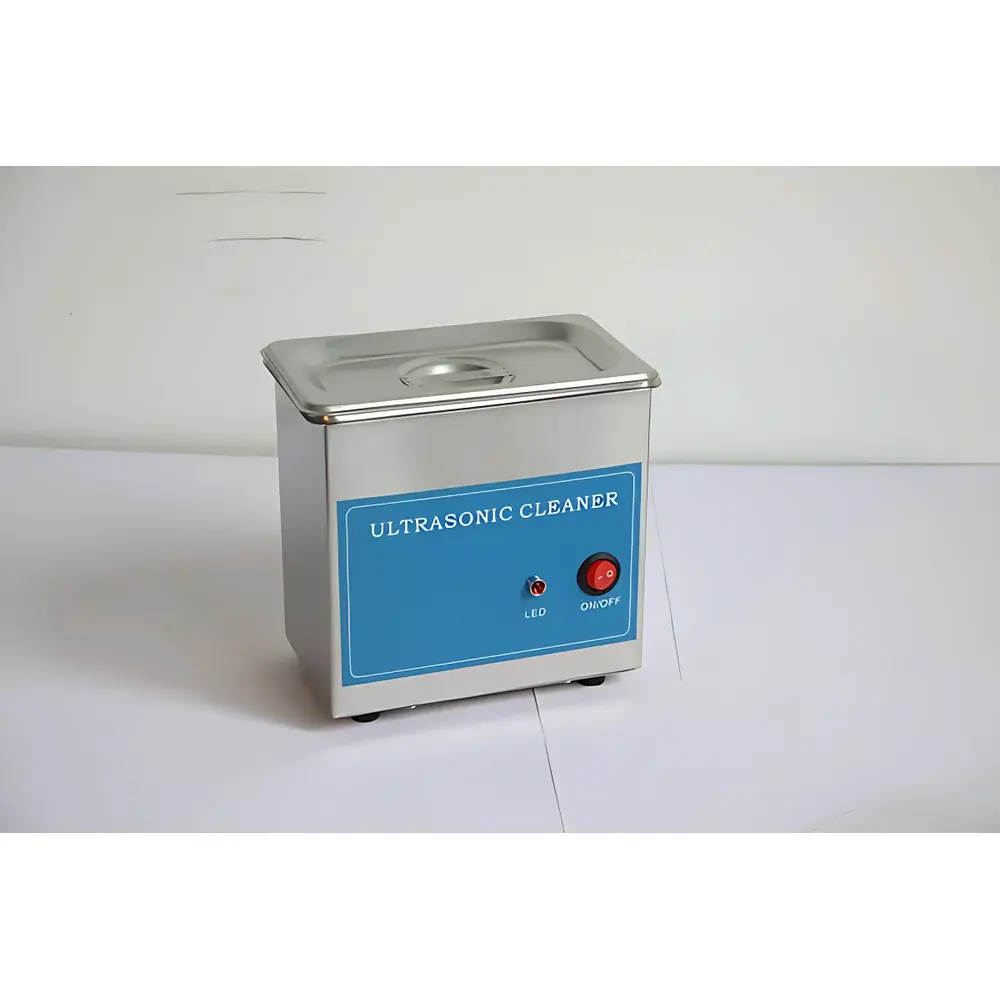
Truelab UC-T08 Benchtop Ultrasonic Cleaner
| Brand | Truelab |
|---|---|
| Origin | Shanghai, China |
| Model | UC-T08 |
| Type | General-purpose ultrasonic cleaner |
| Capacity | 0.8 L |
| Ultrasonic Frequency | 40 kHz |
| Ultrasonic Power | 35 W |
| Adjustable Power | No |
| Adjustable Temperature | No |
| Timer Function | No |
| Sound-Dampening Lid | Yes |
| Drain Port | No |
| Tank Dimensions (L×W×H) | 150 × 85 × 65 mm |
| External Dimensions (L×W×H) | 175 × 110 × 185 mm |
| Net Weight | 1.8 kg |
| Construction | SUS304 stainless steel tank and housing |
| Compliance | CE-marked for laboratory use in EU markets |
| Regulatory Context | Designed for non-sterile cleaning applications under GLP-aligned lab workflows |
Overview
The Truelab UC-T08 is a compact, benchtop ultrasonic cleaner engineered for precision cleaning of small-volume laboratory components, micro-tools, optical parts, electronic substrates, and biological sample carriers. It operates on the principle of acoustic cavitation: a 40 kHz high-frequency signal generated by an integrated ultrasonic generator is electromechanically transduced into longitudinal pressure waves via piezoelectric ceramic transducers bonded to the bottom of the stainless-steel tank. These waves propagate through aqueous or low-viscosity solvent media (e.g., deionized water, isopropyl alcohol, or mild alkaline solutions), inducing transient microcavities that collapse violently near solid surfaces—generating localized shear forces, microstreaming, and thermal transients sufficient to dislodge particulate contaminants, organic residues, oxides, and loosely adherent biofilms without mechanical abrasion. Unlike heated or programmable units, the UC-T08 delivers consistent, repeatable cavitation intensity at fixed power (35 W) and frequency (40 kHz), making it ideal for standardized cleaning protocols where thermal degradation or over-cleaning must be avoided.
Key Features
- Monobloc SUS304 stainless-steel tank: Deep-drawn seamless construction eliminates weld seams and potential leakage points—critical for long-term chemical resistance and corrosion prevention in repeated solvent exposure.
- High-efficiency piezoelectric transducers: Optimized coupling and impedance matching ensure >85% electroacoustic conversion efficiency, maximizing energy delivery to the cleaning medium with minimal heat buildup in the transducer stack.
- Integrated sound-dampening lid: Reduces airborne noise to ≤55 dB(A) at 1 m distance while suppressing solvent evaporation and preventing operator exposure to aerosolized contaminants during operation.
- Compact footprint (175 × 110 × 185 mm): Fits seamlessly into fume hoods, biosafety cabinets, or crowded analytical workbenches without compromising accessibility or workflow ergonomics.
- Robust industrial-grade chassis: Fully enclosed stainless-steel housing provides EMI shielding, mechanical stability, and compatibility with ISO Class 5–7 cleanroom environments when used with validated solvents.
Sample Compatibility & Compliance
The UC-T08 accommodates samples up to 130 × 65 × 50 mm (typical maximum load volume: 0.6 L active cleaning zone). Compatible with glassware (vials, cuvettes, capillaries), metal components (surgical instruments, watch parts), silicon wafers, PCB fragments, and polymer-based consumables (e.g., pipette tips, microcentrifuge tubes). Not intended for sterilization or depyrogenation; validation per ISO 15883-1 or EN 285 is not applicable. Complies with IEC 61000-6-3 (EMC emissions) and IEC 61010-1 (safety requirements for electrical equipment for measurement, control, and laboratory use). Suitable for routine cleaning steps within ASTM D2601 (cleaning verification for precision parts) and USP (cleaning of laboratory apparatus), provided solvent selection and dwell time are documented and controlled.
Software & Data Management
The UC-T08 is a manually operated, analog-control device with no embedded firmware, display interface, or digital connectivity. All operational parameters—power output, frequency, and cycle duration—are factory-fixed; no configuration, calibration logging, or audit trail functionality is present. As such, it meets basic GLP documentation requirements only when integrated into a broader SOP-defined process: users must record batch identifiers, solvent type, lot number, exposure duration (via external timer), and visual inspection results in a dedicated lab notebook or ELN. For regulated environments requiring 21 CFR Part 11 compliance, this unit serves exclusively as a non-critical ancillary tool—no electronic records are generated, stored, or transmitted.
Applications
- Pretreatment of HPLC vials and autosampler needles to eliminate carryover and baseline drift.
- Cleaning of quartz crystal microbalance (QCM) sensors prior to surface functionalization.
- Removal of flux residue from SMT solder joints during failure analysis in electronics labs.
- Decontamination of microfluidic chips and PDMS molds before plasma bonding.
- Routine maintenance of optical filters, lens mounts, and fiber-optic connectors in photonics R&D.
- Pre-analytical preparation of tissue culture inserts and electrophoresis combs to prevent cross-contamination.
FAQ
Is the UC-T08 suitable for cleaning delicate MEMS devices?
Yes—its 40 kHz frequency offers a balance between cavitation intensity and microstructural safety; however, immersion time should be limited to ≤3 minutes and low-surface-tension solvents (e.g., fluorinated ethers) are recommended for fragile structures.
Can I use acetone or chlorinated solvents in this unit?
No. The UC-T08 is rated exclusively for aqueous and polar organic solvents (e.g., ethanol, IPA, diluted NaOH). Halogenated or highly volatile solvents pose fire, material compatibility, and transducer delamination risks.
Does the unit include a degassing function?
No. Degassing must be performed separately using vacuum desiccation or solvent pre-sonication in a dedicated vessel prior to loading samples.
Is the stainless-steel mesh basket included?
No. The UC-T08 ships without accessories; a SUS304 mesh basket (part #TB-MB08) is available as optional add-on for sample suspension and protection.
What is the expected service life of the transducers under continuous daily use?
With proper solvent maintenance and avoidance of dry-running, the transducers maintain ≥90% nominal output for ≥5,000 operating hours (approx. 2 years at 8 h/day, 5 d/week).



