
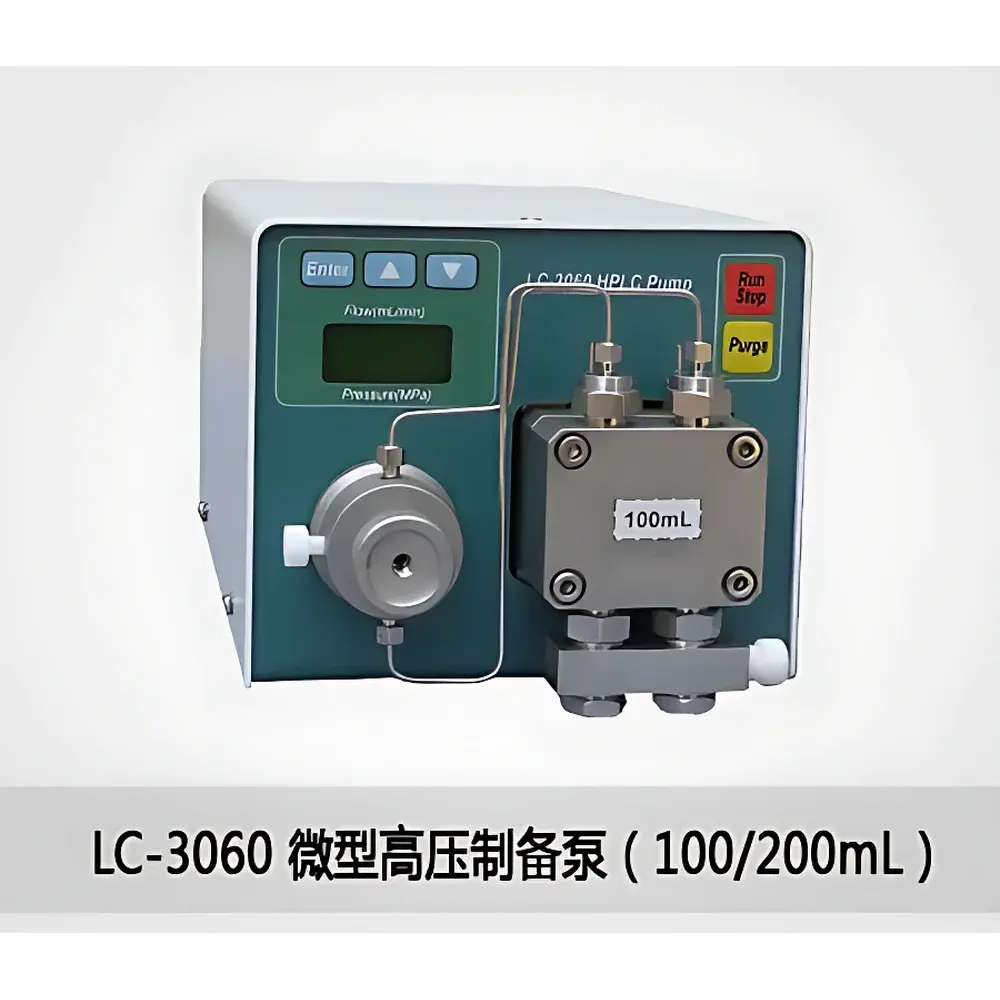
Truelab LC-3060 Miniature High-Pressure Preparative Pump (100/200 mL)
| Brand | Truelab |
|---|---|
| Origin | Beijing, China |
| Model | LC-3060 |
| Flow Rate | 0.01–99.99 mL/min (100 mL head) / 0.1–199.9 mL/min (200 mL head) |
| Pressure Range | 0–26 MPa (100 mL) / 0–10 MPa (200 mL) |
| Flow Accuracy | ±1% (at 10 mL/min, deionized water, 25°C) |
| Flow Precision | ≤0.5% RSD (at 10 mL/min, deionized water, 25°C) |
| Power Supply | 24 V DC, 3 A |
| Dimensions | 130 × 110 × 210 mm (L × H × D) |
| Weight | 2.8 kg |
| Communication Interface | RS-232 / RS-485 with auto-detection |
| Display | 2×8 character LCD |
| Pump Type | Dual-piston parallel reciprocating pump |
| Column Connection | 1/16" OD stainless steel tubing compatible with global HPLC/UHPLC systems |
Overview
The Truelab LC-3060 is a compact, high-pressure preparative pump engineered for precision fluid delivery in laboratory-scale purification, synthesis support, and process development workflows. It operates on the principle of dual-piston parallel reciprocating displacement, delivering stable, pulse-minimized flow across two interchangeable pump heads—100 mL and 200 mL—each optimized for distinct pressure and flow regimes. The 100 mL configuration supports pressures up to 26 MPa (3770 psi), making it suitable for high-backpressure applications such as flash chromatography with sub-10 µm stationary phases or small-bore preparative columns. The 200 mL variant delivers higher volumetric throughput at lower maximum pressure (10 MPa), ideal for catalyst dosing, reaction quenching, or large-volume fraction collection where flow stability outweighs extreme pressure demands. All hydraulic components—including fluid path, check valves, and piston seals—are constructed from chemically resistant stainless steel and ceramic-composite materials, ensuring compatibility with common organic solvents (acetonitrile, methanol, THF), aqueous buffers, and mildly corrosive reagents.
Key Features
- Embedded COTERM-M3 microcontroller (performance tier exceeding ARM7 architecture), enabling real-time pressure feedback control and adaptive flow compensation
- Electronically implemented pressure pulsation suppression—eliminating mechanical dampeners and reducing baseline noise in downstream detectors
- Floating plunger design minimizes radial wear and extends seal lifetime under continuous operation
- High-resolution DC servo motor drive with closed-loop speed regulation ensures consistent torque delivery across the full flow range
- Auto-sensing RS-232/RS-485 interface enables seamless integration into automated preparative systems; protocol supports SCPI-like command syntax for remote parameter setting and status polling
- Compact footprint (130 × 110 × 210 mm) and lightweight construction (2.8 kg) facilitate benchtop deployment in fume hoods, gloveboxes, or mobile analytical carts
- LCD display provides real-time readout of setpoint flow rate, actual pressure, operating mode, and system fault codes in English
Sample Compatibility & Compliance
The LC-3060 is designed for use with low-to-moderately viscous liquids (≤25 cP) and particulate-free solutions. Its fluidic pathway complies with ISO 8573-1 Class 4 purity requirements for compressed air–free liquid handling. While not certified for GMP manufacturing environments, its pressure-limiting firmware, over-pressure shutdown logic (configurable threshold), and non-volatile error logging support GLP-aligned documentation practices. The pump meets IEC 61010-1 safety standards for laboratory electrical equipment and is CE-marked for EMC and LVD compliance. Tubing connections conform to standard 1/16″ OD stainless steel fittings (e.g., Swagelok® SS-4-1), ensuring interoperability with commercially available HPLC manifolds, injection valves, UV/Vis flow cells, and fraction collectors from Agilent, Waters, Shimadzu, and Gilson.
Software & Data Management
The LC-3060 supports bidirectional serial communication via ASCII-based command sets, allowing integration with third-party control platforms including LabVIEW™, Python (pySerial), and MATLAB®. Optional OEM firmware modules enable synchronized gradient generation when paired with a second LC-3060 unit—forming a binary high-pressure mixing system without external low-pressure blending hardware. All operational parameters (flow setpoint, pressure limit, run time, pause intervals) are stored in non-volatile memory and retained after power cycling. Event logs—including pressure excursions, motor stall detection, and communication timeouts—are timestamped and accessible via query command, facilitating audit-ready traceability per FDA 21 CFR Part 11 principles when used in conjunction with validated host software.
Applications
- Preparative HPLC and flash chromatography systems requiring precise, scalable solvent delivery
- Catalyst metering in continuous-flow reactor setups (e.g., Pd-catalyzed cross-coupling, asymmetric hydrogenation)
- Automated sample introduction for offline LC–MS fraction analysis
- Mobile phase delivery in custom-built purification rigs for natural product isolation or peptide synthesis
- Calibration fluid dispensing in gravimetric or volumetric verification protocols
- Stand-alone use as a programmable reagent addition pump in electrochemical or photochemical reactors
FAQ
What is the maximum allowable inlet pressure for the LC-3060?
The pump is designed for ambient-pressure liquid supply; inlet pressure must remain below 0.2 MPa (30 psi) to prevent check valve damage or cavitation.
Can the LC-3060 be operated in pulse-free mode for sensitive UV detection?
Yes—the electronic pulsation suppression algorithm reduces flow ripple to <1.5% peak-to-peak at 10 mL/min, meeting typical requirements for absorbance-based fraction triggering.
Is the pump compatible with aggressive solvents such as concentrated HCl or HF?
No—standard wetted materials are not resistant to strong mineral acids or hydrofluoric acid; use only with solvents listed in the Truelab Chemical Compatibility Guide (v2.1).
Does the LC-3060 support analog input for external flow rate modulation?
Not natively; flow control is digital-only via RS-232/485. Analog interfacing requires an external PLC or DAQ with serial gateway conversion.
How frequently should the piston seals be replaced under continuous operation?
Under typical use (8 h/day, 5 days/week, 10 mL/min average flow), ceramic-coated plunger seals demonstrate ≥12 months service life before scheduled replacement.



