
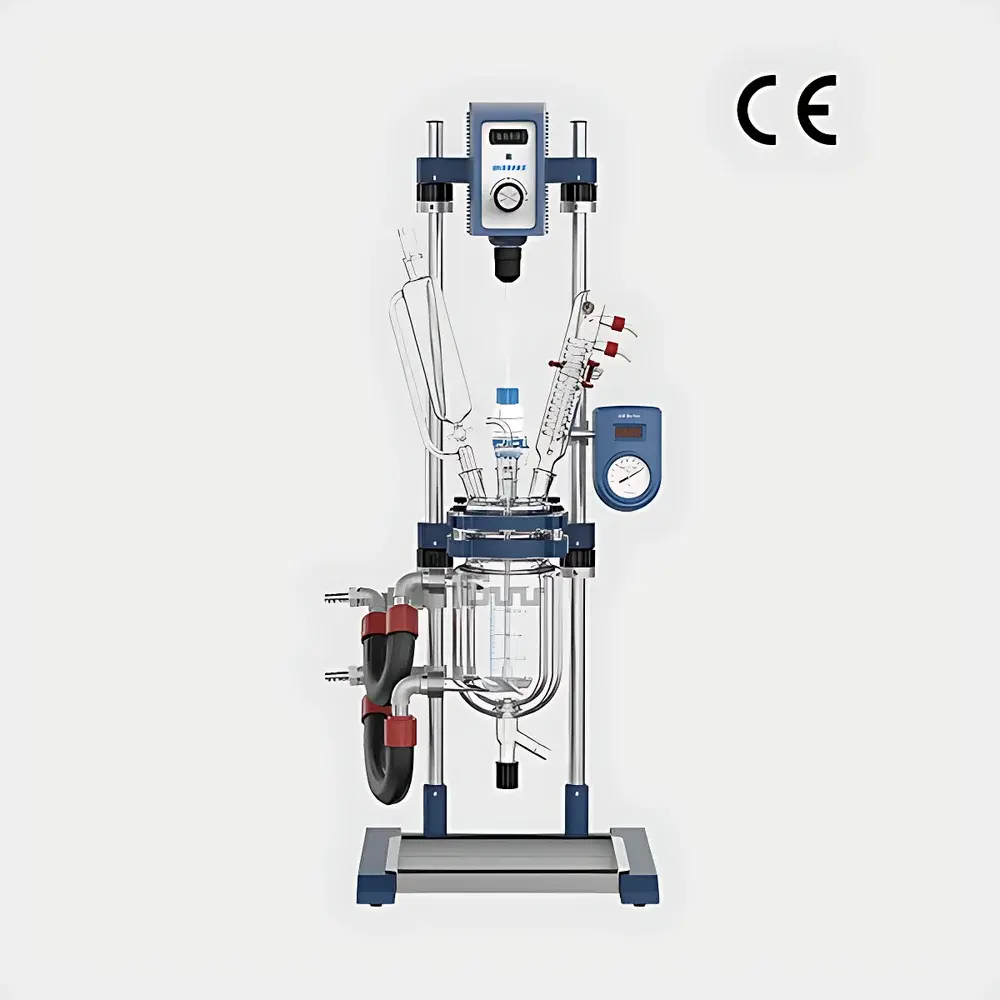
Truelab GR-Series Benchtop Glass Reactor (0.5–3 L Capacity)
| Brand | Truelab |
|---|---|
| Origin | Shanghai, China |
| Model | GR-1 / GR-2 / GR-3 |
| Vessel Material | ASTM E438 Type I, Class A 3.3 borosilicate glass |
| Working Volume | 1–3 L (GR-1: 1 L, GR-2: 2 L, GR-3: 3 L) |
| Minimum Stirring Volume | 0.13–0.3 L |
| Operating Pressure Range | –0.1 MPa to 0 MPa (gauge) |
| Jacket Pressure Rating | ≤0.03 MPa |
| Vacuum Level | ≤0.03 MPa (absolute) |
| Temperature Range | –80 °C to +200 °C |
| Thermal Shock Resistance | 80 °C |
| Stirring Speed | 40–500 rpm, ±1 rpm digital resolution |
| Motor | Brushless DC, 50 W |
| Sealing | Vacuum-rated mechanical seal with PTFE/PEEK/glass support components |
| Stirrer Shaft & Blades | 06Cr19Ni10 stainless steel core with full PTFE coating |
| Jacket Inlet/Outlet | Rc 3/4 and Rc 1/2 threaded ports with stainless steel insulated flexible hoses |
| Drain Valve | Zero-holdup PTFE-lined diaphragm valve (ID φ10 mm) |
| Frame | Hybrid construction — 06Cr19Ni10 stainless steel base, carbon steel frame with epoxy-polyester spray coating, and anodized aluminum uprights |
| Drip Tray | 06Cr19Ni10 stainless steel |
| Electrical Supply | Stirrer — 100–240 V~, 50/60 Hz |
| Ambient Operating Conditions | 5–35 °C, ≤70% RH |
| Dimensions (W×D×H, mm) | GR-1/GR-2 ≈ 480×420×1100 |
| Weight | 19–21 kg |
Overview
The Truelab GR-Series benchtop glass reactor is a modular, vacuum-compatible synthesis platform engineered for precise control of temperature, pressure, and agitation in small-scale chemical and biochemical reaction workflows. Designed around ASTM E438 Type I, Class A 3.3 borosilicate glass vessels, the system operates on fundamental principles of jacketed heat transfer, vacuum-assisted solvent removal, and magnetically coupled or mechanically sealed stirring under inert or reduced-pressure environments. Its transparent vessel architecture enables real-time visual monitoring of phase separation, crystallization kinetics, reflux behavior, and precipitate formation—critical for reaction optimization, process scouting, and scale-down studies prior to pilot or production deployment. The GR-Series supports both batch and semi-batch operation modes, accommodating distillation, concentration, hydrogenation, polymerization, hydrolysis, and enzymatic transformations within a compact footprint suitable for fume hoods or dedicated lab benches.
Key Features
- High-integrity 3.3 borosilicate glass vessel conforming to ISO 3585 and DIN 7080 standards, certified for thermal shock resistance up to 80 °C differential and long-term chemical stability against acids, alkalis, and organic solvents.
- Triple-layer structural frame: corrosion-resistant 06Cr19Ni10 stainless steel base plate, powder-coated carbon steel load-bearing chassis, and anodized aluminum vertical supports—optimized for rigidity, cleanability, and electromagnetic compatibility.
- Vacuum-rated mechanical sealing assembly incorporating PTFE-faced rotating elements, PEEK thrust washers, and fused-glass stationary faces—ensuring leak-tight operation at ≤0.03 MPa absolute pressure without lubricant contamination.
- Brushless DC drive system with 40–500 rpm continuous variable speed control, ±1 rpm digital feedback, and torque-sensing overload protection to maintain consistent shear profiles across viscosity ranges from 10,000 mPa·s.
- Jacket fluid interface with dual Rc-threaded ports (Rc 3/4 and Rc 1/2) and insulated stainless-steel flexible hoses—eliminating thermal stress-induced cracking and enabling seamless integration with external chillers, heating circulators, or thermofluid systems.
- Zero-holdup bottom discharge valve with PTFE diaphragm and integrated drain funnel geometry—preventing cross-contamination between runs and supporting quantitative product recovery per USP analytical instrument qualification guidelines.
Sample Compatibility & Compliance
The GR-Series accommodates heterogeneous, multiphase, and gas-liquid reaction systems including catalytic hydrogenations (with H₂-compatible fittings), Grignard additions, lithium-aluminum hydride reductions, and pH-sensitive biocatalytic reactions. All wetted parts—including vessel, condenser, dropping funnel, and stirrer components—comply with USP Class VI biological safety requirements and meet ISO 10993-5 cytotoxicity thresholds. The system supports GLP-compliant documentation when paired with optional data loggers compliant with FDA 21 CFR Part 11 (electronic signatures, audit trails, user access controls). It conforms to IEC 61010-1:2010 for laboratory electrical safety and EN 61326-1:2013 for electromagnetic immunity in shared lab environments.
Software & Data Management
While the base configuration features standalone digital displays for temperature (PT100 sensor, ±0.1 °C accuracy) and vacuum (capacitance manometer, 0.001–100 kPa range), optional USB- or RS485-enabled data acquisition modules enable time-stamped logging of process variables into CSV or Excel-compatible formats. These modules support synchronization with third-party SCADA platforms and are compatible with LabVIEW™, MATLAB® Data Acquisition Toolbox, and Python-based automation frameworks (e.g., PySerial, Pandas). All firmware updates follow secure signed-binary protocols, and calibration certificates traceable to NIST standards are provided upon request.
Applications
- Synthesis route development for pharmaceutical intermediates under controlled exothermic conditions.
- Distillation and solvent exchange under reduced pressure for moisture-sensitive organometallics.
- Enzyme-catalyzed esterification in biphasic aqueous–organic media with inline pH monitoring.
- Polymerization kinetics studies using in situ FTIR probe ports (available as custom accessory).
- Crystallization screening with controlled cooling ramps and anti-solvent addition via calibrated dropping funnels.
- Photochemical reactions utilizing optional quartz-jacketed vessels and UV-transparent cold-finger condensers.
FAQ
What is the maximum allowable jacket temperature differential relative to ambient?
The jacket fluid inlet temperature must not exceed +200 °C, and the ΔT between jacket and vessel contents shall remain within the 80 °C thermal shock limit specified for 3.3 borosilicate glass.
Can the GR-Series be used for hydrogenation reactions under 1 bar H₂ pressure?
No—the vessel is rated only for vacuum to atmospheric pressure (–0.1 to 0 MPa gauge); pressurized gas-phase reactions require ASME-coded stainless steel reactors.
Is the mechanical seal compatible with chlorinated solvents such as CH₂Cl₂ or chloroform?
Yes—PTFE/PEEK/glass contact materials exhibit full resistance to halogenated organics per ASTM D543 immersion testing protocols.
Does the system include validation documentation for GMP environments?
Factory-installed IQ/OQ protocols are available as add-on packages, including installation checklists, operational boundary tests, and traceable calibration records aligned with Annex 15 and EU GMP Chapter 4 requirements.
What maintenance intervals are recommended for the brushless motor and vacuum seal?
Motor requires no scheduled maintenance; the mechanical seal is rated for ≥5,000 hours of continuous operation under standard lab conditions and should be inspected annually during preventive maintenance audits.



