
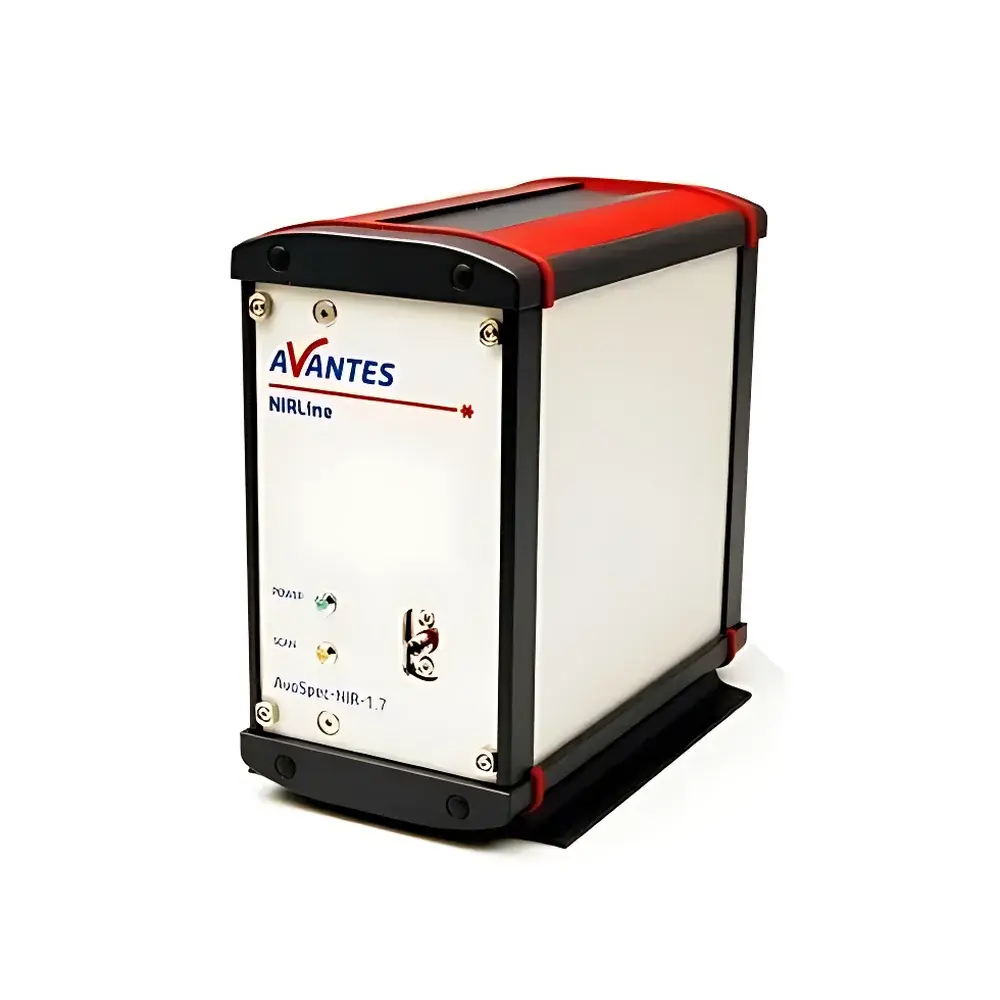
Avantes AvaSpec-NIR256-1.7-EVO Near-Infrared Spectrometer
| Brand | Avantes |
|---|---|
| Origin | Netherlands |
| Model | AvaSpec-NIR256-1.7-EVO |
| Wavelength Range | 900–1750 nm |
| Scan Speed | 0.53 ms/scan (USB 3.0) |
| Integration Time | 10 µs – 500 ms |
| Detector | 256-pixel InGaAs linear array (50 µm × 500 µm) |
| Optical Platform | Symmetrical Czerny-Turner, 50 mm focal length |
| Resolution (FWHM) | 2–50 nm (configurable via slit and grating) |
| Stray Light | <1% |
| Dynamic Range | 6000:1 (HS mode), 9000:1 (LN mode) |
| SNR | 1900:1 (HS), 5000:1 (LN) |
| Sensitivity | 8.2 × 10⁶ counts/µW·ms (HS, 1000–1750 nm) |
| ADC | 16-bit, 500 kHz |
| Interfaces | USB 3.0 (5 Gbps), Gigabit Ethernet (1 Gbps), HD-26 digital I/O |
| Power | USB-powered (600 mA) or external 12 VDC (320 mA) |
| Dimensions & Weight | 185 × 100 × 184 mm, 2.7 kg |
| Software | AvaSoft v8+ with chemometrics support |
Overview
The Avantes AvaSpec-NIR256-1.7-EVO is a high-performance, uncooled near-infrared spectrometer engineered for demanding quantitative and qualitative analysis in research laboratories, academic institutions, and industrial process environments. Based on the robust symmetrical Czerny-Turner optical design with a 50 mm focal length, it delivers stable spectral response across the full 900–1750 nm range—covering the critical first overtone and combination bands of C–H, N–H, and O–H functional groups. Unlike thermoelectrically cooled NIR systems, this EVO-generation instrument achieves exceptional signal fidelity without active cooling, reducing power consumption, thermal drift, and system complexity while maintaining reproducibility suitable for GLP-compliant method development and routine calibration transfer. Its core architecture leverages a 256-pixel InGaAs linear array detector (50 µm × 500 µm pixel pitch), optimized for high quantum efficiency in the extended SWIR region, and integrates a low-noise, high-speed electronics platform supporting real-time acquisition at up to 1,887 spectra per second.
Key Features
- Uncooled InGaAs detection enabling rapid warm-up (<5 s), zero condensation risk, and long-term operational stability in variable ambient conditions
- Dual-gain analog front-end: selectable High-Sensitivity (HS) and Low-Noise (LN) modes—optimized respectively for trace-level detection and high-dynamic-range quantification
- Configurable resolution (2–50 nm FWHM) via interchangeable slits (25–200 µm) and four standard gratings (200–600 grooves/mm)
- Ultra-fast spectral acquisition: 0.53 ms per scan via USB 3.0 interface; full-frame readout synchronized with external triggers via HD-26 connector
- Comprehensive I/O suite: 13 bidirectional digital lines (for shutter, laser gating, synchronization), two analog inputs (e.g., temperature or position feedback), and two analog outputs (e.g., for intensity normalization or actuator control)
- Compact, ruggedized aluminum housing (IP20-rated) with precision-machined optical bench—designed for integration into OEM systems, portable analyzers, or benchtop QA/QC stations
Sample Compatibility & Compliance
The AvaSpec-NIR256-1.7-EVO supports fiber-coupled measurements using SMA 905 connectors, compatible with standard 400 µm, 600 µm, or 1 mm core diameter silica/silica fibers. It interfaces seamlessly with integrating spheres (e.g., AvaSphere-50-LS), transmission cells, diffuse reflectance probes, and flow-through cuvette holders—enabling absorbance, transmittance, and remission measurements across solid, liquid, and semi-solid matrices. The instrument complies with IEC 61326-1 (EMC for laboratory equipment) and meets RoHS 2011/65/EU requirements. Its firmware and AvaSoft software support audit-trail-enabled operation aligned with FDA 21 CFR Part 11 principles—including user authentication, electronic signatures, and immutable data logging—facilitating validation in regulated environments such as pharmaceutical raw material ID (per USP ) or food authenticity screening (per ISO 12099:2017).
Software & Data Management
AvaSoft v8.12+ provides native support for multivariate calibration workflows, including PLS regression, PCA, and cluster analysis, with direct export to MATLAB, Python (via .csv/.jdx), and industry-standard chemometric platforms (e.g., Unscrambler X, CAMO). Raw spectra are stored in vendor-neutral JCAMP-DX (.jdx) format, ensuring long-term archival integrity. Real-time spectral averaging, dark/reference correction, and wavelength calibration persistence (including user-defined polynomial coefficients) are managed through intuitive GUI controls. Batch processing scripts enable automated measurement sequences across multiple samples or time points, with metadata tagging (operator, timestamp, instrument ID, environmental sensor input) embedded directly in the spectrum header. All configuration changes and data exports are logged with timestamps and user IDs, satisfying GLP documentation requirements.
Applications
- Pharmaceutical: API concentration monitoring in granules, tablet coating thickness assessment, and excipient identification via spectral fingerprinting
- Agriculture & Food: Moisture, protein, and fat content prediction in grains, dairy powders, and meat products using validated PLS models
- Polymer Science: Crosslink density estimation in elastomers, additive dispersion homogeneity, and degradation kinetics tracking
- Chemical Process Analytics: Real-time reaction endpoint detection in continuous-flow reactors and distillation column monitoring
- Academic Research: Time-resolved spectroscopy of photochemical intermediates, catalyst surface adsorption studies, and hyperspectral imaging system integration
FAQ
Is the AvaSpec-NIR256-1.7-EVO suitable for field-deployable applications?
Yes—the USB-powered operation, compact form factor (2.7 kg), and absence of cryogenic components make it ideal for mobile labs, drone-mounted sensors, or handheld analyzers when paired with appropriate optics and battery management.
Can I perform real-time chemometric inference onboard the spectrometer?
No—model execution occurs externally in AvaSoft or third-party software; however, the 0.53 ms scan rate and deterministic trigger latency (<100 ns jitter) enable tight synchronization with external PLCs or edge AI units for closed-loop control.
What calibration standards are recommended for routine performance verification?
NIST-traceable tungsten-halogen and deuterium lamps for radiometric calibration; rare-earth oxide filters (e.g., Holmium Oxide in quartz) for wavelength validation between 900–1700 nm.
Does the instrument support synchronization with pulsed lasers or gated detectors?
Yes—via the HD-26 digital I/O port, users can configure hardware-triggered acquisition, TTL-synchronized laser pulsing, and external shutter control with sub-microsecond timing precision.
How does the LN mode improve dynamic range compared to HS mode?
LN mode reduces amplifier gain and increases integration window tolerance, yielding lower read noise and extended full-well capacity—critical for high-concentration samples or broadband light sources where saturation must be avoided without attenuation.





