
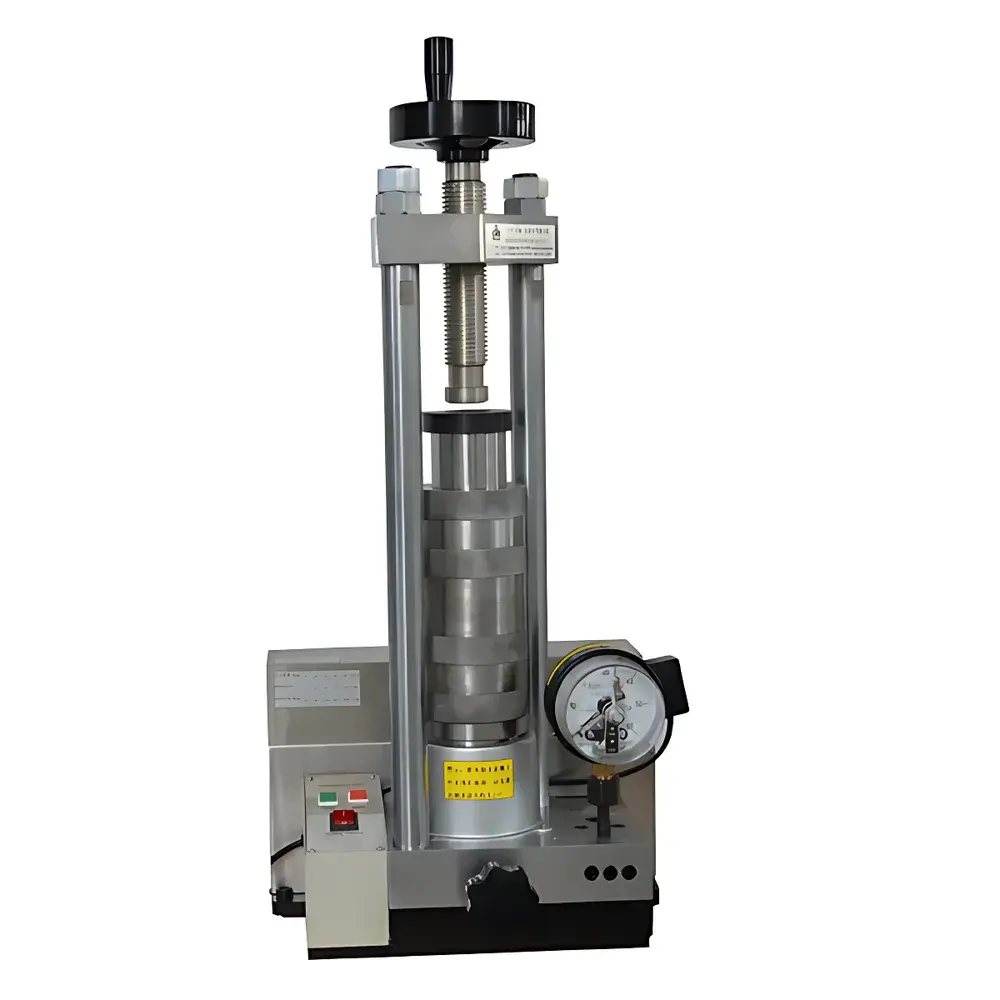
KJ GROUP CIP-30MAHS Electric Cold Isostatic Press
| Brand | KJ GROUP |
|---|---|
| Origin | Liaoning, China |
| Manufacturer Type | Authorized Distributor |
| Country of Origin | China |
| Model | CIP-30MAHS |
| Quotation | Available Upon Request |
| Isostatic Chamber Dimensions | Ø30 mm × 90 mm |
| Maximum Chamber Pressure | 278 MPa (optional upgrade to 400–500 MPa available) |
| Pressure Range | 0–33.3 MPa (equivalent to 0–20 metric tons force) |
| Electric Hydraulic Power Unit Capacity | 20 T |
| Working Space | D₁ = 98 mm, D₂ = 88 mm, H₁ = 345 mm, H₂ = 330 mm |
| Overall Dimensions | 440 mm × 430 mm × 560 mm |
| Net Weight | 100 kg |
Overview
The KJ GROUP CIP-30MAHS Electric Cold Isostatic Press is a precision-engineered laboratory-scale cold isostatic pressing system designed for uniform densification of powder compacts under hydrostatic pressure. Operating on the principle of Pascal’s law, the unit transmits pressure uniformly in all directions via an incompressible fluid medium—typically silicone oil or specialized hydraulic fluid—within a sealed high-pressure chamber. This isotropic stress state eliminates directional bias during compaction, minimizing internal defects such as density gradients, laminations, or interparticle voids. Unlike uniaxial pressing, cold isostatic pressing (CIP) preserves green body geometry while significantly enhancing green density (typically 55–70% theoretical density), thereby improving sinterability and final mechanical performance. The CIP-30MAHS is specifically engineered for research environments where reproducible, small-batch processing of advanced ceramics, hardmetals, refractory composites, and functional oxide powders is required.
Key Features
- Compact footprint (440 × 430 × 560 mm) optimized for university labs, R&D centers, and quality control facilities with space constraints.
- Electrically driven hydraulic power unit delivering precise, stepless pressure control from 0 to 33.3 MPa (0–20 T), ensuring stable ramping and dwell profiles without hydraulic leakage or thermal drift.
- Robust stainless-steel isostatic chamber with internal dimensions of Ø30 mm × 90 mm, rated for continuous operation up to 278 MPa; optional high-pressure configurations (400–500 MPa) are available upon technical consultation and chamber requalification.
- Integrated safety architecture including dual redundant pressure sensors, overpressure relief valve, emergency stop circuit, and real-time pressure monitoring with digital display.
- Sealed fluid containment system compliant with ISO 4414 for hydraulic fluid safety and environmental protection; compatible with low-volatility, high-flash-point fluids meeting ASTM D6180 specifications.
Sample Compatibility & Compliance
The CIP-30MAHS accommodates cylindrical, rectangular, and irregularly shaped green bodies fabricated from submicron to coarse powders—including alumina, zirconia, silicon carbide, tungsten carbide–cobalt, silicon nitride, and metal injection molding (MIM) feedstocks. Sample encapsulation is performed using elastomeric molds (e.g., rubber, polyurethane, or fluorosilicone) conforming to ASTM C773 standards for green strength evaluation. All operational parameters comply with ISO 13355 (cold isostatic pressing of ceramic powders) and support GLP-aligned documentation workflows. The system supports traceable pressure calibration per ISO/IEC 17025-accredited procedures when paired with certified transducers.
Software & Data Management
While the base configuration features analog-digital hybrid control with front-panel setpoint adjustment and real-time pressure readout, optional PC-integrated control software enables programmable multi-step press cycles (ramp-hold-relief), automated data logging (timestamped pressure vs. time), and CSV export for post-processing in MATLAB or Python. Audit trails meet FDA 21 CFR Part 11 requirements when deployed with user authentication, electronic signatures, and immutable record storage—facilitating regulatory submissions for medical-grade ceramic implants or aerospace component qualification.
Applications
- Green body densification prior to sintering in structural ceramics R&D.
- Pre-forming of complex-shaped components for additive manufacturing support structures.
- Consolidation of nanocomposite powders where shear-induced alignment must be avoided.
- Manufacturing of reference standards for XRD, SEM-EDS, or dilatometry requiring homogeneous microstructure.
- Process development for solid-state battery electrode layers and solid electrolyte pellets.
FAQ
What is the maximum recommended operating pressure for routine use?
The standard chamber is qualified for continuous operation at ≤278 MPa; sustained use above this threshold requires validation of mold integrity, fluid compatibility, and periodic NDT inspection of the pressure vessel.
Can the system accommodate custom mold geometries?
Yes—provided outer dimensions remain within the specified working envelope (D₁ ≤ 98 mm, H₁ ≤ 345 mm) and wall thickness complies with ASME BPVC Section VIII Division 1 guidelines for elastomeric tooling.
Is remote monitoring supported?
With optional Ethernet-enabled controller module, real-time pressure telemetry and alarm status can be integrated into LabView or SCADA platforms via Modbus TCP protocol.
Does the unit meet CE or UL certification requirements?
The CIP-30MAHS conforms to IEC 61000-6-2 (EMC immunity) and IEC 61000-6-4 (EMC emissions); full CE marking requires site-specific risk assessment and integration into a certified machine safety loop.
What maintenance intervals are recommended?
Hydraulic fluid analysis every 1,000 operating hours; O-ring replacement and chamber seal inspection every 6 months or after 200 cycles—whichever occurs first—per maintenance logbook guidance included with shipment.



