
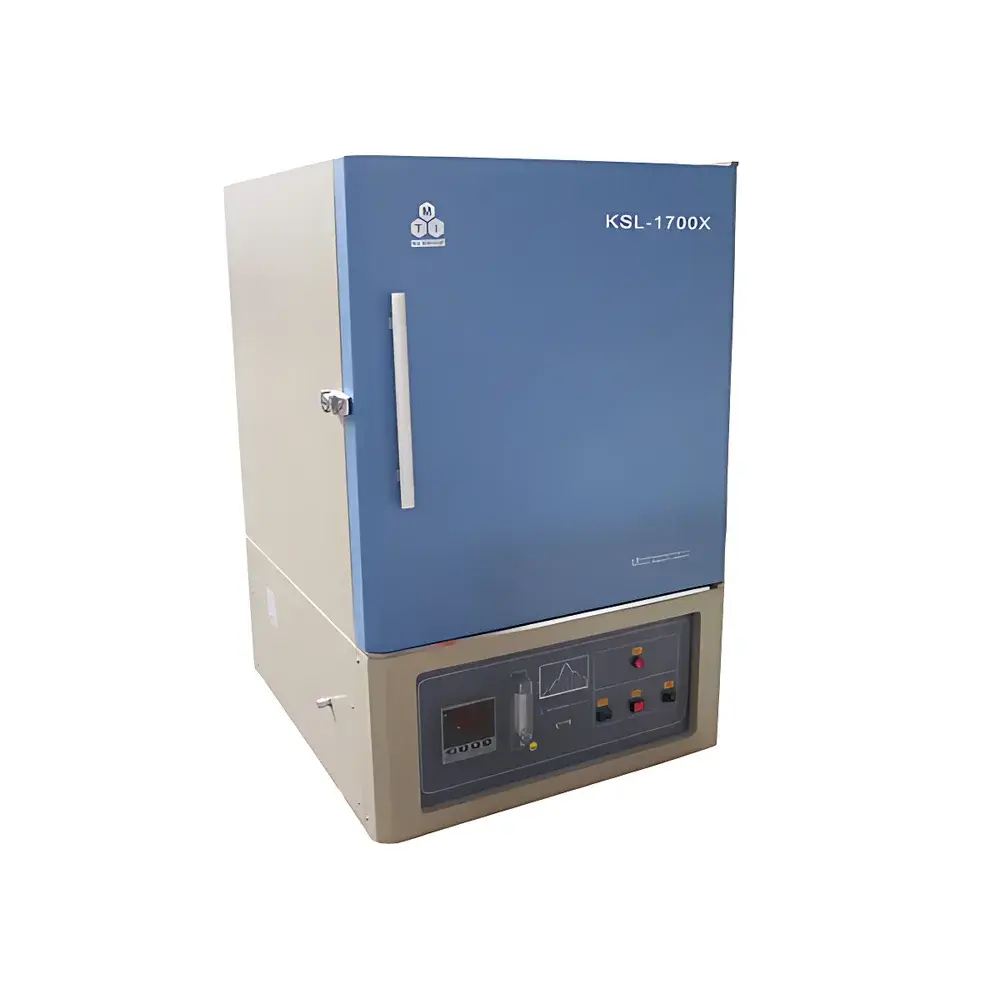
KJ GROUP KSL-1700X-A1 High-Temperature Box Furnace (3.4 L, 1700 °C)
| Brand | KJ GROUP |
|---|---|
| Origin | Anhui, China |
| Manufacturer Type | Authorized Distributor |
| Instrument Type | Box-Type Muffle Furnace |
| Model | KSL-1700X-A1 |
| Max Operating Temperature | 1650 °C (continuous), up to 1700 °C (intermittent) |
| Temperature Uniformity | ±1 °C |
| Power Supply | AC 220 V, 50 Hz, 3 kW |
| Max Heating Rate | 10 °C/min |
| Heating Element | Silicon Molybdenum (MoSi₂) Rods |
| Internal Chamber Dimensions | 150 mm × 150 mm × 150 mm (3.375 L) |
| External Dimensions | 500 mm × 490 mm × 700 mm |
| Net Weight | 120 kg |
| Thermocouple Type | Type B (Pt–30%Rh / Pt–6%Rh) Dual-Element |
| Control System | PID-Based Programmable Controller (30-Stage Ramp/Soak) |
| Certification | CE Marked |
| Chamber Coating | Imported Al₂O₃ Reflective Ceramic Coating |
Overview
The KJ GROUP KSL-1700X-A1 is a high-temperature box furnace engineered for precision thermal processing in research laboratories, materials science facilities, and quality control environments requiring stable operation at extreme temperatures. Designed around the fundamental principle of resistive heating via silicon molybdenum (MoSi₂) rods, the furnace delivers uniform, repeatable thermal profiles within a fully insulated refractory chamber. Its maximum intermittent operating temperature of 1700 °C—supported by continuous-rated capability up to 1650 °C—enables sintering of advanced ceramics (e.g., ZrO₂, SiC, AlN), annealing of high-melting-point alloys, ashing of refractory samples, and pre-sintering of solid oxide fuel cell (SOFC) components. The side-opening door configuration facilitates safe, ergonomic sample loading while minimizing heat loss during access. Integrated Type B dual-platinum-rhodium thermocouples provide high-stability temperature sensing across the full operational range, and the furnace’s ceramic fiber insulation combined with an imported alumina reflective coating enhances thermal efficiency and extends service life under cyclic thermal stress.
Key Features
- High-temperature rated MoSi₂ heating elements with proven longevity at ≥1600 °C and resistance to oxidation in air atmospheres
- 30-segment programmable PID controller enabling precise ramp/soak thermal profiles for controlled crystallization, phase transformation studies, or multi-step heat treatments
- Internally coated with US-sourced high-purity alumina (Al₂O₃) ceramic layer to improve infrared reflectivity, reduce energy consumption, and inhibit surface degradation
- CE-certified design compliant with EN 61000-6-3 (EMC) and EN 61000-6-2 (immunity), meeting essential safety requirements for laboratory deployment in EU-regulated institutions
- Robust double-layer insulation architecture—including high-density ceramic fiber board and low-conductivity vacuum-formed modules—ensures surface temperatures remain below 60 °C at ambient conditions during operation
- Side-hinged, counterbalanced furnace door with high-temperature gasket seal minimizes thermal leakage and supports reproducible atmospheric exposure during sample insertion/removal
Sample Compatibility & Compliance
The KSL-1700X-A1 accommodates standard crucibles (e.g., alumina, zirconia, graphite) and flat substrates up to 130 mm × 130 mm × 50 mm in volume. It is suitable for inert, oxidizing, and weakly reducing atmospheres (e.g., air, O₂, N₂, Ar); however, it is explicitly not designed for vacuum or sealed reducing environments. Due to the absence of gas-tight sealing, operation with flammable, explosive, or highly corrosive gases (e.g., H₂, NH₃, Cl₂, SO₂, or alkali vapors such as Na or S) requires prior consultation and optional custom modifications—including specialized refractory lining or quartz viewing ports—to mitigate chemical attack on internal components. The furnace meets general laboratory safety standards per IEC 61010-1 and supports GLP-compliant workflows when paired with external data loggers that record time-stamped temperature traces with audit-trail capability.
Software & Data Management
While the KSL-1700X-A1 operates natively via its front-panel PID interface, optional RS485 communication enables integration with third-party SCADA systems or KJ GROUP’s proprietary PC-based control software (sold separately). This software supports real-time temperature monitoring, remote parameter adjustment, automated data export (CSV/TXT), and generation of ISO/IEC 17025-aligned calibration reports. When used in regulated environments—such as those governed by FDA 21 CFR Part 11—the software can be configured with user-level access controls, electronic signatures, and immutable event logs to satisfy electronic record integrity requirements. Firmware updates are delivered via USB and maintain backward compatibility with existing profile libraries.
Applications
- Sintering of ultra-high-temperature ceramics (UHTCs) including hafnium carbide and tantalum hafnium carbide composites
- Thermal gravimetric analysis (TGA) pre-conditioning and residue quantification of mineralogical samples
- Heat treatment of lithium-ion battery cathode precursors (e.g., LiCoO₂, NMC) under controlled oxidative atmospheres
- Crystallization kinetics studies of glass-ceramic systems using isothermal holds between 1000–1600 °C
- Pre-oxidation of metal matrix composites prior to hot isostatic pressing (HIP)
- Ash content determination per ASTM D3174 and ISO 1171 for coal, biomass, and polymer composites
FAQ
What is the recommended maximum heating and cooling rate for optimal furnace longevity?
The manufacturer specifies a maximum ramp rate of 10 °C/min for both heating and cooling cycles. Exceeding this rate may accelerate thermal fatigue in the MoSi₂ elements and refractory lining.
Can this furnace be operated under vacuum or inert gas purge?
It is not vacuum-rated; however, passive inert gas purging (e.g., N₂ or Ar at low flow rates) is permissible with proper venting. For active gas atmosphere control, optional gas inlet/outlet ports and flow meters are available as accessories.
Is the alumina chamber coating repairable if damaged?
Yes—minor surface cracking or spalling can be restored using KJ GROUP’s OEM Al₂O₃ slurry coating kit, which restores emissivity and thermal reflectivity without requiring full chamber replacement.
Does the furnace include traceable calibration documentation?
Standard delivery includes a factory calibration certificate referencing NIST-traceable Type B thermocouple verification at three points (800 °C, 1200 °C, and 1600 °C), valid for 12 months from shipment date.
What maintenance intervals are recommended for routine operation?
Visual inspection of heating elements and chamber integrity every 200 operational hours; thermocouple verification every 6 months; full refractory assessment recommended after 1,000 cumulative hours above 1400 °C.
Related Products



