
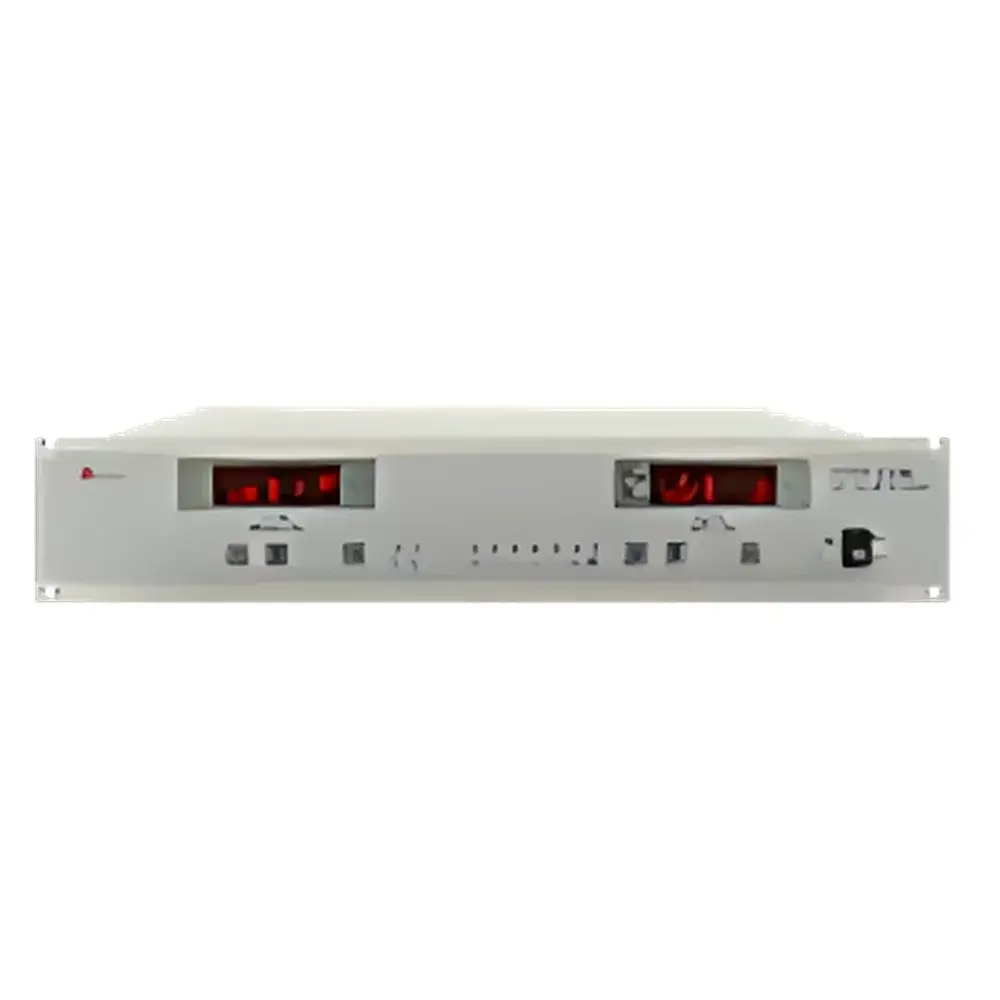
KJ GROUP ZDF-5214 Dual-Range Composite Vacuum Gauge
| Brand | KJ GROUP |
|---|---|
| Origin | Liaoning, China |
| Model | ZDF-5214 |
| Measurement Range | 1.0×10⁵ to 1.0×10⁻⁷ Pa (full scale) |
| Effective Range | 3×10³ to 1×10⁻⁶ Pa |
| Reference Ranges | 1.0×10⁵–3×10³ Pa (resistive gauge) and 5×10⁻⁶–1×10⁻⁷ Pa (cold cathode ionization gauge) |
| Compatible Gauges | ZJ-52T (thermocouple/resistive), ZJ-14 (cold cathode) |
| Control Load Capacity | AC 220 V / 3 A or DC 28 V / 10 A |
| Power Supply | AC 220 V ±10 %, 50 Hz, 45 W |
| Dimensions (W×H×D) | 480 × 88 × 260 mm |
| Cutout Size | 440 × 80 mm |
| Weight | ~4 kg |
| Optional | 0–5 V / 4–20 mA analog output, RS-232/RS-485 interface, custom cable length (standard 5 m), multiple flange interfaces (KF/DN10–40, CF/DN16–35, glass/metal direct insertion) |
Overview
The KJ GROUP ZDF-5214 Dual-Range Composite Vacuum Gauge is an integrated vacuum measurement instrument engineered for high-reliability, wide-range pressure monitoring in industrial vacuum systems, thin-film deposition chambers, vacuum furnaces, and research-grade vacuum environments. It combines two complementary vacuum sensing principles—thermal conductivity (resistive gauge) and cold cathode ionization—within a single controller chassis, enabling seamless coverage across five decades of pressure: from atmospheric conditions (1.0×10⁵ Pa) down to high vacuum (1.0×10⁻⁷ Pa). The resistive sensor (ZJ-52T) operates on the principle that gas thermal conductivity decreases with pressure; its output is calibrated for air and nitrogen at ambient temperature. The cold cathode ionization gauge (ZJ-14) measures electron-induced ion current generated in a high-voltage discharge field, providing stable, low-pressure response without filament degradation. A dedicated microcontroller performs real-time non-linear compensation, temperature drift correction, and cross-sensor range handover logic—ensuring continuity and metrological consistency across the full operational envelope.
Key Features
- Dual-sensor architecture with automatic range switching between resistive (3×10³–1×10⁻⁶ Pa) and cold cathode (5×10⁻⁶–1×10⁻⁷ Pa) modes
- Five-digit LED display using scientific notation for unambiguous reading of orders of magnitude
- Four programmable relay outputs supporting point control or band-based vacuum regulation; expandable to six channels via optional module
- Robust control load rating: AC 220 V / 3 A or DC 28 V / 10 A, suitable for solenoid valves, pneumatic actuators, and interlock circuits
- Integrated power conditioning and EMI filtering for stable operation in electrically noisy industrial settings
- Configurable control hysteresis, delay timers, and power-fail memory retention for critical process continuity
Sample Compatibility & Compliance
The ZDF-5214 is designed for use with standard vacuum gauges conforming to Chinese national specifications (JB/T 7264–2017) and compatible with internationally recognized mechanical and electrical interfaces—including KF (DN10–40), CF (DN16–35), glass-sealed, and metal direct-insertion configurations. While calibrated for N₂ and dry air per ISO 20487:2019 (vacuum technology — calibration of vacuum gauges), users must apply gas-specific correction factors when measuring non-standard gases (e.g., H₂, He, Ar, or reactive vapors); such corrections are supported via external lookup tables or manual scaling in system-level SCADA integration. The unit meets GB/T 18268.1–2010 (EMC requirements for laboratory equipment) and operates within ambient temperature limits of 0–40 °C and relative humidity ≤80 % RH (non-condensing). It is not intrinsically safe and is intended for installation in non-hazardous locations only.
Software & Data Management
Although the ZDF-5214 operates as a standalone hardware controller, its RS-232 and RS-485 serial interfaces support Modbus RTU protocol for integration into supervisory control and data acquisition (SCADA) systems. Optional analog outputs (0–5 V or 4–20 mA) provide continuous pressure feedback to PLCs or chart recorders. Configuration and calibration parameters—including control setpoints, hysteresis values, and display units—are stored in non-volatile EEPROM, preserving settings during power interruption. While the device does not implement FDA 21 CFR Part 11-compliant audit trails or electronic signatures, its deterministic relay behavior, fixed firmware, and traceable calibration points make it suitable for GLP-aligned environments where procedural documentation and periodic verification are maintained externally.
Applications
- Process vacuum monitoring in PVD/CVD coating systems, where rapid transitions between roughing and high-vacuum stages demand uninterrupted measurement continuity
- Quality assurance in vacuum heat treatment furnaces, ensuring precise pressure ramping and dwell control during annealing or brazing cycles
- Leak detection system integration, leveraging dual-channel correlation to distinguish between pump-down anomalies and true leaks
- Research vacuum chambers requiring long-term stability and repeatability under variable gas composition and temperature gradients
- Education laboratories demonstrating fundamental vacuum physics concepts including Knudsen number transitions and molecular flow regimes
FAQ
What gases can the ZDF-5214 accurately measure?
The resistive sensor (ZJ-52T) is factory-calibrated for dry air and nitrogen at 23 °C. For other gases—including hydrogen, helium, argon, or hydrocarbons—users must apply published gas sensitivity correction factors. The cold cathode gauge (ZJ-14) exhibits lower gas dependence but still requires empirical adjustment for optimal accuracy.
Can the ZDF-5214 be used in ultra-high vacuum (UHV) systems below 1×10⁻⁷ Pa?
No. Its specified lower limit is 1×10⁻⁷ Pa. For UHV applications (<1×10⁻⁸ Pa), a Bayard–Alpert hot cathode ionization gauge or extractor-type gauge is required.
Is temperature compensation applied automatically?
Yes—the internal microcontroller applies real-time temperature compensation to both sensors using built-in thermistor readings, minimizing drift over the 0–40 °C operating range.
Does the instrument support remote calibration or firmware updates?
No. Calibration is performed manually using certified reference standards; firmware is fixed and not field-upgradable.
What is the recommended maintenance interval?
Annual verification against a traceable primary standard is advised. The cold cathode gauge should be cleaned with isopropyl alcohol if exposed to oil vapor or condensable contaminants; the resistive gauge requires no routine maintenance beyond visual inspection.
Related Products



