
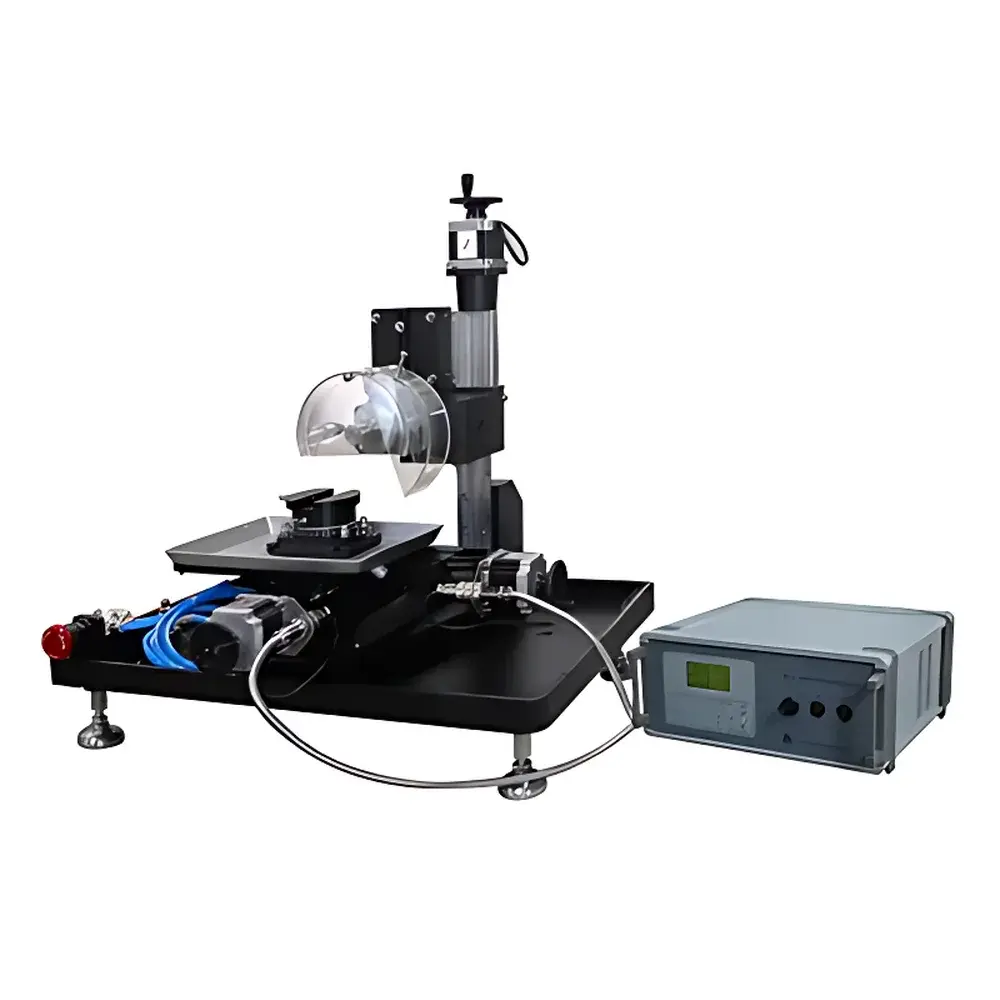
KJ GROUP SYJ-400 CNC Precision Wafer Dicing and Scribing Machine
| Brand | KJ GROUP |
|---|---|
| Origin | Liaoning, China |
| Manufacturer Type | Authorized Distributor |
| Country of Origin | China |
| Model | SYJ-400 |
| Instrument Type | Precision CNC Cutting Machine |
| Control Options | Microcontroller-based Panel or PC-based MTICUT Software (Windows OS, USB interface) |
| Motor Type | High-torque AC Brushless Motor |
| Spindle Speed | 0–3000 rpm, infinitely variable |
| Spindle Power | 180 W |
| X-axis Travel | 210 mm |
| Y-axis Travel | 110 mm |
| Z-axis Travel | 90 mm |
| Max Cutting Depth | 50 mm |
| Positioning Accuracy (X/Y/Z) | 0.01 mm |
| Rotary Stage Range | 360° ±0.5° |
| Sample Stage Dimensions | 80 mm × 25.4 mm |
| Compatible Blade Diameters | Ø100 mm / Ø150 mm (Hub ID: Ø12.7 mm) |
| Cooling | External Circulating Water System (Adjustable Flow via Needle Valve) |
| Enclosure | Integrated Splash Guard |
| Dimensions (W×D×H) | 580 mm × 560 mm × 660 mm |
| Weight | ≈39 kg |
| Operating Environment | 0–45 °C, 10–85% RH (non-condensing) |
| Power Supply | AC220 V, 50 Hz (standard) |
| Required Infrastructure | Tap water inlet & drain outlet |
Overview
The KJ GROUP SYJ-400 CNC Precision Wafer Dicing and Scribing Machine is a compact, CE-certified laboratory-grade cutting system engineered for high-accuracy sectioning, scribing, and grooving of brittle and hard materials. It operates on the principle of controlled mechanical abrasion using diamond-impregnated rotating blades, with motion coordinated across three orthogonal axes (X, Y, Z) and a fully indexed rotary stage. Designed for reproducible micro-sectioning in materials science, semiconductor R&D, geoscience, and ceramic engineering labs, the SYJ-400 delivers sub-10-µm positional repeatability via high-resolution stepper motor drives and rigid mechanical architecture. Its modular control architecture supports both standalone operation via an integrated front-panel interface and advanced programmable workflows via the Windows-based MTICUT software suite—enabling automated multi-pass slicing, depth-controlled scribing, and angular indexing routines without manual intervention.
Key Features
- Three-axis CNC motion system (X: 210 mm, Y: 110 mm, Z: 90 mm) with 0.01 mm step resolution and backlash-compensated lead screws
- 360° precision rotary stage with ±0.5° angular repeatability, enabling oblique-angle cuts and radial segmentation
- Variable-speed brushless spindle (0–3000 rpm, infinitely adjustable) delivering consistent torque across the full speed range
- Dual-control architecture: embedded microcontroller panel for rapid setup or PC-driven MTICUT software (USB-connected) supporting G-code import, macro scripting, and real-time axis monitoring
- Integrated splash guard and adjustable coolant flow valve for directed aqueous cooling—compatible with corrosion-inhibited cutting fluids to prevent linear guide degradation
- Modular blade mounting system supporting Ø100 mm and Ø150 mm diamond blades (hub ID Ø12.7 mm), with quick-change clamping and concentricity alignment fixtures
- Compact footprint (580 × 560 × 660 mm) and low acoustic signature (<65 dB(A) at 1 m), suitable for shared lab environments
Sample Compatibility & Compliance
The SYJ-400 accommodates a broad spectrum of rigid, non-ductile substrates including single-crystal wafers (Si, GaAs, sapphire), technical ceramics (Al₂O₃, SiC, ZrO₂), optical glasses (BK7, fused silica), geological specimens (granite, quartzite, basalt), and metallic alloys (tungsten carbide, Inconel). Material-specific blade selection—including electroplated, sintered, and edge-bonded diamond variants—is supported through standardized arbor geometry and optional blade kits. The system complies with EU Machinery Directive 2006/42/EC and carries CE marking for safe operation within laboratory settings. While not certified to ISO 17025 or GLP as a measurement instrument per se, its deterministic kinematics and traceable positioning enable use in method-validated sample preparation workflows compliant with ASTM E3, ISO 14702, and USP for solid dosage form sectioning.
Software & Data Management
The MTICUT software platform (v3.2+, Windows 10/11 compatible) provides a structured environment for defining cutting sequences, setting depth-of-cut increments, assigning rotational offsets, and scheduling batch operations. All executed programs are timestamped and stored locally with operator ID tagging. Audit trail functionality records parameter changes, emergency stops, and blade runtime—supporting internal QA documentation requirements. Raw coordinate logs (CSV export) and screenshot-based operation snapshots can be archived for process review. The system does not require FDA 21 CFR Part 11 compliance out-of-the-box; however, when deployed in regulated environments, it may be validated alongside site-specific SOPs for sample preparation traceability under GMP Annex 11 or ISO 9001 clause 8.5.2.
Applications
- Preparation of cross-sectional TEM lamellae from polished ceramic composites
- Scribing isolation trenches in photovoltaic cell substrates prior to cleaving
- Sectioning mineral thin sections for petrographic analysis (ASTM D3418)
- Controlled kerf-cutting of sapphire wafers for LED die separation prototyping
- Multi-angle grooving of thermoelectric module substrates for interconnect patterning
- High-reproducibility slicing of metallographic samples for grain structure quantification (ISO 643)
FAQ
What blade types are recommended for silicon wafer dicing?
Electroplated diamond blades (e.g., Ø100 mm × 0.5 mm thickness) are optimal for Si wafers due to their sharp, exposed diamond grit and minimal kerf loss. Sintered variants are preferred for harder ceramics like SiC.
Is the rotary stage calibrated for absolute angular position?
Yes—the stage features an optical encoder with factory calibration traceable to NIST-traceable angle standards; angular deviation remains ≤±0.5° over full 360° rotation.
Can the SYJ-400 integrate with automated fluid recirculation systems?
Yes—optional JXZ-25Y filtration units connect directly via standard 1/4″ BSP ports; flow rate is maintained between 0.5–2.0 L/min using the onboard needle valve.
Does the system support G-code input for custom toolpaths?
MTICUT accepts standard ISO 6983 G-code (G00/G01/G90/G91/G28) with user-defined coordinate offsets and dwell commands; no post-processor required.
What maintenance intervals are recommended for long-term accuracy?
Linear guides and lead screws require lubrication with ISO VG 68 synthetic oil every 100 operational hours; coolant lines should be flushed quarterly; spindle bearing preload is factory-set and non-adjustable.



