
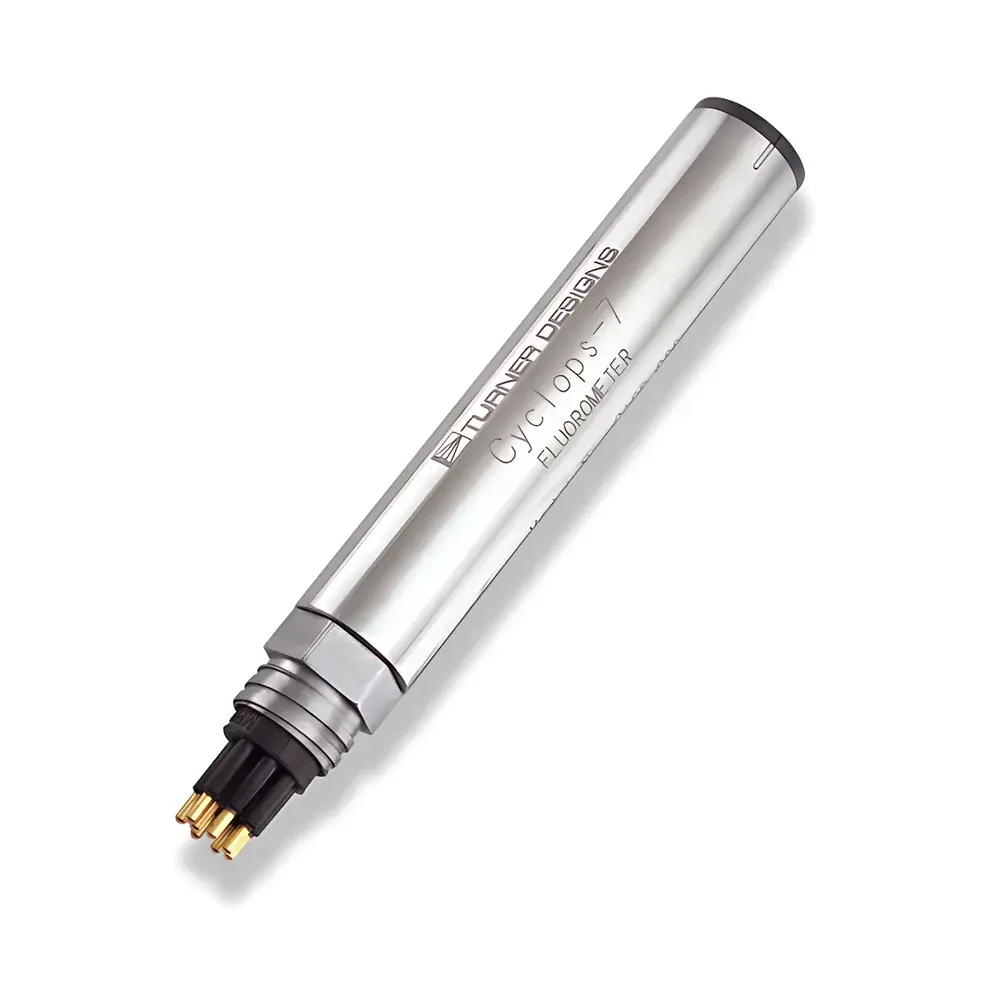
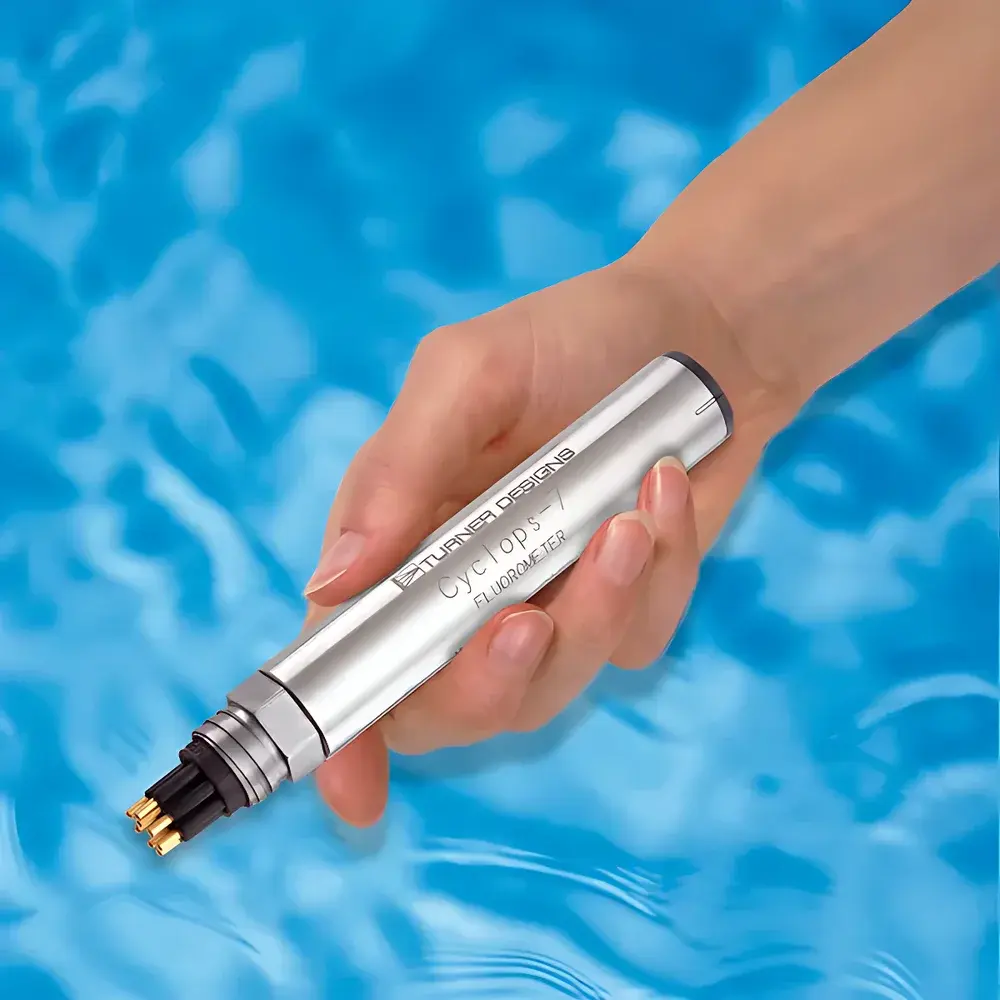
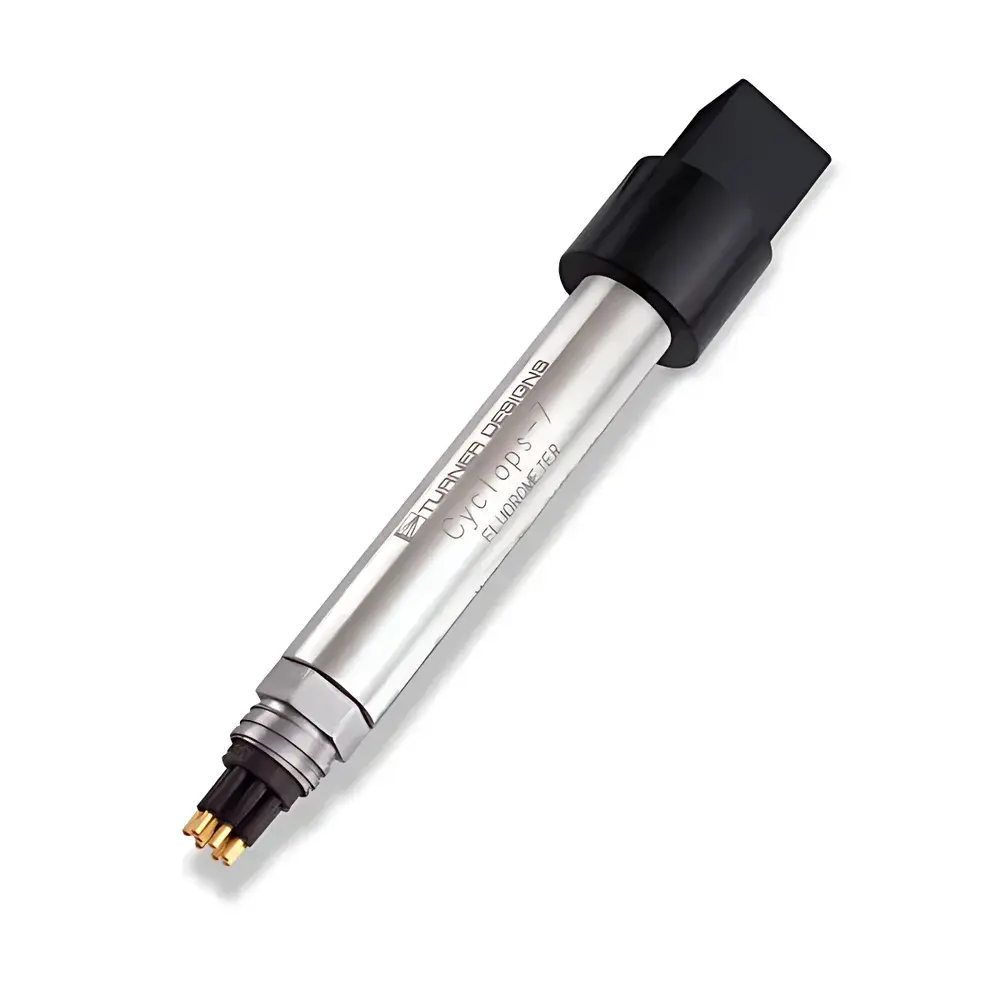
Turner Designs Cyclops-7F Submersible UV Fluorescence Oil-in-Water Sensor
| Brand | Turner Designs |
|---|---|
| Origin | USA |
| Model | Cyclops-7F |
| Instrument Type | Portable |
| Measurement Principle | UV-Induced Fluorescence (PAH-Specific) |
| Measurement Range | 0–2700 ppb (as naphthalene or equivalent PAH standard) |
| Detection Limit | 0.2 ppb |
| Accuracy | ±0.01% FS (Full Scale) |
| Resolution | 0.2 ppb |
| Sampling Frequency | 1 Hz |
| Housing Options | Titanium alloy or high-performance polymer (for corrosion/salinity resistance) |
Overview
The Turner Designs Cyclops-7F is a compact, submersible ultraviolet fluorescence sensor engineered for continuous, in-situ quantification of polycyclic aromatic hydrocarbons (PAHs) and petroleum-derived hydrocarbons in aqueous matrices. Unlike conventional extractive methods relying on solvent-based separation and lab-based GC/FID or UV-Vis spectrophotometry, the Cyclops-7F employs selective UV excitation (typically at 254 nm or 365 nm, depending on configuration) to induce native fluorescence in aromatic oil constituents—primarily naphthalene, phenanthrene, pyrene, and related compounds. Emitted fluorescence intensity (measured at characteristic wavelengths, e.g., 310–410 nm) is linearly correlated with hydrocarbon concentration under calibrated conditions. This optical approach eliminates sample preservation, extraction, and transport delays, enabling real-time detection at the point of interest—whether in pressurized process lines, open-channel effluents, or submerged groundwater wells.
Key Features
- True in-situ operation: Fully submersible design rated to 100 m depth (IP68), permitting direct deployment without sampling pumps or flow cells.
- No reagents or solvents required: Non-destructive, maintenance-light optical measurement compliant with green analytical chemistry principles.
- High temporal resolution: Continuous 1 Hz data acquisition supports rapid leak detection and dynamic plume tracking.
- Ruggedized housing options: Standard stainless-steel body; optional Grade 5 titanium or chemically inert polymer housing for seawater, brine, or acidic/alkaline industrial effluents.
- Integrated temperature compensation: Onboard thermistor enables automatic correction for thermal drift across 0–40 °C operating range.
- Low power consumption: Designed for long-term battery or solar-powered remote monitoring (typical draw < 150 mW during measurement).
Sample Compatibility & Compliance
The Cyclops-7F is validated for use in potable water, cooling tower water, condensate, bilge water, ballast water, and natural surface/groundwater systems. It demonstrates robust performance in high-conductivity (up to 50 mS/cm), high-turbidity (≤ 400 NTU), and saline environments (≤ 35 ppt). While not a direct replacement for EPA Method 1664 or ISO 9377-2 gravimetric oil-in-water analysis, the sensor provides orthogonal, field-deployable screening data traceable to NIST-traceable PAH standards (e.g., naphthalene in methanol). Its output meets data integrity requirements for Tier 1 environmental monitoring per ASTM D7150 and supports compliance workflows aligned with ISO 14001 environmental management systems. For regulated reporting, sensor data may be used as an early-warning trigger for confirmatory laboratory analysis.
Software & Data Management
Raw fluorescence intensity values are transmitted digitally via RS-485 (Modbus RTU), SDI-12, or analog 4–20 mA output. When interfaced with Turner Designs’ Databank handheld logger or third-party SCADA/PLC systems, users access timestamped, temperature-compensated concentration values in ppb. Firmware supports user-defined calibration curves, zero/span verification routines, and configurable alarm thresholds. All data logs include embedded metadata (sensor ID, firmware version, battery voltage, temperature) to satisfy GLP documentation requirements. Optional cloud integration (via compatible gateways) enables secure TLS-encrypted upload to time-series databases supporting audit trails per FDA 21 CFR Part 11 guidelines.
Applications
- Early leak detection in refinery condensate return lines and steam trap discharge points.
- Real-time monitoring of aircraft fuel hydrant systems and ramp drainage at airports.
- Bilge and ballast water compliance screening aboard commercial vessels (MEPC.207(62)-aligned operational monitoring).
- Groundwater plume delineation at legacy UST (underground storage tank) sites contaminated with diesel, gasoline, or crude oil.
- Process water quality assurance in pharmaceutical cooling loops and semiconductor fab ultrapure water recirculation systems.
- Long-term ecological assessment of PAH loading in estuarine and coastal zones impacted by shipping or offshore operations.
FAQ
Does the Cyclops-7F measure total petroleum hydrocarbons (TPH) or only PAHs?
It responds selectively to fluorescent aromatic compounds—primarily low-to-mid molecular weight PAHs (e.g., naphthalene, fluorene, phenanthrene). Aliphatic hydrocarbons (e.g., hexadecane) produce negligible signal and are not quantified.
Can it be deployed in wastewater with high suspended solids?
Yes—its optical path is short (3–5 mm) and self-cleaning flow dynamics minimize fouling; however, routine manual cleaning is recommended in >100 NTU environments.
Is factory calibration sufficient for regulatory reporting?
Field calibration using site-specific reference standards (e.g., diesel-in-water emulsions) is strongly advised prior to critical deployments; certificate of calibration is provided with each unit.
What is the expected service life of the UV LED and photodetector?
LED lifetime exceeds 20,000 hours at nominal drive current; photodiode stability is verified over 5-year accelerated aging tests.
Does it require annual recalibration?
Turner Designs recommends functional verification every 6 months and full recalibration every 12–24 months, depending on exposure severity and QA/QC program requirements.
Related Products







