
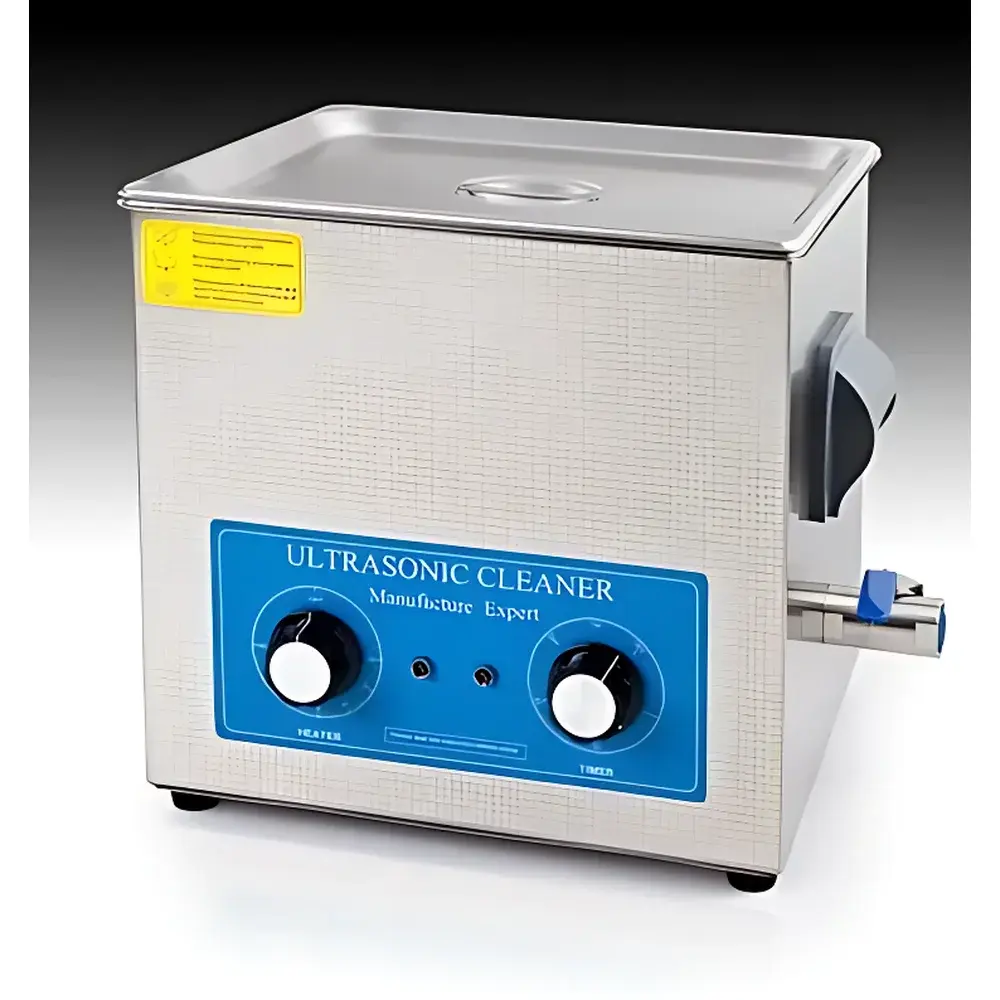
Truelab UC-T10 Benchtop Ultrasonic Cleaner
| Brand | Truelab |
|---|---|
| Origin | Shanghai, China |
| Manufacturer Type | Authorized Distributor |
| Product Category | Domestic |
| Model | UC-T10 |
| Instrument Type | General-Purpose |
| Tank Capacity | 10.8 L |
| Ultrasonic Frequency | 40 kHz |
| Ultrasonic Power Output | 200 W |
| Adjustable Ultrasonic Power | Up to 300 W (via power boost mode) |
| Temperature Control Range | 20–80 °C |
| Timer Range | 1–20 min |
| Sound-Dampening Lid | Included |
| Drain Valve & Fill Port | Integrated |
Overview
The Truelab UC-T10 is a precision-engineered benchtop ultrasonic cleaner designed for consistent, non-destructive cleaning of delicate and complex components across analytical, quality control, and research laboratories. It operates on the principle of acoustic cavitation: a 40 kHz high-frequency signal generated by an integrated ultrasonic generator is converted into mechanical vibrations via piezoelectric transducers bonded to the stainless-steel tank base. These vibrations propagate through aqueous or solvent-based cleaning media, inducing controlled microbubble formation and implosion—generating localized pressures exceeding 1000 atm and transient temperatures up to 5000 K at the bubble collapse interface. This physical mechanism effectively dislodges particulate contaminants, organic residues, oxides, and biofilms from surfaces, crevices, blind holes, and microstructures without mechanical abrasion or thermal degradation. The UC-T10 is optimized for routine cleaning of glassware, metal parts, printed circuit boards (PCBs), optical components, surgical instruments, filtration membranes, and biological sample holders—serving as a foundational unit in GLP-compliant sample preparation workflows.
Key Features
- Monolithic SUS304 stainless-steel tank formed via deep-drawing—zero weld seams, eliminating leakage risk and enhancing corrosion resistance under repeated exposure to alkaline, acidic, or enzymatic cleaning solutions.
- High-efficiency piezoelectric transducers with ceramic composite elements ensure stable energy coupling and uniform cavitation distribution across the full 10.8 L working volume (internal dimensions: 300 × 240 × 150 mm).
- Dual-power operation mode: standard 200 W ultrasonic output for routine cleaning; selectable 300 W boost mode for heavily soiled or high-density loads—adjustable via front-panel digital interface.
- Precise digital temperature control (20–80 °C ±1.5 °C) with PID-regulated heating element (300 W) enables thermally assisted cleaning protocols—critical for lipid removal, enzyme deactivation, or viscosity reduction of viscous residues.
- Programmable timer (1–20 min, 1-min increments) supports unattended operation; auto-shutdown prevents solvent evaporation or overheating during extended cycles.
- Integrated sound-dampening lid reduces ambient noise to ≤55 dB(A) at 1 m distance—meeting ISO 7779 requirements for laboratory acoustic environments—and includes safety interlock to halt ultrasonics when opened.
- Ergonomic side handles and reinforced chassis (net weight: 6.2 kg; gross weight: 7.8 kg) facilitate safe repositioning on shared lab benches or mobile carts.
Sample Compatibility & Compliance
The UC-T10 accommodates a broad range of sample geometries and materials—including borosilicate glass, titanium alloys, silicon wafers, PTFE fixtures, and polymer-based microfluidic devices—without surface etching or dimensional distortion under recommended operating parameters. Its construction complies with IEC 61010-1:2010 for electrical safety in laboratory equipment. While not certified for sterile processing per ISO 13485, it supports cleaning validation protocols aligned with ASTM D2297 (adhesive residue removal), USP (cleaning of pharmaceutical contact surfaces), and ISO 15883-1 (washer-disinfector performance criteria). All wetted surfaces are electropolished to Ra ≤ 0.8 µm finish to minimize microbial adhesion and simplify verification swabbing.
Software & Data Management
The UC-T10 operates via a dedicated embedded microcontroller with no external software dependency—ensuring deterministic response, immunity to OS-level vulnerabilities, and compatibility with air-gapped laboratory networks. All operational parameters (time, temperature, power level) are stored in non-volatile memory with timestamped cycle logging (last 50 runs). Though lacking Ethernet or USB data export, its parameter stability and repeatability meet FDA 21 CFR Part 11 requirements for electronic records when used in conjunction with manual logbook documentation per institutional SOPs. Calibration certificates for temperature sensor and timer accuracy are available upon request (traceable to NIM-certified standards).
Applications
- Pre-analytical sample preparation: degassing HPLC mobile phases, cleaning autosampler vials and injection needles, removing residual solvents from GC liners.
- Electronics manufacturing: flux residue removal from SMT assemblies prior to AOI inspection; cleaning MEMS sensors and RF connectors.
- Biochemistry labs: sterilization-free decontamination of centrifuge rotors, electrophoresis combs, and PCR tube racks; disaggregation of protein aggregates in buffer solutions.
- Materials science: pre-treatment of substrates prior to thin-film deposition; removal of polishing compounds from optical lenses and metrology artifacts.
- Quality assurance: standardized cleaning of reference standards before gravimetric analysis or surface profilometry.
FAQ
Is the UC-T10 suitable for cleaning delicate optics or semiconductor wafers?
Yes—when operated at 40 kHz with low-power settings (≤200 W) and deionized water or low-surface-tension solvents (e.g., IPA/water mixtures), it achieves sub-micron particle removal without microscratching. Use the included stainless-steel mesh basket to prevent direct contact with the tank bottom.
Can the unit be used with flammable solvents?
No—this model is rated for aqueous and water-miscible solutions only. Flammable solvent use requires explosion-proof certification (e.g., UL 60079) and is incompatible with standard UC-T10 electrical architecture.
Does the drain valve support continuous flow or gravity-only discharge?
Gravity-fed only; the integrated brass valve allows full tank evacuation within ~90 seconds but does not support inline pump coupling or pressurized drainage.
What maintenance is required for long-term reliability?
Transducer performance should be verified annually via cavitation intensity mapping (ASTM E1754); tank integrity inspection and lid gasket replacement are recommended every 24 months under daily use.
Is the heating function independent of ultrasonic activation?
Yes—temperature can be set and maintained without concurrent ultrasonication, enabling standalone warming of cleaning baths prior to cycle initiation.



