
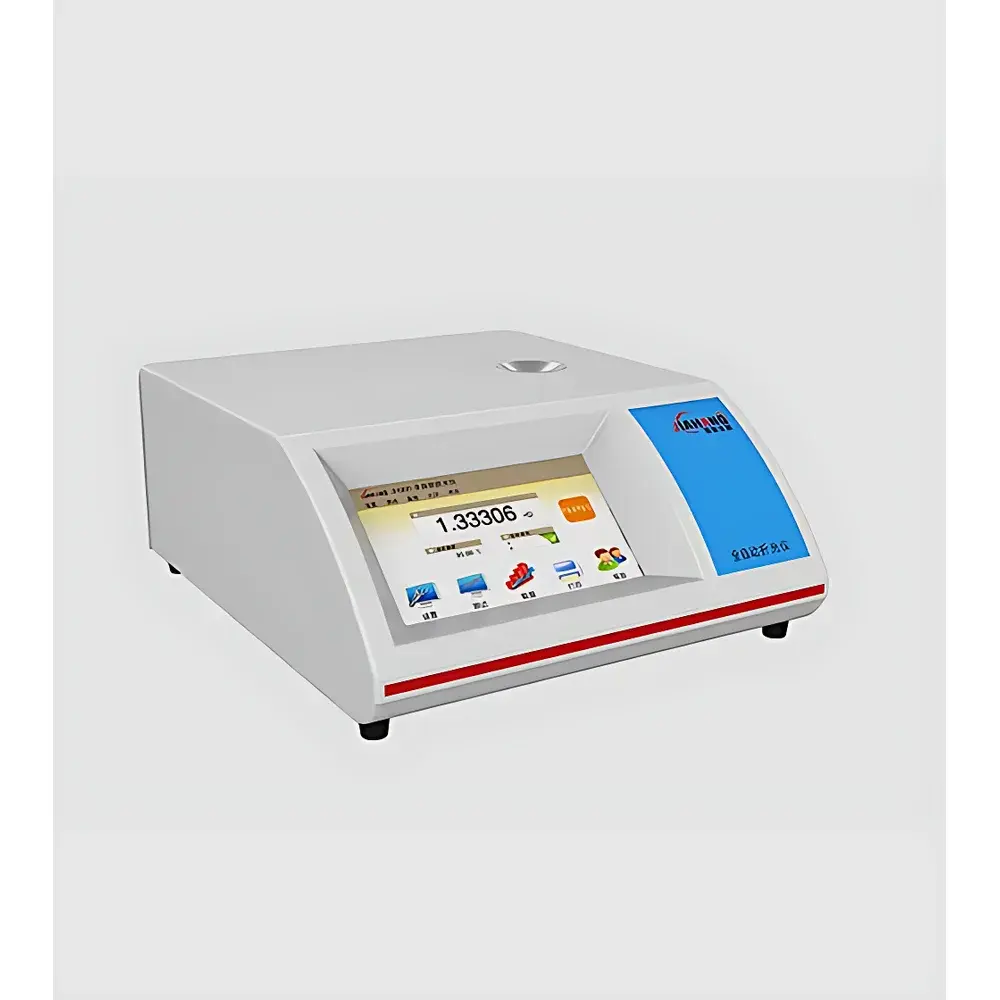
Truelab JH200 Advanced Digital Refractometer (with JH300/JH500/JH600 Model Variants)
| Brand | Truelab |
|---|---|
| Origin | Shanghai, China |
| Instrument Type | Benchtop Digital Refractometer |
| Measurement Range | 1.3000–1.7000 (nD) |
| Accuracy | ±0.0002 (nD) |
| Brix Range | 0–100% |
| Brix Accuracy | ±0.1% |
| Light Source | LED at 589 nm |
| Prism Material | Sapphire-grade optical prism |
| Sample Cell | Stainless steel |
| Detection Method | Linear CCD array |
| Display | Full-color TFT touchscreen |
| Data Interfaces | USB & RS-232 |
| Power Supply | 220 V / 50 Hz |
| Temperature Control | None (ambient-only operation) |
| Compliance | Designed for ISO 21747, ASTM D1218, and USP <831> refractive index methodology |
Overview
The Truelab JH200 Advanced Digital Refractometer is a precision benchtop instrument engineered for rapid, repeatable measurement of refractive index (nD) and mass fraction of aqueous sugar solutions (Brix %) in industrial quality control and academic research laboratories. Based on the principle of total internal reflection at a solid–liquid interface, the instrument utilizes a high-stability 589 nm monochromatic LED light source—aligned to the sodium D-line standard—to illuminate a sapphire-grade prism surface. A linear CCD sensor captures the critical angle boundary with sub-pixel resolution, enabling digital interpolation and real-time calculation of nD values across the full 1.3000–1.7000 range. Unlike traditional Abbe refractometers requiring manual scale reading and subjective endpoint judgment, the JH200 automates optical alignment, signal acquisition, and thermal equilibrium assessment—delivering objective, operator-independent results within 3–5 seconds per measurement. Its ambient-temperature-only design reflects a deliberate engineering choice for cost-sensitive, high-throughput environments where strict temperature regulation is not mandated by application or regulatory protocol.
Key Features
- High-fidelity sapphire prism with exceptional scratch resistance and long-term optical stability under repeated cleaning and aggressive sample exposure
- Linear CCD detection system with 2048-pixel resolution ensures consistent critical angle determination—even for turbid, deeply colored, or viscous samples (e.g., molasses, crude oil fractions, polymer solutions)
- Full-color TFT capacitive touchscreen interface with intuitive icon-driven navigation and multilingual UI support (English, Spanish, German, Chinese)
- Built-in Brix calibration curve compliant with ICUMSA Methods GS2/3-15 and AOAC 932.12 for direct % w/w output without manual conversion
- Dual data export capability via USB mass storage mode and RS-232 serial communication—compatible with LIMS integration and automated report generation
- Robust stainless-steel sample well designed for easy cleaning, minimal carryover, and compatibility with solvents including ethanol, acetone, and chlorinated hydrocarbons
Sample Compatibility & Compliance
The JH200 accommodates transparent, translucent, opaque, and highly viscous liquid samples without dilution or filtration—enabling direct analysis of undiluted fruit concentrates, pharmaceutical syrups, biodiesel blends, and essential oils. It meets fundamental metrological requirements outlined in ISO 21747:2020 (Refractometers — Vocabulary and general principles), ASTM D1218 (Standard Test Method for Refractive Index of Hydrocarbon Liquids), and USP (Refractive Index). While lacking active Peltier temperature control, its ambient-operational architecture aligns with applications governed by ASTM D1747 (for automotive fluids) and ISO 5661 (for edible oils), where measurements are explicitly specified at laboratory ambient conditions (typically 20 °C ± 2 °C). All firmware and calibration routines are traceable to NIM (National Institute of Metrology, China) reference standards.
Software & Data Management
The embedded operating system supports up to 1,000 stored measurement records with timestamp, operator ID (user-defined), sample ID, nD, Brix, and pass/fail status flags. Data export generates CSV files compatible with Excel, JMP, and Minitab for SPC charting and statistical process validation. USB interface permits firmware updates and configuration backup; RS-232 enables bidirectional command-response protocols (SCPI-like syntax) for integration into automated test sequences. Audit trail functionality logs all calibration events, parameter changes, and user logins—supporting GLP-compliant documentation practices. No proprietary software installation is required for basic operation or data retrieval.
Applications
- Food & Beverage: Brix verification in juice, syrup, dairy, and fermented beverage production lines
- Pharmaceuticals: Excipient concentration checks (e.g., glycerin, propylene glycol) and API solution strength screening
- Petrochemicals: Hydrocarbon classification, solvent purity assessment, and blending ratio verification
- Chemical Manufacturing: Quality release testing of surfactants, resins, and glycol-based antifreezes
- Academic Research: Teaching labs for physical chemistry and food science curricula; method development for novel biopolymer characterization
FAQ
Does the JH200 support temperature-controlled measurements?
No—the JH200 operates exclusively at ambient laboratory temperature and does not include Peltier or water-jacketed temperature regulation. For temperature-dependent applications, users must control room conditions per ISO 21747 Clause 6.2.
Can the instrument measure non-aqueous solutions such as ethylene glycol or silicone oil?
Yes—provided the sample wets the sapphire prism uniformly and remains optically homogeneous during measurement. Viscosity up to 5,000 mPa·s is routinely supported.
Is Brix measurement limited to sucrose solutions?
The built-in Brix scale is calibrated against sucrose standards per ICUMSA guidelines. For non-sucrose systems (e.g., fructose-rich HFCS), users may apply correction factors or define custom calibration curves via the advanced settings menu.
What is the recommended maintenance interval for the sapphire prism?
No scheduled maintenance is required. Clean with lint-free tissue and reagent-grade isopropanol after each use; avoid abrasive cleaners or ultrasonic baths.
How is measurement traceability ensured?
Each unit ships with a factory calibration certificate referencing NIM-traceable refractive index standards (nD = 1.4325, 1.4890, and 1.5230 at 20 °C), valid for 12 months under normal operating conditions.





