
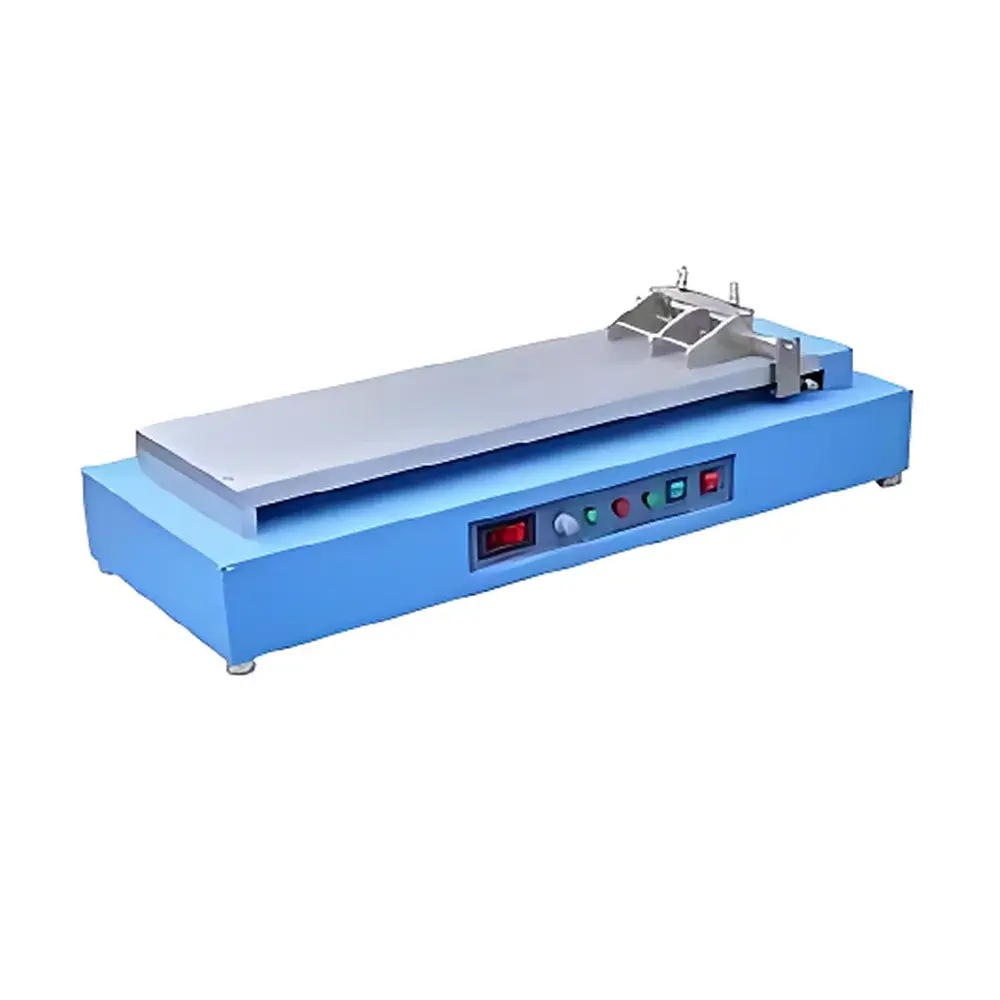
KJ GROUP MSK-AFA-L800 Doctor Blade Coating System
| Brand | KJ GROUP |
|---|---|
| Origin | Liaoning, China |
| Manufacturer Type | Authorized Distributor |
| Country of Origin | China |
| Model | MSK-AFA-L800 |
| Pricing | Available Upon Request |
| Power Supply | AC 110/220 V, 50/60 Hz |
| Total Power Consumption | 150 W |
| Coating Speed | 10–100 mm/s (adjustable) |
| Coating Stroke | 10–800 mm |
| Vacuum Platen Dimensions | 800 × 260 mm |
| Effective Vacuum Area | 740 × 218 mm |
| Micrometer-Adjustable Doctor Blade | 180 mm length, 0.01–5 mm gap range |
| Film Thickness Accuracy | ±0.01 mm |
| Footprint | 960 × 370 × 240 mm |
| Weight | 50 kg |
| Operating Environment | Altitude < 1000 m, Temperature 10–40 °C, Relative Humidity 45–65 % RH |
Overview
The KJ GROUP MSK-AFA-L800 Doctor Blade Coating System is a precision-engineered laboratory-scale film coating instrument designed for reproducible, uniform thin-film deposition via the doctor blade (or knife-over-edge) method. It operates on the principle of controlled fluid shear between a fixed, adjustable blade and a moving substrate under vacuum-assisted immobilization. Unlike roller or slot-die systems, this platform relies on gravity-fed slurry flow and mechanical gap regulation to define wet film thickness—making it especially suitable for viscous, non-Newtonian electrode slurries used in battery R&D. The system integrates a dry, oil-free vacuum pump (AP-1400V, optional) and a rigid aluminum vacuum platen (740 × 218 mm active area), eliminating hydrocarbon contamination risks common with oil-lubricated pumps. Its fixed-width architecture maintains consistent lateral dimensionality across the full 800 mm coating length, enabling scalable process mapping from lab to pilot line.
Key Features
- Vacuum-based substrate fixation using an oil-free vacuum pump ensures zero risk of hydrocarbon residue on sensitive electrochemical substrates such as copper/aluminum foils or polymer films.
- Micrometer-adjustable doctor blade (180 mm standard; optional lengths up to 250 mm) enables precise gap control from 0.01 mm to 5.00 mm in 1 µm increments—critical for tuning solid loading and drying stress in Li-ion electrode layers.
- Motorized linear drive with programmable stroke limits (10–800 mm) and variable speed control (10–100 mm/s) supports both rapid screening and slow, high-viscosity coating protocols.
- Modular blade configuration options include dual-blade, vertically adjustable, laterally offset, and frame-mounted variants—facilitating multi-layer sequential coating or edge-defined patterning.
- CE-certified electrical architecture complies with EN 61000-6-2 (immunity) and EN 61000-6-4 (emission) standards; all safety interlocks meet IEC 61508 SIL1 requirements.
Sample Compatibility & Compliance
The MSK-AFA-L800 accommodates rigid and semi-flexible substrates up to 250 mm wide and 800 mm long—including metal foils (Cu, Al), PET/PI films, glass plates, and ceramic substrates—provided surface flatness remains within ±15 µm over the coated area. Substrate clamping is achieved exclusively through negative pressure (< −80 kPa), eliminating mechanical clamps that induce localized deformation or edge lift. All wetted components (blades,料盅, collection trays) are constructed from 316 stainless steel or anodized aluminum to resist corrosion from aqueous or NMP-based slurries. The system supports GLP-compliant documentation when paired with external data loggers; while not inherently 21 CFR Part 11 compliant, its analog speed/thickness controls may be integrated into validated LIMS environments via optional 0–10 V analog I/O interfaces.
Software & Data Management
The MSK-AFA-L800 operates via front-panel digital controls with LED indicators for vacuum status, motor direction, and stroke position. No embedded firmware or proprietary software is required for basic operation—ensuring long-term maintainability and compatibility with legacy lab infrastructure. Optional RS-485 Modbus RTU interface enables integration with SCADA or MES platforms for batch traceability. For R&D labs requiring audit-ready records, third-party acquisition systems (e.g., LabVIEW, Python + PySerial) can log real-time speed, stroke, vacuum level, and ambient temperature—supporting ISO/IEC 17025 method validation workflows. Calibration certificates for micrometer dials and speed encoders are available upon request.
Applications
This system is routinely deployed in academic and industrial laboratories for: electrode fabrication for lithium-ion, solid-state, and sodium-ion batteries; functional layer deposition in perovskite photovoltaics; dielectric and conductive ink patterning for flexible electronics; ceramic green tape casting; and pharmaceutical film-coating process development (e.g., sustained-release matrix tablets). Its ability to produce films with thickness repeatability of ±0.01 mm across 800 mm lengths makes it ideal for evaluating slurry rheology–coating correlations, binder migration effects, and drying-induced cracking thresholds—key parameters in DOE-driven formulation optimization.
FAQ
What substrate materials are compatible with the vacuum platen?
Standard compatibility includes Cu/Al foil (≥6 µm), PET (≥25 µm), PI (≥12.5 µm), borosilicate glass (≥0.7 mm), and sintered ceramic sheets—provided surface roughness Ra ≤ 0.8 µm and no through-holes larger than 50 µm.
Can the system coat multiple layers without breaking vacuum?
Yes—by integrating optional dual-blade or vertically stacked blade modules, sequential wet-on-wet or dry-on-dry multilayer architectures can be realized without releasing vacuum or repositioning the substrate.
Is NMP-resistant blade sealing available?
All standard blades feature PTFE-faced elastomeric gaskets rated for continuous exposure to NMP, DMF, and water at temperatures up to 60 °C.
What maintenance intervals are recommended for the vacuum pump?
The AP-1400V oil-free diaphragm pump requires only annual inspection of inlet filters and check valves; no lubrication or oil changes are necessary.
Does the system support automated recipe storage?
Not natively—but external PLC or PC-based controllers can store and recall up to 99 parameter sets (speed, stroke, dwell time) via Modbus register mapping.



