
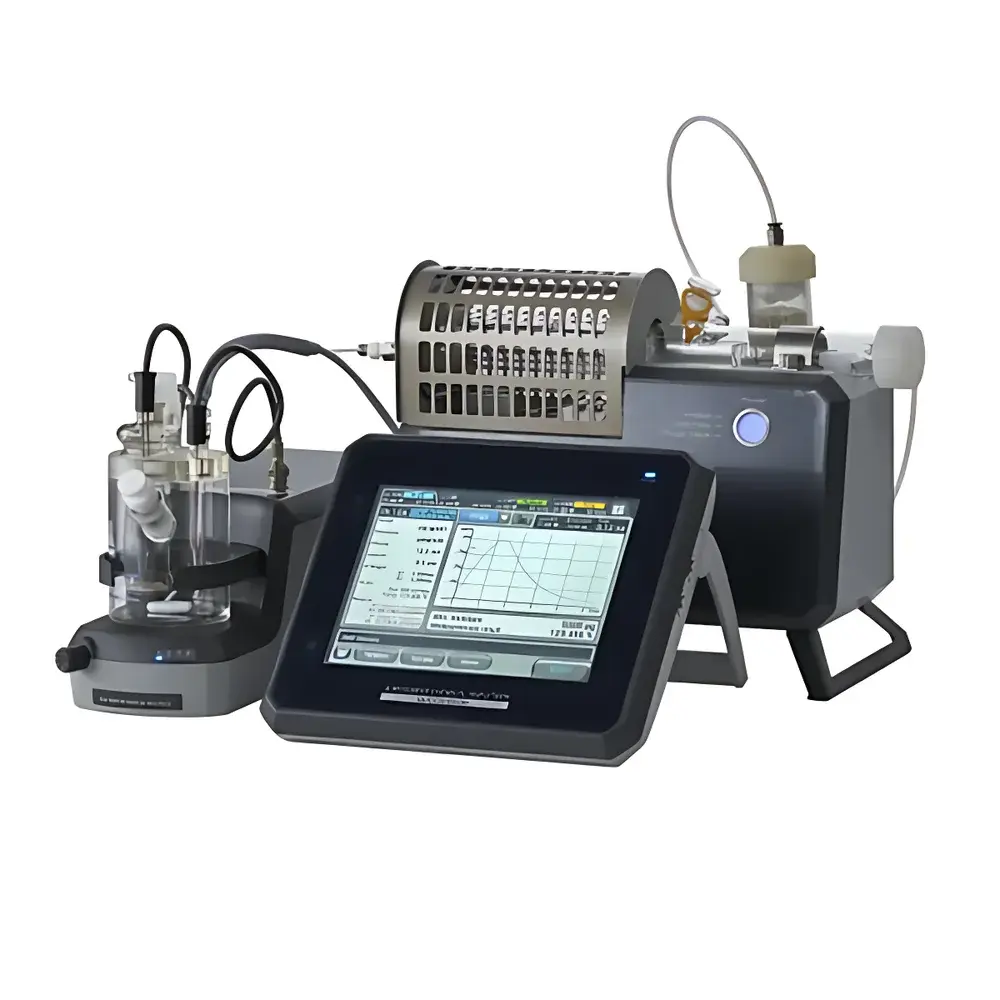
Nittoseiko Analytech CA-310 Coulometric Karl Fischer Moisture Analyzer
| Brand | Nittoseiko Analytech |
|---|---|
| Origin | Japan |
| Model | CA-310 |
| Titration Method | Fully Automated Coulometric Titration |
| Instrument Type | Coulometric Karl Fischer Moisture Analyzer |
| Measurement Resolution | 0.01 µg |
| Water Content Range | 10 µg – 100 mg |
| Sensitivity | 0.1 µg H₂O |
| Precision | ±3 µg (for samples containing 10 µg – 1 mg or more water) |
| Repeatability | ≤0.3% RSD (for ≥1 mg water) |
| Maximum Electrolysis Current | 430 mA |
| Maximum Titration Rate | 2.2 mg H₂O/min (36 µg H₂O/sec) |
| Background Compensation | Automatic real-time correction with continuous display (µg H₂O/sec) |
| Stirring Method | Magnetic stirring |
| Cell Capacity | 150 mL |
| Display | 5.7-inch color LCD |
| Data Storage | Up to 200 measurement records |
| Internal Memory Backup | >2 months on full charge |
| Power Supply | AC 220–240 V, 50/60 Hz, 310 VA |
| Operating Temperature | 5–40 °C |
| Operating Humidity | ≤85% RH (non-condensing) |
| Dimensions (Main Unit) | 330 × 320 × 148 mm |
| Weight (Main Unit) | ~5 kg |
Overview
The Nittoseiko Analytech CA-310 is a high-precision, single-channel coulometric Karl Fischer moisture analyzer engineered for trace-level water quantification in demanding laboratory and quality control environments. Based on the electrochemical principle of coulometric titration—where iodine is generated *in situ* via controlled electrolysis of iodide ions—the CA-310 delivers exceptional sensitivity and reproducibility for samples containing ultra-low water concentrations. Unlike volumetric KF systems, the coulometric method eliminates reagent standardization and syringe-related errors, making it ideal for applications requiring sub-microgram detection limits. The instrument implements constant-current polarization detection with pulse-controlled electrolysis current, ensuring stable endpoint determination and minimizing over-titration artifacts. Its design reflects Nittoseiko’s legacy in analytical instrumentation, incorporating robust hardware architecture, real-time background drift compensation, and rigorous adherence to metrological best practices.
Key Features
- High-resolution coulometric detection with 0.01 µg measurement resolution and 0.1 µg absolute sensitivity—validated per ISO 8533 and ASTM E203 guidelines.
- Real-time background correction algorithm continuously monitors and subtracts ambient moisture ingress (displayed as µg H₂O/sec), enhancing accuracy in low-water matrices.
- 5.7-inch full-color LCD interface with intuitive navigation, multi-language support (English, Japanese, Chinese), and context-sensitive on-screen help system.
- Dual USB ports: one dedicated for data export (CSV/Excel-compatible) and firmware updates; the other configurable for direct thermal printer connection (58 mm paper width).
- Integrated electrode self-cleaning function—automatically applies reverse-polarity pulses during idle periods to prevent iodine deposition and maintain electrode response stability.
- GLP/GMP-compliant operation: automatic timestamping (year/month/day/hour/minute/second), audit-ready data logging, user access levels, and electronic signature support via optional PC software.
- Expandable architecture supporting dual-cell configurations (e.g., simultaneous analysis of solid and liquid samples) and optional RS-232 or USB-to-PC connectivity for LIMS integration.
Sample Compatibility & Compliance
The CA-310 accommodates a broad spectrum of sample types—including pharmaceutical excipients, lithium battery electrolytes, polymer granules, solvents, oils, and hygroscopic powders—via direct injection, oven coupling (optional), or gas-phase extraction. Its 150 mL titration cell enables stable long-duration analyses while minimizing vapor-phase interference. All operational parameters comply with regulatory expectations for analytical instrumentation under FDA 21 CFR Part 11 (when used with validated software), USP , EP 2.5.12, and JP 2.05. Built-in self-diagnostic routines verify display integrity, printer functionality, memory consistency, and titration performance prior to each assay—ensuring consistent readiness for regulated workflows.
Software & Data Management
Data handling follows ALCOA+ principles: attributable, legible, contemporaneous, original, accurate, complete, consistent, enduring, and available. Each measurement record includes sample ID, operator ID, date/time stamp, cell status, background drift value, titration curve metadata, and final moisture content with uncertainty estimation. Up to 200 results are stored internally; external export supports batch transfer to network drives or LIMS via USB mass storage mode. Statistical functions include mean, SD, RSD, confidence intervals, and re-calculation using internal/external standards. Customizable report templates meet internal SOP requirements and external audit documentation standards.
Applications
- Pharmaceutical QC: Residual moisture testing of lyophilized APIs per ICH Q5C and compendial monographs.
- Battery materials: Quantification of trace water in LiPF₆-based electrolytes where <10 ppm H₂O impacts SEI formation and cycle life.
- Polymer manufacturing: In-process verification of drying efficiency for PET, PA6, and PEEK resins prior to extrusion.
- Chemical synthesis: Monitoring water content in Grignard reagents, organolithium compounds, and catalyst precursors.
- Fuel and lubricant testing: Detection of free water in aviation turbine fuels (ASTM D6304) and transformer oils (IEC 60814).
FAQ
What distinguishes coulometric from volumetric Karl Fischer titration?
Coulometric KF generates iodine electrochemically within the titration cell, enabling precise, reagent-free quantification down to 0.1 µg water. Volumetric KF relies on standardized iodine-containing solutions and is better suited for higher water concentrations (>100 µg).
Does the CA-310 support dual-channel operation out of the box?
The base CA-310 is a single-channel system; dual-cell capability requires optional hardware expansion modules and corresponding firmware licensing.
How is GLP compliance enforced on the CA-310?
Through mandatory electronic signatures (with password protection), immutable timestamping, full audit trail of method changes and calibration events, and secure data archiving with checksum validation.
Can the instrument interface with an analytical balance automatically?
Yes—via built-in RS-232 balance interface; sample weight is auto-imported upon stabilization, eliminating manual entry errors and supporting 21 CFR Part 11 data integrity requirements.
What maintenance protocols are recommended for long-term reliability?
Daily: Verify background drift (<0.5 µg H₂O/sec); weekly: Clean cathode/anode electrodes with dry nitrogen; quarterly: Replace molecular sieve desiccant in the reagent bottle and confirm cell seal integrity.





