
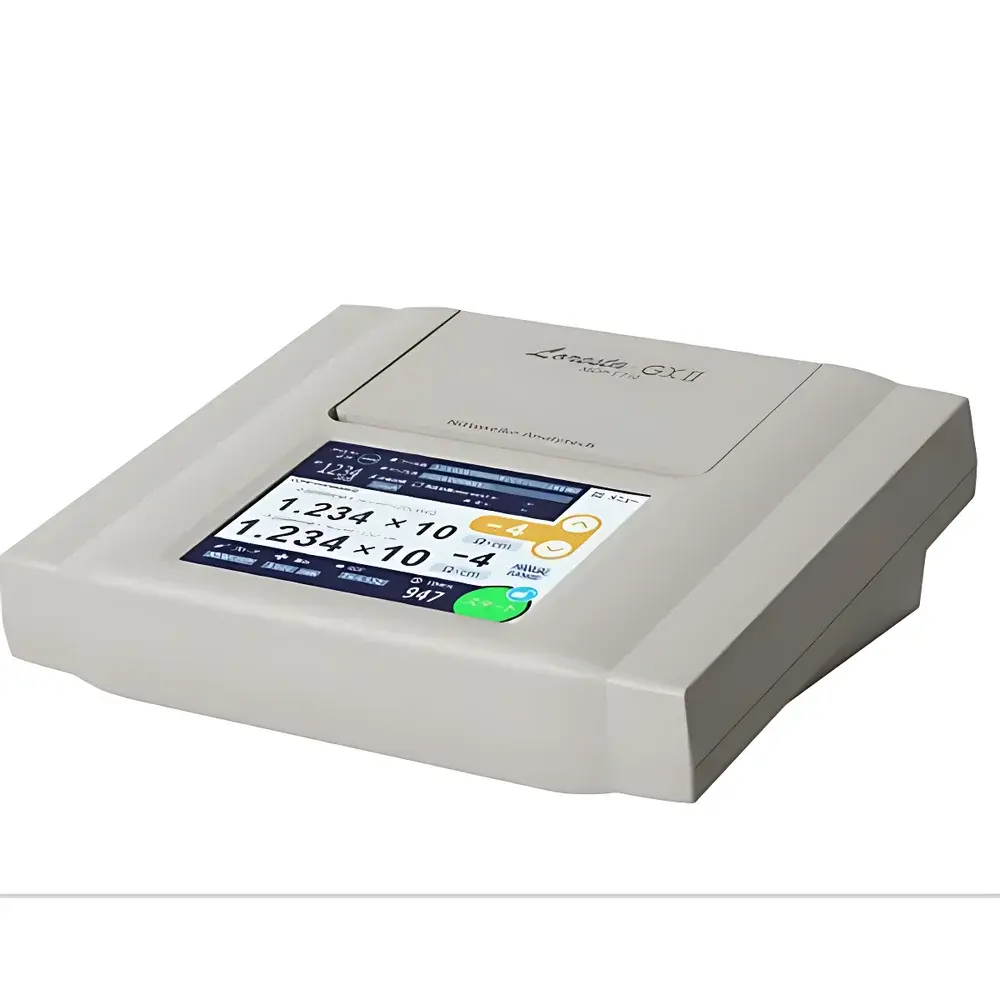
Nittoseiko Analytech MCP-T710 Low-Resistance Surface Resistivity Tester
| Brand | Nittoseiko Analytech |
|---|---|
| Origin | Japan |
| Model | MCP-T710 |
| Display | 7.5-inch true-color TFT-LCD (640×480), capacitive touch interface |
| Measurement Principle | Four-point probe (4-pin) |
| Resistance Range | 1.0×10⁻⁸ Ω to 9.999×10⁷ Ω |
| Test Modes | Auto-hold, Timer-controlled, Polarity-reversible current sourcing |
| Probe Compatibility | Interchangeable MCP-series gold-plated spring-loaded probes |
| Contact Pressure & Spacing | Fixed and calibrated |
| RCF Calculation | Automatic, based on sample geometry |
| Units | Ω, Ω/sq, Ω·cm, S/cm |
| Data Interface | USB 2.0 for export and archival |
| Compliance | Designed for ISO/IEC 17025-aligned QC labs |
Overview
The Nittoseiko Analytech MCP-T710 is a precision four-point probe (4PP) surface resistivity tester engineered for high-reproducibility low-resistance characterization of conductive and semi-conductive thin films, coatings, and bulk materials. Unlike two-point methods, the 4PP configuration decouples contact resistance and lead resistance from the measurement—enabling accurate quantification of sheet resistance (Ω/sq), volume resistivity (Ω·cm), and conductivity (S/cm) across an extended dynamic range from 10⁻⁸ Ω to 10⁷ Ω. The instrument operates on constant-current sourcing with polarity-reversible excitation, minimizing thermoelectric offset errors and enabling reliable assessment of anisotropic or asymmetric interfaces. Its architecture complies with fundamental metrological requirements defined in ASTM F390, IEC 62607-4-2, and JIS K 7194 for surface electrical property evaluation, making it suitable for R&D laboratories, production line QA/QC stations, and third-party testing facilities operating under ISO/IEC 17025 accreditation.
Key Features
- True four-point probe measurement with fixed-pitch, gold-plated spring-loaded probes—ensuring consistent contact pressure (±0.5 N) and inter-probe spacing (1.0 mm standard, configurable per MCP probe variant)
- 7.5-inch capacitive touchscreen interface (640×480 resolution) with intuitive icon-driven navigation, real-time waveform preview, and on-screen calibration prompts
- Dual operational modes: Auto-hold (freezes reading upon stabilization) and Timer mode (user-defined test duration from 0.1 s to 999 s)
- Automatic Resistivity Correction Factor (RCF) computation based on user-input sample geometry (diameter, thickness, or rectangular dimensions), eliminating manual correction tables
- Reversible DC current polarity to suppress Seebeck-induced drift and improve measurement fidelity on heterogeneous or layered substrates
- Multi-unit display and export: selectable units include ohms (Ω), ohms per square (Ω/sq), ohm-centimeters (Ω·cm), and siemens per centimeter (S/cm)
- USB 2.0 port supporting CSV-formatted data export with embedded metadata: operator ID, timestamp, probe ID, test mode, RCF value, and raw voltage/current pairs
Sample Compatibility & Compliance
The MCP-T710 accommodates flat, rigid, or moderately flexible planar specimens up to 200 mm in diameter or linear dimension. It is validated for use with conductive polymers, ITO-coated glass, sputtered metal films, electroplated alloys (e.g., Mg–Ni, Cu–Sn), antistatic laminates, EMI shielding composites, carbon-loaded elastomers, and doped silicon wafers. All probe interchangeability follows Nittoseiko’s MCP mechanical interface standard (MCP-100 series), ensuring repeatable probe alignment and thermal stability during extended operation. The system meets electromagnetic compatibility (EMC) requirements per IEC 61326-1 and is designed to support audit-ready documentation under FDA 21 CFR Part 11 when paired with validated laboratory information management systems (LIMS). Calibration certificates are traceable to NMIJ (National Metrology Institute of Japan) standards.
Software & Data Management
No proprietary PC software is required for basic operation—the MCP-T710 functions autonomously with onboard firmware v3.2+. However, optional Nittoseiko DataLink Utility (Windows-compatible) enables batch analysis, statistical process control (SPC) charting, and PDF report generation with embedded digital signatures. All stored measurements include immutable fields: date/time stamp (RTC-backed), operator code, probe serial number, ambient temperature/humidity (via optional external sensor input), and RCF derivation logic. Data files adhere to ISO/IEC 17025 clause 7.5.2 for record retention integrity and are compatible with common LIMS import protocols (e.g., ASTM E1482 XML schema).
Applications
- Quality assurance of transparent conductive oxides (TCOs) in display manufacturing—validating uniformity of ITO, AZO, or FTO layers post-annealing
- Process validation of electroless nickel plating on magnesium alloys, where low-resistance continuity indicates complete coverage and absence of micro-porosity
- R&D screening of conductive ink formulations (Ag, Cu, graphene-based) on PET or PI substrates under varying sintering conditions
- Electromagnetic interference (EMI) shielding effectiveness correlation—linking surface resistivity values to shielding attenuation (dB) per MIL-STD-285
- Failure analysis of delaminated conductive adhesives in flex circuit assembly, where localized resistivity spikes indicate interfacial degradation
- Regulatory compliance testing for ANSI/ESD S20.20–2021 and IEC 61340-5-1 electrostatic control programs
FAQ
What probe types are compatible with the MCP-T710?
The instrument accepts all Nittoseiko MCP-series probes—including MCP-110 (standard 1.0 mm pitch), MCP-120 (2.0 mm pitch for thicker substrates), and MCP-130 (micro-tip variant for <5 µm film characterization). Each probe carries its own calibration coefficient stored in EEPROM.
Does the MCP-T710 support temperature-controlled measurements?
The base unit does not integrate environmental control, but it provides analog output signals (0–5 V) synchronized with measurement cycles, enabling synchronization with external hot/cold stages or environmental chambers via third-party DAQ systems.
Can test data be exported directly to Excel or LIMS without proprietary software?
Yes—CSV files generated via USB export contain tab-delimited columns with headers compliant with ASTM E1382, requiring no conversion for direct ingestion into Excel, Python pandas, or most LIMS platforms.
Is the MCP-T710 suitable for measuring resistivity of non-planar or curved surfaces?
It is optimized for flat or gently curved surfaces (radius >50 mm). For highly contoured geometries, contact uniformity cannot be guaranteed; alternative methods such as van der Pauw or eddy-current testing are recommended.
How often does the system require recalibration?
Annual verification against NIST-traceable standard resistors (e.g., Keysight B1500A reference modules) is recommended. Internal self-diagnostic routines run at power-on and validate analog front-end gain, offset, and timing integrity.



