Solar Light PMA2110 UVA Radiometer
| Brand | Solar Light |
|---|---|
| Origin | USA |
| Manufacturer Type | Authorized Distributor |
| Origin Category | Imported |
| Model | PMA2110 |
| Price | Upon Request |
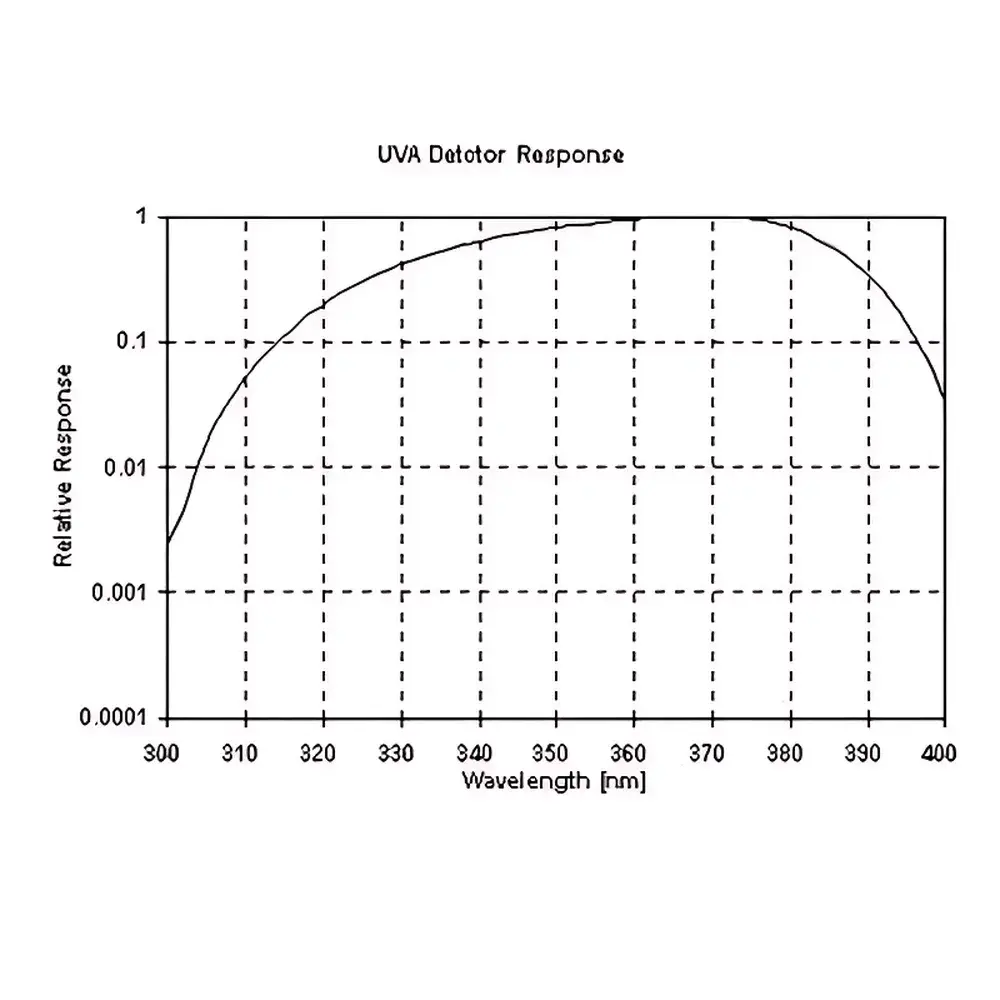
| Spectral Range | 320–400 nm |
| Angular Response | ≤5% deviation from ideal cosine response up to ±60° |
| Measurement Range | 0.001–200 mW/cm² (0–2000 W/m²) |
| Display Resolution | 0.001 mW/cm² / 0.01 W/m² |
| Operating Temperature | 0–50 °C (32–120 °F), non-condensing |
| Temperature Coefficient | <0.1 %/°C |
| Cable | Retractable coaxial cable, 0.3–1.5 m |
| Detector Diameter | 40.6 mm |
| Height | 45.8 mm |
| Weight | 200 g |
| Calibration | NIST-traceable, radiometrically calibrated in W/m² and mW/cm² |
Overview
The Solar Light PMA2110 UVA Radiometer is a precision-calibrated, handheld optical detector engineered for quantitative measurement of ultraviolet-A (UVA) irradiance across the biologically and industrially critical 320–400 nm spectral band. It operates on the principle of photodiode-based radiometry, with a thermally stabilized silicon photodiode coupled to an interference-filtered optical train optimized specifically for UVA transmission. The detector’s spectral responsivity is rigorously characterized and validated against NIST-traceable reference standards, ensuring metrological integrity for both laboratory and field-deployed applications. Its compact, ruggedized aluminum housing—sealed against dust and incidental moisture—supports operation in controlled environments (e.g., UV curing chambers, dermatological test booths) and ambient outdoor settings (e.g., solar UV monitoring stations), provided condensation and direct precipitation are avoided. Unlike broadband UV sensors, the PMA2110 delivers spectrally selective UVA quantification without significant out-of-band sensitivity to UVB or visible light, minimizing measurement bias in mixed-spectrum exposures.
Key Features
- Optimized spectral selectivity: Interference filter + photodiode assembly with peak transmittance centered at 365 nm and full-width half-maximum (FWHM) spanning 320–400 nm, conforming to ISO 17166:2019 (CIE S 007/E) UVA definition.
- High-fidelity angular response: Polytetrafluoroethylene (PTFE)-based diffuser engineered to approximate Lambertian cosine response; angular error ≤ ±5% for incident angles up to ±60° from normal incidence—critical for accurate integration of diffuse or extended-source irradiance.
- Wide dynamic range: Linear response over five decades (2 × 10⁵), supporting measurements from low-intensity ambient UVA (e.g., daylight exposure studies) to high-flux industrial sources (e.g., mercury-vapor arc lamps, LED arrays).
- NIST-traceable calibration: Each unit ships with individual calibration certificate reporting responsivity (A/W) at multiple wavelengths within the UVA band, traceable to NIST Standard Reference Photometers SRM 2000 and SRM 2002.
- Stable thermal performance: Integrated temperature compensation circuitry limits drift to <0.1 %/°C across the full operating range (0–50 °C), enabling reliable data acquisition without active thermal stabilization.
- Direct radiometric output: Supports dual-unit display (mW/cm² and W/m²) with 3-digit resolution (0.001 mW/cm²), eliminating need for post-acquisition unit conversion or scaling factors.
Sample Compatibility & Compliance
The PMA2110 is compatible with all common UVA-emitting sources—including low-pressure mercury lamps (365 nm line), medium-pressure UV arcs, UVA-LED arrays (365–405 nm), and filtered xenon arc solar simulators. It is routinely deployed in protocols compliant with ASTM E2108 (Standard Practice for Determining UV Exposure in Accelerated Weathering Tests), ISO 11341 (Paints and varnishes – Exposure to artificial weathering), and IEC 62471 (Photobiological safety of lamps). While not intrinsically certified for hazardous locations, its construction meets IP54-rated environmental protection for non-hazardous indoor/outdoor use. For GLP/GMP-regulated environments, the instrument supports audit-ready documentation when paired with Solar Light’s optional data logging interface (PMA2100 series base station), which records timestamped irradiance values with operator ID and calibration expiration metadata.
Software & Data Management
The PMA2110 operates as a standalone analog-output sensor but integrates seamlessly with Solar Light’s PMA2100-series control units and third-party DAQ systems via its standard BNC analog voltage output (0–2 V = 0–200 mW/cm²). When connected to the PMA2100 base station, users gain access to real-time graphing, statistical summary (min/max/avg/std dev), dose integration (J/m²), and CSV export. All acquired datasets include embedded calibration traceability identifiers and can be configured to comply with FDA 21 CFR Part 11 requirements—including electronic signatures, audit trails, and data integrity controls—when used with validated software modules (e.g., Solar Light UVSoft v5.2 with 21 CFR Part 11 Add-on).
Applications
- UV curing process validation and in-line monitoring in inkjet, flexographic, and screen printing lines.
- Dermatological phototesting: Quantitative UVA delivery verification in SPF testing per ISO 24444 and COLIPA guidelines.
- Clinical phototherapy dosimetry for conditions such as psoriasis and vitiligo under controlled UVA exposure regimens.
- Material degradation studies: Accelerated aging of polymers, coatings, and adhesives per ASTM G154 and ISO 4892-3.
- Environmental UV-A monitoring: Long-term spectral irradiance tracking in atmospheric research networks and UV index validation campaigns.
- Optical component characterization: Transmittance/reflectance measurement of UVA-blocking filters, sunglasses, and protective window films.
FAQ
Is the PMA2110 calibrated for absolute irradiance or relative response?
It is factory-calibrated for absolute spectral irradiance in W/m² and mW/cm², with NIST-traceable uncertainty ≤ ±5% (k=2) across the 320–400 nm band.
Can it be used outdoors in direct sunlight?
Yes, provided ambient temperature remains within 0–50 °C and the detector surface is protected from rain, dew, or particulate contamination that may degrade the PTFE diffuser.
What is the recalibration interval recommendation?
Solar Light recommends annual recalibration for routine QA/QC use; biannual recalibration is advised for high-usage or regulated environments (e.g., ISO 17025 labs).
Does it require external power or batteries?
No—the PMA2110 is a passive, self-powered sensor; its analog output is powered by the connected readout device (e.g., PMA2100 base station or DAQ system).
How is cosine error quantified and verified?
Each unit undergoes angular responsivity mapping at 10° increments from 0° to 70° using a collimated UVA source and goniometric stage; final certification reports list measured deviation vs. ideal cosine curve at ±60°.