
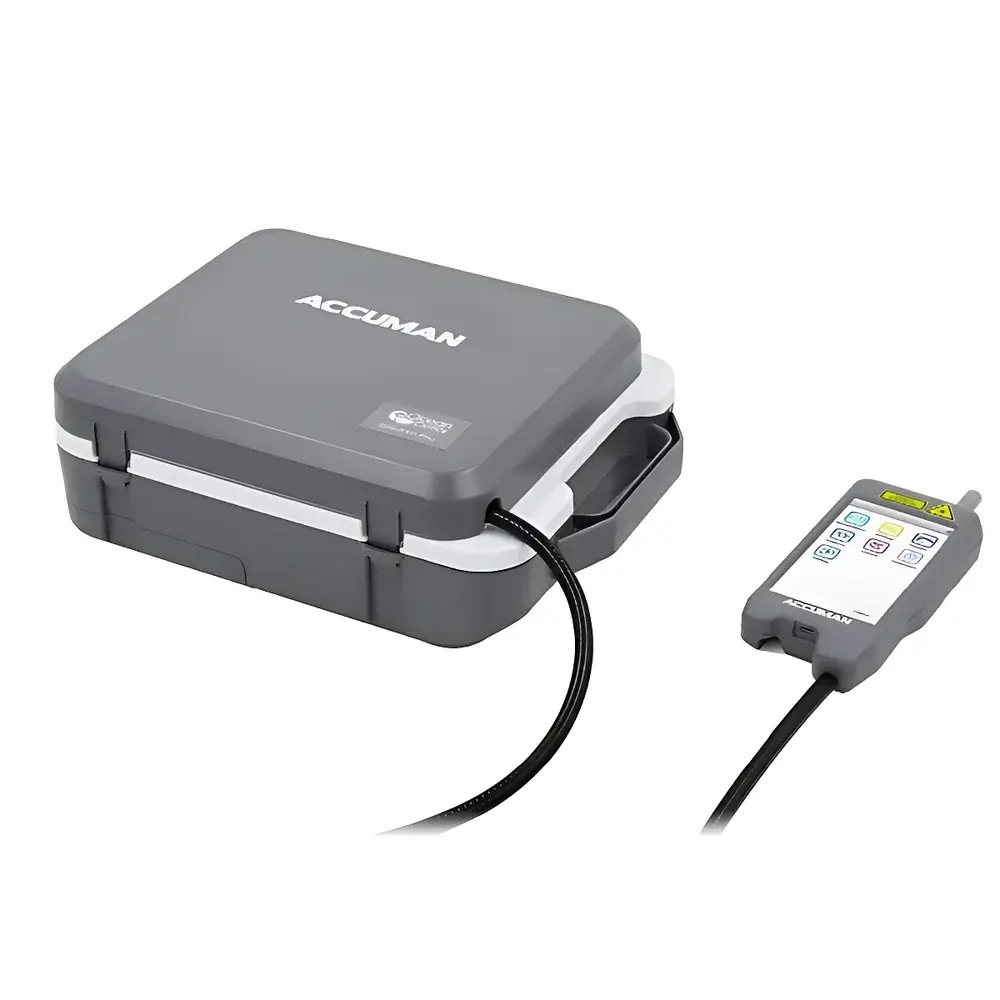
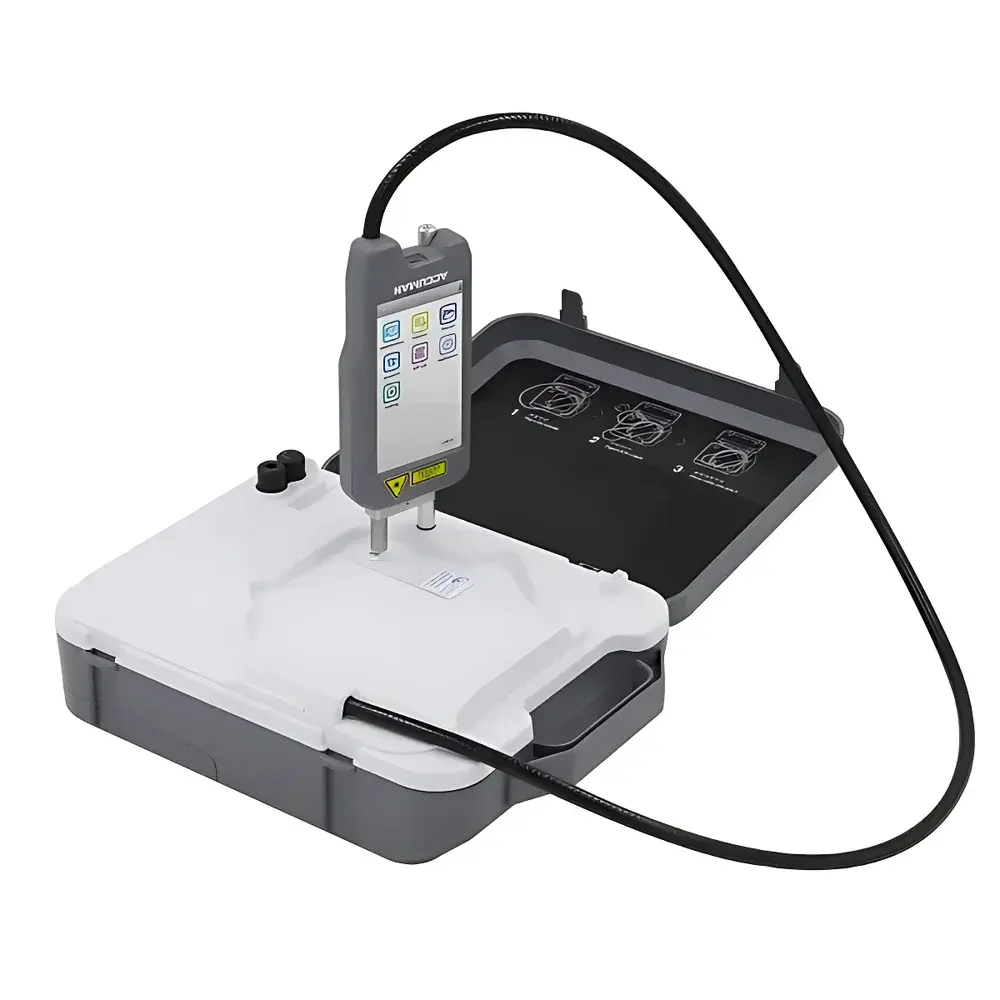
Ocean Optics ACCUMAN SR-510 Pro Portable Research-Grade Raman Spectrometer
| Brand | Ocean Optics |
|---|---|
| Origin | USA |
| Model | ACCUMAN SR-510 Pro |
| Instrument Type | Portable/Handheld Raman Spectrometer |
| Spectral Range | 200–3900 cm⁻¹ (configurable) |
| Spectral Resolution | 4–12 cm⁻¹ (dependent on grating and spectral window) |
| Laser Wavelength | 785 nm ± 0.5 nm, linewidth < 2 cm⁻¹, frequency stability < 0.1 cm⁻¹ |
| Laser Power | Up to 350 mW, 10-step linear adjustment |
| Detector | TE-cooled back-illuminated thin CCD array |
| Signal-to-Noise Ratio | 1000:1 |
| Integration Time | 0.1–30 s |
| Numerical Aperture | 0.22 |
| Working Distance | 7.5 mm |
| Display | 4.5″ LCD, 720p capacitive multi-touch |
| Data Interfaces | USB 2.0, Wi-Fi |
| Battery Life | >5 hours (rechargeable Li-ion) |
| Weight | 330 g (handheld probe), 3.8 kg (main unit) |
| Dimensions | 15.5 × 7.4 × 2.5 cm (probe), 29 × 22 × 10 cm (unit) |
| Operating Temperature | 0–45 °C |
| Data Formats | .pdf, .csv, .txt, .jdx, .rdb |
Overview
The Ocean Optics ACCUMAN SR-510 Pro is a portable, research-grade Raman spectrometer engineered for high-fidelity molecular fingerprinting in both laboratory and field-deployed environments. Based on confocal dispersive Raman spectroscopy with 785 nm excitation, the system leverages a stabilized single-mode diode laser and a deep-cooled, back-illuminated CCD detector to deliver low-noise, high-dynamic-range spectra across a broad wavenumber range (200–3900 cm⁻¹). Its optical architecture—featuring a fixed 0.22 NA collection optics and 7.5 mm working distance—is optimized for reproducible signal acquisition from solids, powders, liquids, and gels without sample preparation. Unlike benchtop systems requiring optical tables and environmental controls, the ACCUMAN SR-510 Pro integrates all core spectroscopic components—including laser source, spectrometer, detector, and embedded computing—into a ruggedized, battery-powered platform. This enables direct, real-time spectral acquisition under ambient lighting and variable thermal conditions while maintaining measurement traceability to NIST-traceable Raman standards.
Key Features
- Research-grade optical performance: TE-cooled back-illuminated CCD detector with 1000:1 signal-to-noise ratio ensures detection of weak Raman bands even in fluorescence-prone samples.
- Stabilized 785 nm laser source: <2 cm⁻¹ linewidth and <0.1 cm⁻¹ frequency drift over 8 hours support long-term quantitative repeatability and inter-laboratory comparability.
- Configurable spectral resolution: Selectable gratings enable resolution tuning from 4 cm⁻¹ (for high-resolution chemical discrimination) to 12 cm⁻¹ (for enhanced throughput in rapid screening).
- Dual-control architecture: Independent operation via integrated 4.5″ multi-touch display or remote control via USB/Wi-Fi from Windows/macOS/Linux workstations.
- Modular sampling interface: Standard SMA 905 fiber coupling supports interchangeable probes—including immersion, reflective, and standoff configurations—as well as optional microscope integration for micro-Raman mapping.
- Embedded spectral processing: On-device fluorescence background subtraction using iterative polynomial fitting and constrained non-negative least squares (CNLS), minimizing post-acquisition workflow latency.
Sample Compatibility & Compliance
The ACCUMAN SR-510 Pro accommodates heterogeneous sample geometries through its flexible probe handling: handheld operation for irregular surfaces, tripod-mounted positioning for planar substrates, and custom fixtures for vials, tablets, or cultural heritage artifacts. It complies with IEC 61326-1 for electromagnetic compatibility and meets IP52 ingress protection specifications for dust resistance and limited water exposure. While not certified for hazardous locations, its Class 3B laser subsystem adheres to ANSI Z136.1 and IEC 60825-1 safety standards, including automatic power reduction upon beam interruption. Data integrity protocols align with GLP/GMP expectations: audit-trail-enabled software logs user actions, instrument parameters, calibration events, and timestamped spectral metadata in .rdb format—supporting traceability requirements under FDA 21 CFR Part 11 when deployed with validated software configurations.
Software & Data Management
The bundled SpectraSuite software provides a unified environment for instrument control, spectral acquisition, preprocessing, and chemometric analysis. Core capabilities include automated dark/baseline correction, peak identification against integrated libraries (e.g., RRUFF, ICDD), and similarity matching using cosine correlation and Euclidean distance metrics. Quantitative modeling tools support partial least squares (PLS) regression and principal component regression (PCR) for concentration prediction in multicomponent systems. All reports export in ISO-standardized formats (.jdx for JCAMP-DX interoperability, .csv for spreadsheet analysis, .pdf for archival documentation). Data synchronization occurs via encrypted Wi-Fi or direct USB transfer; no cloud dependency ensures full data sovereignty—a critical requirement for regulated pharmaceutical or forensic applications.
Applications
This instrument serves cross-disciplinary analytical needs where portability does not compromise spectral fidelity. In pharmaceutical QA/QC, it verifies raw material identity and detects counterfeit APIs via library-matched spectral signatures. In materials science, it characterizes carbon allotropes (graphene, nanotubes), polymer crystallinity, and stress-induced shifts in semiconductor wafers. Cultural heritage labs use it for non-invasive pigment identification on manuscripts and painted surfaces. Environmental field teams deploy it for on-site detection of hydrocarbon contaminants in soil or microplastics in aqueous matrices. Academic teaching labs benefit from its intuitive interface and built-in tutorials for introducing vibrational spectroscopy fundamentals without infrastructure overhead.
FAQ
Is the ACCUMAN SR-510 Pro suitable for quantitative analysis?
Yes—its calibrated intensity response, stable laser output, and integrated PLS/PCR modeling tools support validated quantitative workflows when paired with reference standards and documented SOPs.
Can it be used for microscopic Raman analysis?
Yes—via optional C-mount adapter, the spectrometer couples directly to upright or inverted microscopes, enabling diffraction-limited spatial resolution down to ~1 µm with appropriate objectives.
Does it support external triggering or synchronization with other instruments?
Yes—TTL-compatible trigger input/output ports allow synchronization with stage controllers, pulsed lasers, or time-resolved detectors for advanced experimental setups.
What calibration standards are included?
NIST-traceable silicon (520.7 cm⁻¹), cyclohexane (2847 cm⁻¹), and polystyrene (1001 cm⁻¹) calibration caps are supplied for wavelength and intensity verification.
Is firmware upgradable in the field?
Yes—over-the-air updates via USB or Wi-Fi maintain compatibility with new spectral algorithms, regulatory requirements, and accessory drivers without hardware modification.





