
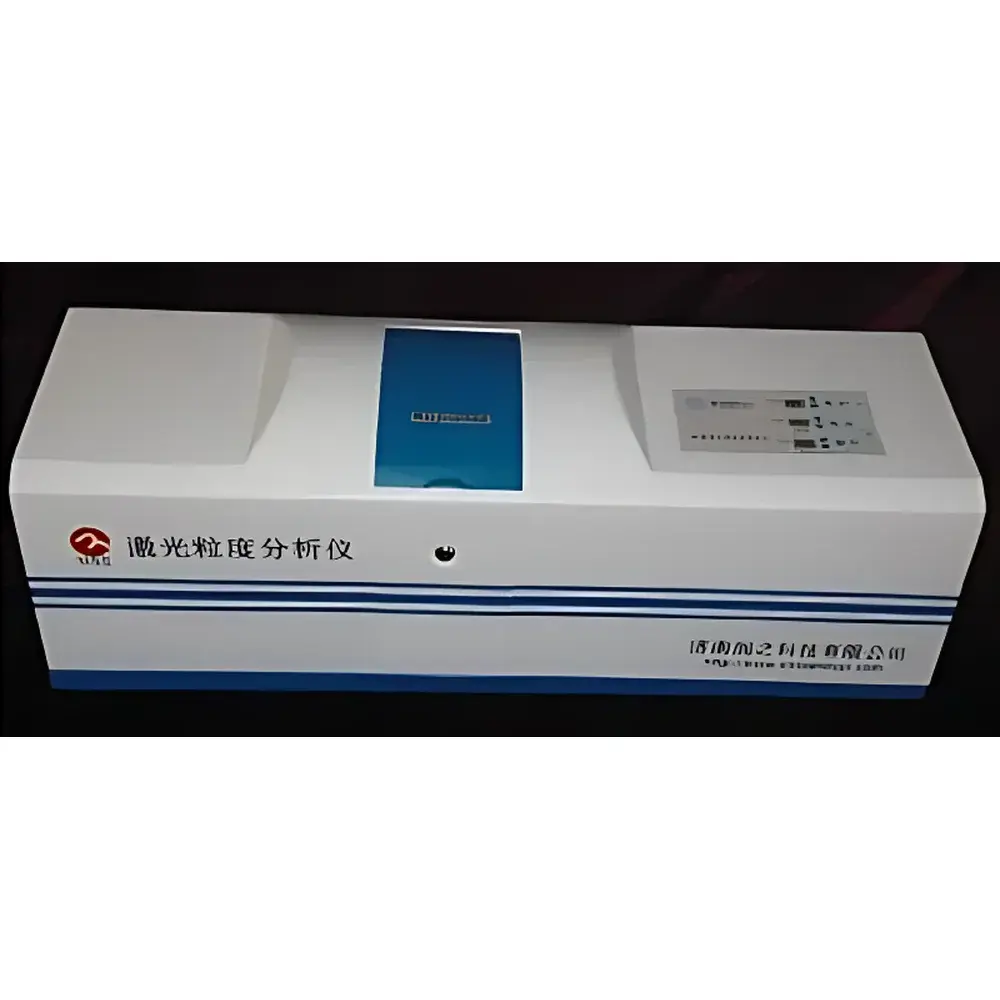
Rise-2008 Laser Particle Size Analyzer
| Origin | Beijing, China |
|---|---|
| Manufacturer Type | Authorized Distributor |
| Origin Category | Domestic (China) |
| Model | Rise-2008 |
| Pricing | Available Upon Request |
| Measurement Range | 0.02–1200 µm |
| Accuracy Error | < ±1% (D50, NIST-traceable standard reference materials) |
| Repeatability | < ±1% (D50, same sample, consecutive runs) |
| Power Supply | AC 220 V ±10%, 50 Hz, 200 W |
| Dimensions (L×W×H) | 1000 × 330 × 320 mm |
| Weight | 38 kg |
Overview
The Rise-2008 Laser Particle Size Analyzer is a high-precision, wet-dispersion instrument engineered for reliable and reproducible particle size distribution (PSD) analysis across industrial quality control, pharmaceutical development, and academic research laboratories. It operates on the fundamental principle of Mie scattering theory—fully accounting for the complex refractive index of both particles and dispersion medium—to quantitatively invert angular light scattering intensity into volumetric particle size distribution. Unlike simplified Fraunhofer-based systems, the Rise-2008 implements true non-negative, unconstrained inverse algorithms—eliminating a priori assumptions about distribution shape (e.g., log-normal or Rosin-Rammler), thereby preserving fidelity to the actual sample morphology. This approach requires rigorous optical design and detector calibration, which the system fulfills through its proprietary three-dimensional crossed fan-array photodetector architecture with extended angular coverage up to 135°, enabling accurate resolution across the full 0.02–1200 µm dynamic range.
Key Features
- Stable He-Ne laser source (632.8 nm wavelength, 25,000 h lifetime) ensures long-term signal coherence and minimal drift.
- Single-optical-path convergent beam design eliminates Fourier lens stacks, reducing alignment sensitivity and enhancing optical throughput and resolution.
- Integrated 100 W ultrasonic disperser with digitally controlled timing (0–9 min 50 s, 1 s increments); operation concurrent with measurement to prevent re-agglomeration.
- 400 mL stainless-steel sample cell with optimized circular geometry, seamless drainage, and corrosion-resistant surface finish for rapid cleaning and cross-sample integrity.
- Independent, touch-enabled controls for ultrasonication, stirring (0–3000 rpm), and circulation (0–5000 rpm), all with real-time digital feedback and programmable profiles.
- Non-uniform 3D fan-array photodetector system with 130 discrete channels covering forward, side, and backscatter angles—maximizing information capture from sub-micron to coarse particles.
Sample Compatibility & Compliance
The Rise-2008 supports aqueous and organic dispersions—including deionized water, ethanol, isopropanol, and other low-viscosity solvents—making it suitable for inorganic oxides, polymers, pigments, catalysts, APIs, and nanomaterials. Its wet-dispersion methodology complies with ISO 13320:2020 (Particle size analysis — Laser diffraction methods) and aligns with ASTM E799-22 guidelines for dispersion protocol validation. While not inherently 21 CFR Part 11 compliant out-of-the-box, the system’s audit-trail-capable software architecture permits configuration for GLP/GMP environments when deployed with validated SOPs and electronic signature modules. All hardware conforms to IEC 61010-1 safety standards for laboratory electrical equipment.
Software & Data Management
The PADMAS (Particle Diameter Measure & Analysis System) software provides comprehensive post-acquisition processing, including differential and cumulative distributions, R-R plots, custom binning (1–130 user-defined channels), and multiple reporting formats (volume-, number-, and surface-area-weighted). Standard outputs include D10, D50, D90, span, specific surface area (volume- or mass-based), and statistical comparisons across batches. Raw data exports natively to CSV and Excel (.xlsx); graphical outputs are exportable as PNG, TIFF, or PDF for integration into regulatory submissions or publications. Report templates support bilingual (English/Chinese) generation, header/footer customization, and print preview—facilitating internal documentation and external client deliverables.
Applications
- Pharmaceuticals: API crystallinity assessment, excipient characterization, suspension stability evaluation, and inhaler aerosol performance screening.
- Materials Science: Ceramics sintering feedstock qualification, battery cathode/anode slurry homogeneity verification, and catalyst support particle uniformity testing.
- Chemicals & Coatings: Pigment dispersion efficiency, emulsion droplet sizing, and rheology-coupled formulation optimization.
- Environmental & Geoscience: Sediment grain-size analysis, soil aggregate stability studies, and airborne particulate matter (PM2.5/PM10) surrogate characterization.
- Quality Assurance: Incoming raw material release testing, in-process monitoring, and final product batch certification per internal specifications or ISO/ASTM criteria.
FAQ
What dispersion media are compatible with the Rise-2008?
Deionized water, distilled water, ethanol, isopropanol, and other low-viscosity, non-corrosive liquids with known refractive indices may be used. Viscosity should remain below 20 mPa·s for optimal pump and ultrasonic performance.
Does the system support dry powder measurement?
No—the Rise-2008 is configured exclusively for wet dispersion analysis. Dry powder measurement requires optional pneumatic dispersion accessories not included in the base configuration.
Can the software generate reports compliant with FDA submission requirements?
PADMAS supports configurable audit trails, user access levels, and electronic signatures when integrated into a validated IT infrastructure meeting 21 CFR Part 11 Annex 11 expectations—but validation must be performed by the end-user laboratory.
Is calibration traceable to national standards?
Yes—system performance verification uses NIST-traceable polystyrene latex standards (e.g., NIST SRM 1963, 8012), and accuracy/repeatability claims are verified against ISO 13320 reference protocols.
What maintenance is required for long-term operational stability?
Routine maintenance includes quarterly optical window cleaning, annual laser power verification, biannual ultrasonic transducer inspection, and periodic calibration using certified reference materials—full procedures are documented in the English-language operator manual and supported via remote technical assistance.



