
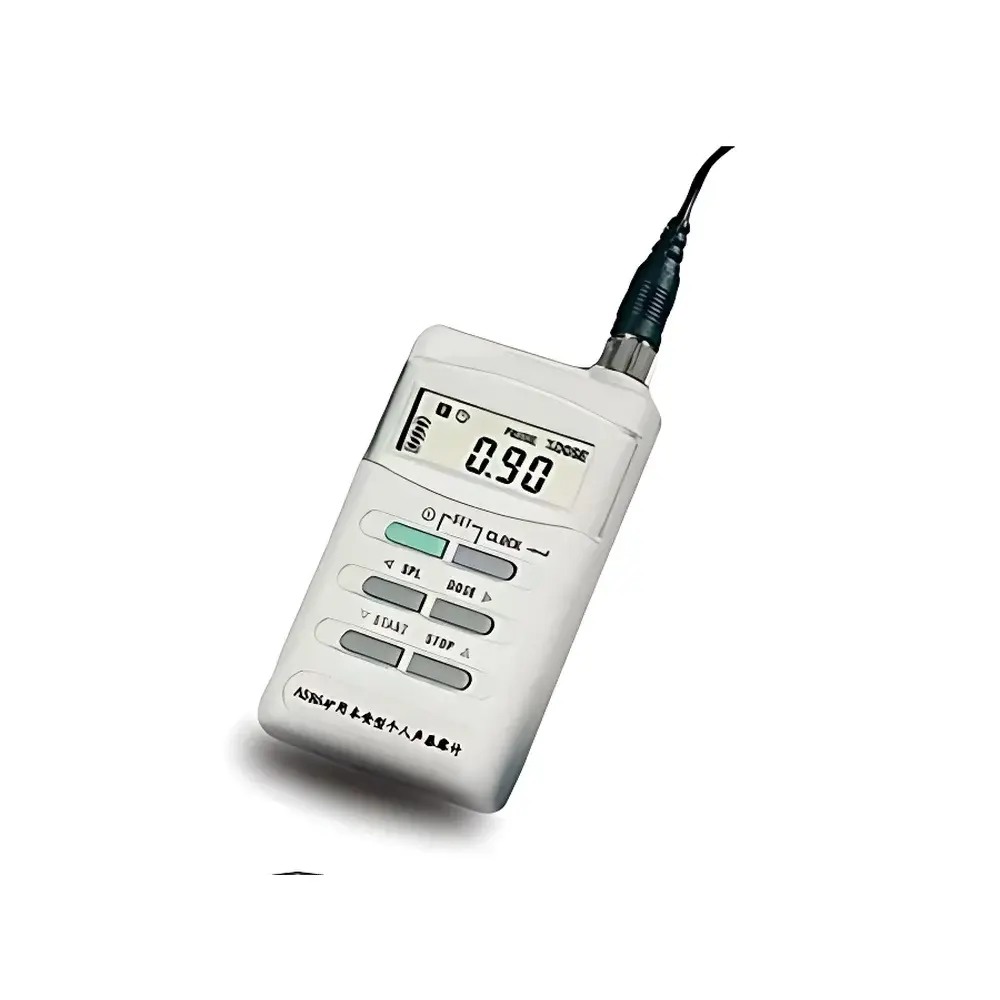
ASR6 Intrinsically Safe Personal Noise Dosimeter for Mining Applications
| Origin | Beijing |
|---|---|
| Manufacturer Type | Distributor |
| Origin Category | Domestic |
| Model | ASR6 |
| Price Range | USD 280–700 |
| Frequency Range | 20 Hz–12.5 kHz |
| Measurement Range | 70–140 dB |
| Accuracy | ±1.5 dB |
| Measurement Durations | 10 s, 1 min, 5 min, 10 min, 15 min, 30 min, 1 h, 4 h, 8 h, 24 h |
Overview
The ASR6 Intrinsically Safe Personal Noise Dosimeter is a certified Class II sound level meter engineered for continuous noise exposure monitoring in hazardous underground mining environments. Designed in strict compliance with IEC 61672-1:2013 (Electroacoustics – Sound level meters – Part 1: Specifications) and GB/T 15952–2010 (Personal sound exposure meters), it operates on the principle of time-integrated A-weighted sound pressure level (LAeq,T) measurement to quantify occupational noise dose relative to regulatory exposure limits (e.g., 85 dB(A) over an 8-hour TWA). Its intrinsic safety certification (Exib I Mb) ensures safe deployment in methane- and coal-dust-laden atmospheres classified under IEC 60079-0 and GB 3836.1–2021, making it suitable for permanent wear by personnel in coal face excavation zones, return airways, electrical machinery chambers, and other Zone 0/1 explosive gas environments.
Key Features
- Intrinsically safe design certified to Exib I Mb per GB 3836.4–2021 and IEC 60079-11, enabling operation in explosive atmospheres with methane concentrations up to 100% LEL
- Dual-mode acoustic measurement: simultaneous real-time LAeq,T (time-averaged A-weighted sound pressure level) and LEX,8h (daily personal noise exposure level) calculation with % dose display
- High-stability digital detection architecture based on MSP430 microcontroller, supporting automatic range switching and minimizing drift across temperature gradients (0–40 °C operating range)
- Wide dynamic range (70–140 dB) with ±1.5 dB accuracy referenced to 94 dB @ 1 kHz (calibrated per IEC 61260-1:2014 Class 2)
- Configurable measurement durations from 10 seconds to 24 hours, including standard 8-hour occupational exposure windows
- IP54-rated enclosure providing protection against dust ingress and water splashing—validated for humid, high-particulate underground conditions (RH ≤ 95%, atmospheric pressure 80–110 kPa)
- Integrated event logging: stores up to five independent exposure records (E1–E5), each containing peak C-weighted level (LCpeak), first occurrence time of ≥140 dB events, cumulative exposure duration, and timestamped LAeq values
Sample Compatibility & Compliance
The ASR6 is validated for use with standard ½-inch electret condenser microphone cartridges compliant with IEC 61094-4. It meets the electromagnetic compatibility requirements for X-class instruments per IEC 61672-1 Annex D, indicating low susceptibility to RF interference in proximity to mining communication systems and variable-frequency drives. Its mechanical construction satisfies ISO 2631-1 vibration sensitivity thresholds (<0.1 m/s² rms) and is tested for non-condensing storage at –10–60 °C. Regulatory conformance includes: GB/T 15952–2010 (Personal Sound Exposure Meters), IEC 61672-1:2013 Class 2, and mandatory Chinese Coal Mine Safety Mark (KA) certification. While not FDA 21 CFR Part 11 or GLP/GMP validated, its audit-ready data logs support OSHA 1910.95 and EU Directive 2003/10/EC compliance reporting.
Software & Data Management
Data acquisition and configuration are managed via RS-232 serial interface (DB9 male connector) using vendor-provided Windows-compatible software. The device supports ASCII-based command protocol for remote start/stop, parameter upload/download, and firmware version interrogation. Each stored exposure record includes full metadata: date/time stamp (per built-in real-time clock with leap-year-aware calendar), measurement duration, LAeq,T value, % noise dose, LCpeak, and elapsed time to first exceedance of 140 dB(C). Exported CSV files contain columnar fields compatible with Excel, MATLAB, or enterprise EHS platforms for trend analysis, exposure mapping, and regulatory submission. All data writes are non-volatile and retain integrity during power interruption.
Applications
The ASR6 serves as a primary tool for occupational hygiene assessment in high-risk industrial sectors where ignition hazards preclude conventional instrumentation. Key deployment scenarios include: longitudinal hearing conservation programs in underground coal mines; noise mapping of continuous miners, roof bolters, and ventilation fans; post-shift exposure verification for maintenance crews in explosive gas zones; compliance auditing by provincial coal safety inspection bureaus; and baseline noise surveys prior to installation of engineering controls (e.g., acoustic enclosures, mufflers). Its ruggedized form factor and belt-clip mounting enable unobtrusive, long-duration wear without compromising worker mobility or safety protocols.
FAQ
What does “Exib I Mb” certification signify for underground use?
Exib I Mb denotes protection level “ib” (intrinsic safety for Zone 1) and equipment category “Mb” (mining-specific, suitable for methane-rich atmospheres per IEC 60079-0 and GB 3836.1). It certifies that the device cannot ignite explosive mixtures under normal operation and single-fault conditions.
Can the ASR6 be used for regulatory compliance reporting under OSHA or EU directives?
Yes—its IEC 61672-1 Class 2 and GB/T 15952 conformance provides metrological traceability for noise dose quantification required by OSHA 1910.95, EU Directive 2003/10/EC, and China’s Work Safety Law Article 39.
Is calibration traceable to national standards?
Factory calibration is performed using NIST-traceable acoustic calibrators (e.g., Brüel & Kjær 4231) and documented per ISO/IEC 17025 principles; end-user field verification follows GB/T 15173–2010 procedures.
Does the device support A- and C-weighting simultaneously?
It applies A-weighting for LAeq,T and % dose calculation per ISO 1999; C-weighted peak detection (LCpeak) is measured concurrently but not integrated into dose algorithms.
How is data integrity ensured during extended underground shifts?
Non-volatile flash memory retains all logged records through power cycles, and the real-time clock maintains synchronization within ±2 seconds/month—critical for multi-shift exposure aggregation.
Related Products







