
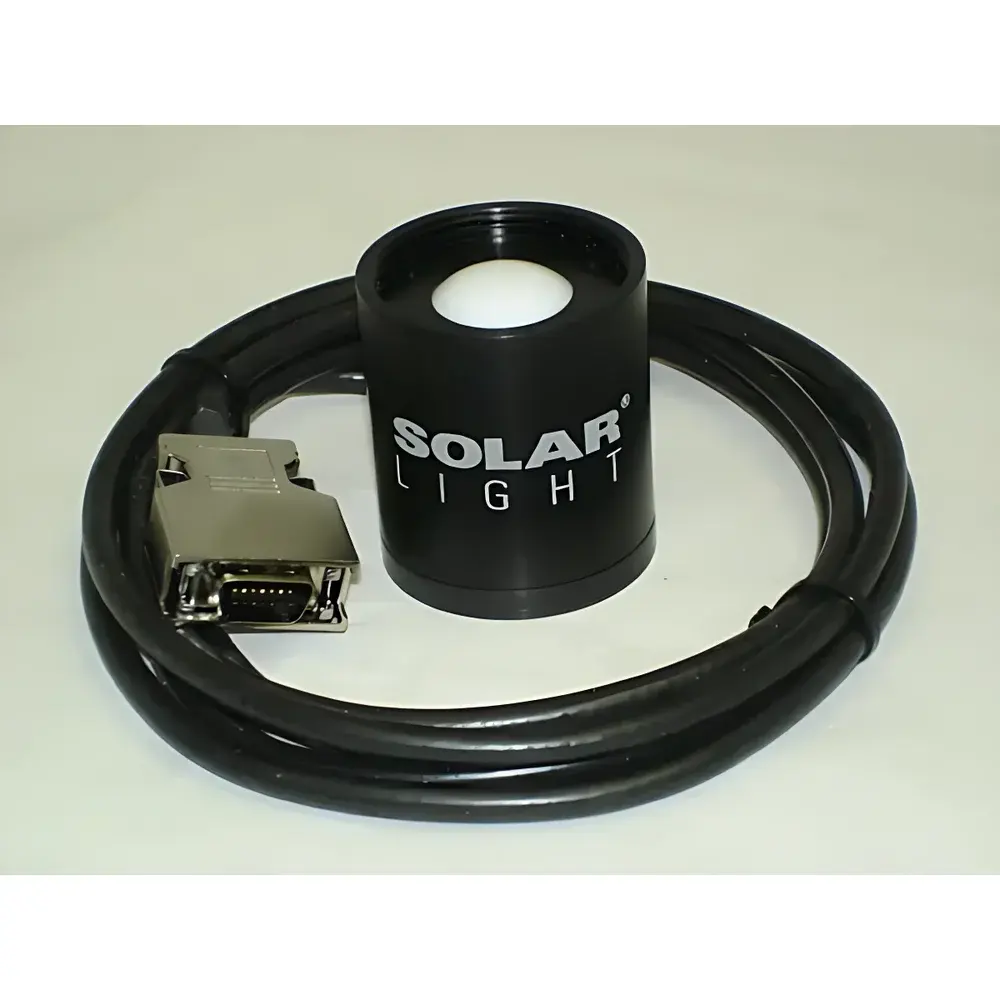
Solar Light PMA2101 Biologically-Weighted UVB Radiometer
| Brand | Solar Light |
|---|---|
| Origin | USA |
| Model | PMA2101 |
| Spectral Response | CIE 1987 Erythema Action Spectrum (280–320 nm) |
| Angular Response | Lambertian (cosine-corrected, ≤5% deviation up to 60°) |
| Measurement Range | 0.01 µW/cm² to >1 mW/cm² |
| Units | MED/hr, µW/cm², W/m² |
| Calibration | NIST-traceable |
| Operating Temperature | 0–50 °C (non-condensing) |
| Dimensions | Ø40.6 mm × 45.8 mm |
| Weight | 200 g |
| Cable | Retractable 0.3–1.5 m |
Overview
The Solar Light PMA2101 Biologically-Weighted UVB Radiometer is a precision optical sensor engineered for quantitative measurement of erythemally effective ultraviolet radiation in the UV-B spectral band (280–320 nm). It operates on the principle of biological weighting—applying the CIE 1987 Erythema Action Spectrum as a spectral weighting function to broadband UV irradiance—thereby converting raw radiometric data into biologically relevant dose units such as Minimal Erythemal Dose per hour (MED/hr). Unlike unweighted broadband detectors, the PMA2101 integrates photodiode-based detection with a custom interference filter and diffuser assembly optimized to match the CIE reference curve with high fidelity. Its near-Lambertian angular response ensures accurate integration of diffuse, hemispherical, or extended-source UV fields—critical for environmental monitoring, photobiological safety assessment, and controlled exposure studies. The detector is calibrated against NIST-traceable standards under ISO/IEC 17025-accredited conditions, supporting metrological integrity across laboratory, clinical, and field applications.
Key Features
- Biological weighting aligned to the CIE 1987 Erythema Action Spectrum—validated for human skin photobiology
- Cosine-corrected optical input with ≤5% angular deviation up to ±60° incidence—enabling reliable measurement of sky-diffuse and non-collimated UV sources
- Wide dynamic range spanning five orders of magnitude: from 0.01 µW/cm² (sub-solar background) to >1 mW/cm² (intense artificial UV-B lamps)
- NIST-traceable calibration certificate supplied with each unit; recalibration recommended annually per ISO 17025 guidelines
- Thermally stabilized design with <1% /°C temperature coefficient for solar-weighted irradiance—minimizing drift under variable ambient conditions
- Compact, ruggedized aluminum housing (Ø40.6 mm × 45.8 mm, 200 g) rated for operation between 0–50 °C in non-condensing environments
- Retractable 0.3–1.5 m shielded coaxial cable with low-noise signal transmission and electromagnetic compatibility (EMC) compliance
Sample Compatibility & Compliance
The PMA2101 is compatible with all Solar Light PMA-series meters (e.g., PMA2100, PMA2200) and third-party data loggers supporting 0–2 V analog output or RS-232 digital interface. It meets IEC 60825-1 requirements for UV hazard classification instrumentation and conforms to ASTM E2105–22 (Standard Test Method for Determining Erythemal UV Dose Rate Using Broadband Instruments). Its spectral responsivity has been verified per CIE S 013/E:2003 and supports regulatory alignment with FDA 21 CFR Part 1040.20 (UV radiation devices), EU Directive 2006/25/EC (artificial optical radiation), and ISO 21348 (space environment UV definitions). For GLP/GMP-regulated workflows—including SPF testing, phototherapy validation, and dermatological device qualification—the detector supports audit-ready calibration documentation and traceable uncertainty budgets.
Software & Data Management
When paired with Solar Light’s WinUV™ software (v5.0+), the PMA2101 enables real-time spectral weighting visualization, cumulative MED tracking, and automated report generation compliant with ISO/IEC 17025 record-keeping requirements. Data export formats include CSV, XML, and PDF with embedded calibration metadata. The system supports time-stamped logging at user-defined intervals (1 s to 1 hr), configurable alarm thresholds for MED/hr exceedance, and synchronized multi-channel acquisition when used alongside UVA, UVC, or visible-light detectors. All software modules adhere to FDA 21 CFR Part 11 principles, including electronic signatures, audit trails, and role-based access control—ensuring full data integrity for clinical trials and regulatory submissions.
Applications
- Environmental UV monitoring: ground-level erythemal dose rate quantification for public health advisories and climate research
- Sunscreen efficacy (SPF) testing per ISO 24444 and COLIPA guidelines—measuring UV-B transmittance through topical formulations
- Clinical phototherapy dosimetry: precise delivery control in narrowband UV-B (311 nm) treatment of psoriasis and vitiligo
- Material degradation studies: accelerated UV-B exposure testing of polymers, coatings, and packaging per ASTM G154
- Agricultural photobiology: quantifying UV-B impact on plant morphogenesis, flavonoid synthesis, and crop stress responses
- Industrial UV curing process validation: verifying biologically weighted irradiance in semiconductor and printing applications
FAQ
What biological action spectrum does the PMA2101 implement?
The detector applies the CIE 1987 Erythema Action Spectrum (S(λ)) as defined in CIE Publication 103-1993 and updated in CIE S 013/E:2003.
Is the PMA2101 suitable for outdoor solar measurements?
Yes—it is designed for direct solar exposure with thermal compensation and weather-resistant housing; however, precipitation must be avoided per operational specifications.
Can the PMA2101 be recalibrated, and how often is it recommended?
Recalibration is supported by Solar Light’s ISO/IEC 17025-accredited laboratory and recommended annually—or after mechanical shock, prolonged high-irradiance exposure, or deviation exceeding ±3% from baseline verification.
Does the detector require external power or operate passively?
It is a powered sensor requiring 5–15 VDC input from the host meter or data logger; no internal battery is included.
How is cosine error characterized, and what is its impact on measurement uncertainty?
Cosine response is validated per ISO/CIE 19476:2015; deviation remains ≤5% up to ±60°, contributing <±0.8% to total expanded uncertainty (k=2) under typical diffuse-sky conditions.




