
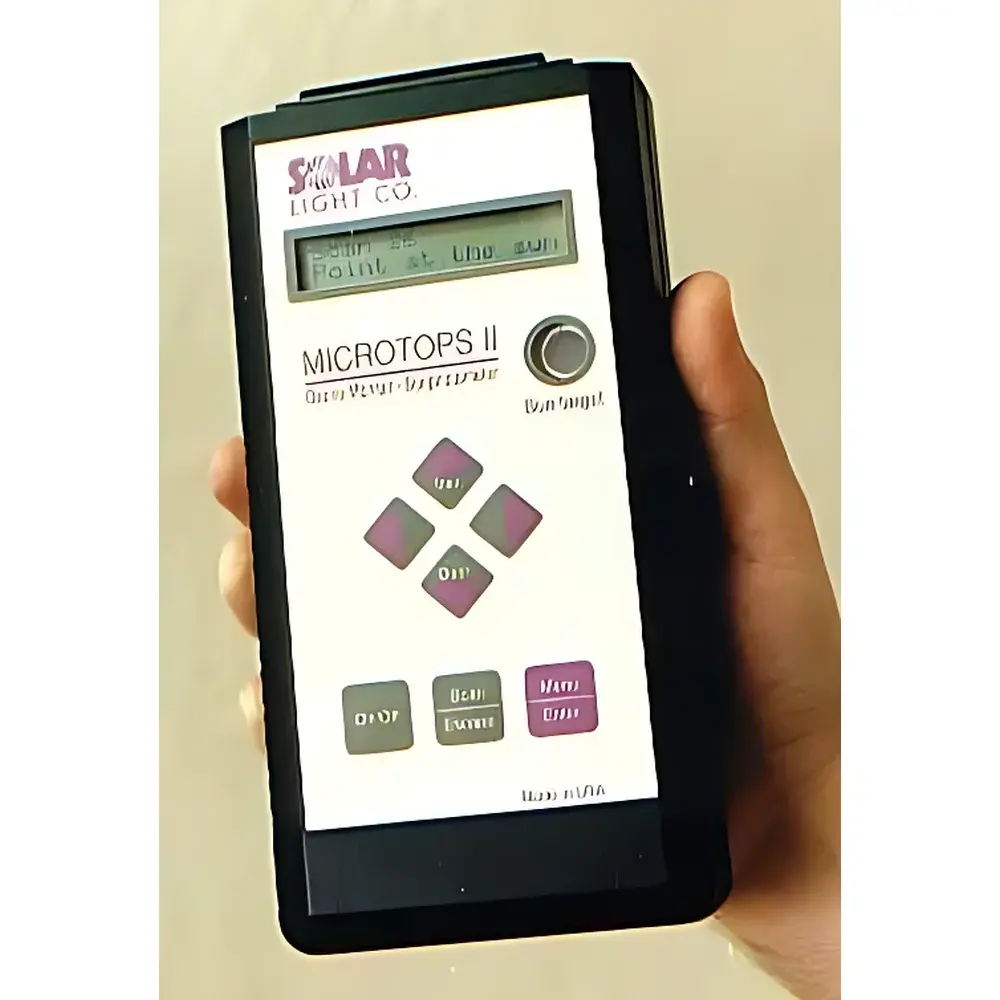
Solar Light Microtops II Handheld Sun Photometer & Ozone Meter
| Brand | Solar Light |
|---|---|
| Origin | USA |
| Model | Microtops II |
| Optical Channels | 305.5 ±0.3 nm (2.0 nm FWHM), 312.5 ±0.3 nm (2.0 nm FWHM), 320.0 ±0.3 nm (2.0 nm FWHM), 936 ±1.5 nm (10 nm FWHM, optional), 1020 ±1.5 nm (10 nm FWHM, optional) |
| Stray Light | ≤1×10⁻⁹ (305.5 nm), ≤1×10⁻⁸ (312.5/320.0 nm), ≤1×10⁻⁶ (936/1020 nm) |
| Resolution | 0.0001 µW/cm² (305 nm channel) |
| Dynamic Range | >300,000 |
| Field of View | 2.5° |
| Accuracy | ±1–2% (O₃ column), traceable to WMO standard protocols |
| Nonlinearity | ≤0.002% FS |
| Operating Environment | 0–50 °C, no precipitation |
| Interface | RS-232C serial |
| Power | 4 × AA alkaline batteries |
| Weight | 600 g |
| Dimensions | 10 × 20 × 4.3 cm |
| Data Logging | Non-volatile memory with timestamp, GPS coordinates (optional), solar zenith angle, altitude, barometric pressure, ambient temperature |
Overview
The Solar Light Microtops II Handheld Sun Photometer & Ozone Meter is a field-deployable, five-channel radiometric instrument engineered for precise, autonomous measurement of total column ozone (O₃), precipitable water vapor (PWV), and aerosol optical thickness (AOT) from direct-sun observations. It operates on the principle of differential optical absorption spectroscopy (DOAS) in the ultraviolet and near-infrared spectral regions, leveraging well-characterized narrowband interference filters centered at wavelengths where ozone and water vapor exhibit distinct absorption signatures. The instrument implements the World Meteorological Organization (WMO)-endorsed Dobson-type algorithm for ozone retrieval—specifically using the 305.5/312.5 nm and 312.5/320.0 nm dual-wavelength ratio methods—ensuring metrological consistency with global ground-based ozone monitoring networks. Its compact, battery-powered architecture enables deployment in remote or resource-constrained settings without reliance on external computing infrastructure or AC power.
Key Features
- Five independently calibrated optical channels: three UV bands (305.5, 312.5, 320.0 nm) optimized for ozone column retrieval, plus two optional NIR bands (936 nm and 1020 nm) for simultaneous PWV and AOT quantification.
- High-fidelity optical design featuring thermally stabilized, ultra-narrowband interference filters with stray light rejection down to 1×10⁻⁹ at 305.5 nm—critical for low-signal UV measurements under variable atmospheric conditions.
- Low-noise analog front-end with 20-bit analog-to-digital conversion, delivering high linearity (<0.002% full-scale nonlinearity), resolution of 0.0001 µW/cm² at 305 nm, and dynamic range exceeding 300,000:1.
- Integrated real-time computation engine: ozone, water vapor, and AOT values are calculated onboard using embedded algorithms compliant with WMO-recommended spectral weighting functions and Langley plot corrections.
- Self-contained data acquisition: all raw irradiance values, derived geophysical parameters, and metadata—including UTC timestamp, solar zenith angle, GPS coordinates (with optional external GPS receiver), altitude, barometric pressure, and ambient temperature—are stored in non-volatile memory.
- Ergonomic handheld form factor (10 × 20 × 4.3 cm; 600 g) with intuitive optical sighting system (2.5° field of view) and tactile button interface—designed for single-operator use without prior computational training.
Sample Compatibility & Compliance
The Microtops II is designed for direct-sun irradiance measurements under clear-sky or partially cloudy conditions (excluding precipitation). It complies with WMO Global Atmosphere Watch (GAW) guidelines for portable ozone photometry and supports traceability to the Dobson reference scale via intercomparison protocols. While not certified for regulatory compliance under EPA or ISO 17025, its measurement uncertainty (±1–2% for O₃ column) meets the performance criteria recommended by the Network for the Detection of Atmospheric Composition Change (NDACC) for supplemental ozone monitoring. Data formats adhere to GAW-standard ASCII conventions, enabling interoperability with NOAA’s ESRL Global Monitoring Laboratory databases and NASA’s AERONET Level 1.5 processing pipelines. Optional GPS integration satisfies ICAO Annex 3 requirements for georeferenced environmental observation metadata.
Software & Data Management
Data retrieval is performed via RS-232C serial interface using Solar Light’s proprietary MICROTOPS Organizer software (Windows-compatible). The application automates download, time-stamp validation, solar geometry correction, and export to CSV or NetCDF formats compatible with Python (e.g., xarray, PyAERONET), MATLAB, and R statistical environments. MICROTOPS Organizer includes built-in quality assurance tools: automatic flagging of low-SNR acquisitions, solar zenith angle filtering (<85°), and outlier detection based on inter-channel consistency checks. All raw and processed datasets retain full audit trails—including operator ID, firmware version, and calibration certificate expiration dates—supporting GLP-aligned documentation practices. No cloud dependency or vendor-hosted analytics are required; all computations remain local and transparent.
Applications
- Long-term ozone trend analysis at regional monitoring stations, particularly in developing nations where access to Dobson or Brewer spectrophotometers is limited.
- Validation of satellite-derived ozone products (e.g., OMI, TROPOMI, OMPS) through coordinated ground-truth campaigns aligned with overpass timing.
- Field studies of stratospheric-tropospheric exchange, including polar vortex dynamics and springtime ozone depletion events.
- Urban air quality research integrating AOT and PWV data to constrain aerosol–radiation interactions in photochemical modeling (e.g., CMAQ, CAMx).
- Undergraduate and graduate atmospheric science curricula—used extensively in field methods courses for hands-on instruction in radiative transfer, instrument calibration, and error propagation analysis.
- Environmental impact assessments requiring rapid, repeatable ozone baseline characterization prior to industrial development or land-use change.
FAQ
What calibration standards does the Microtops II follow?
The instrument is factory-calibrated against NIST-traceable tungsten-halogen and deuterium lamp sources, with ozone-specific sensitivity coefficients validated via intercomparison with primary-standard Dobson spectrophotometers at NOAA/ESRL and WMO GAW stations.
Can it operate under partial cloud cover?
Yes—measurements are valid when the sun disk remains unobscured, even if surrounding sky is cloudy. The 2.5° field of view minimizes contamination from diffuse skylight, though operators should avoid periods of rapidly changing cloud transmittance.
Is firmware upgradable in the field?
Firmware updates are performed via RS-232 connection using MICROTOPS Organizer; no hardware modification or return-to-factory service is required.
How is temperature drift compensated?
Thermal stabilization of optical filters and real-time thermistor readings (integrated into each measurement cycle) enable on-the-fly correction of detector responsivity drift across the 0–50 °C operating range.
Does it meet FDA 21 CFR Part 11 requirements for electronic records?
No—the Microtops II lacks electronic signature capability and audit trail encryption; however, its deterministic data logging architecture allows full reconstruction of raw inputs and processing steps, supporting manual verification workflows in regulated research environments.







