
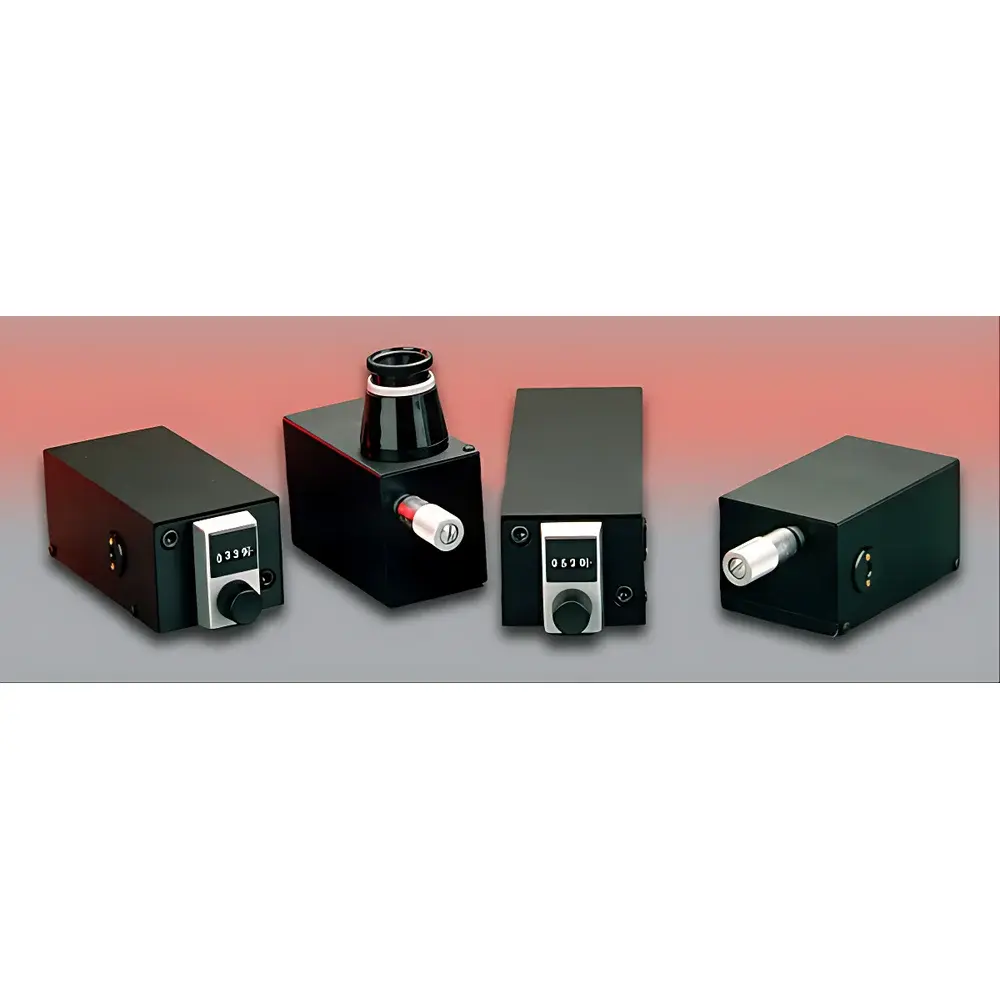
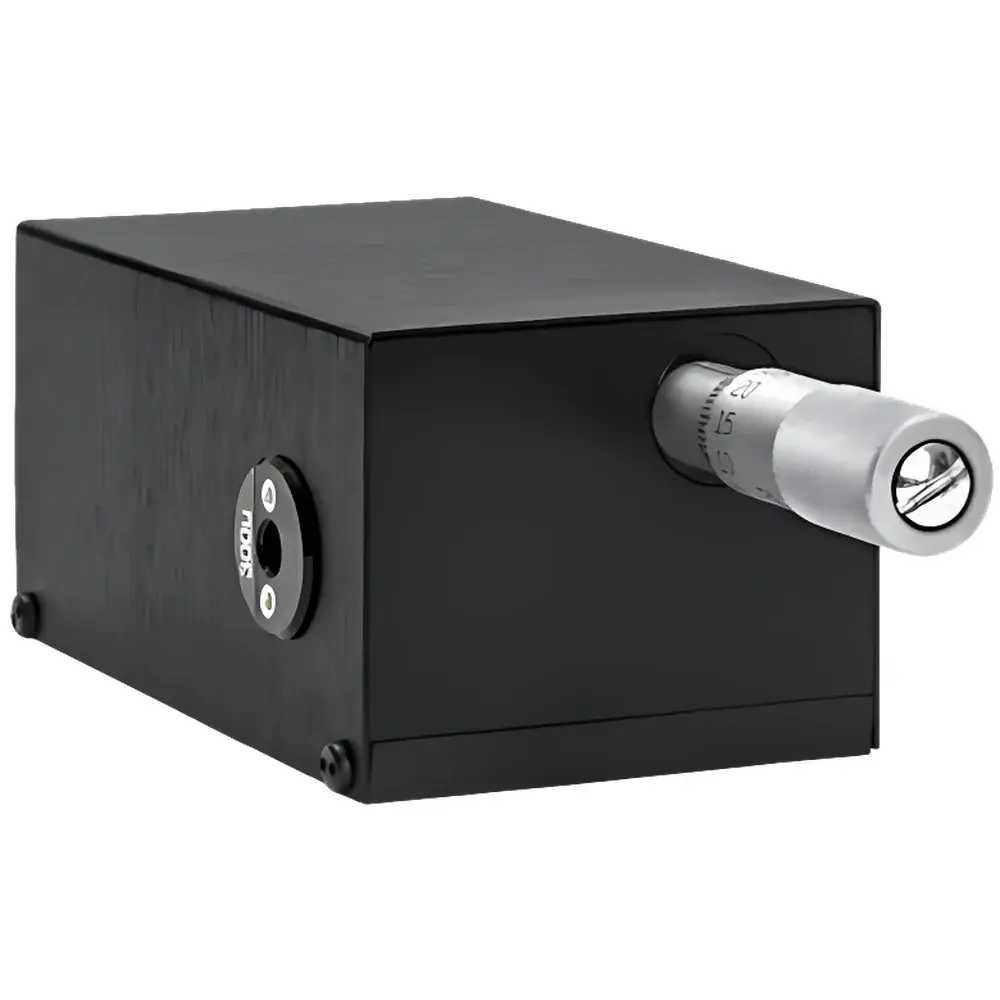
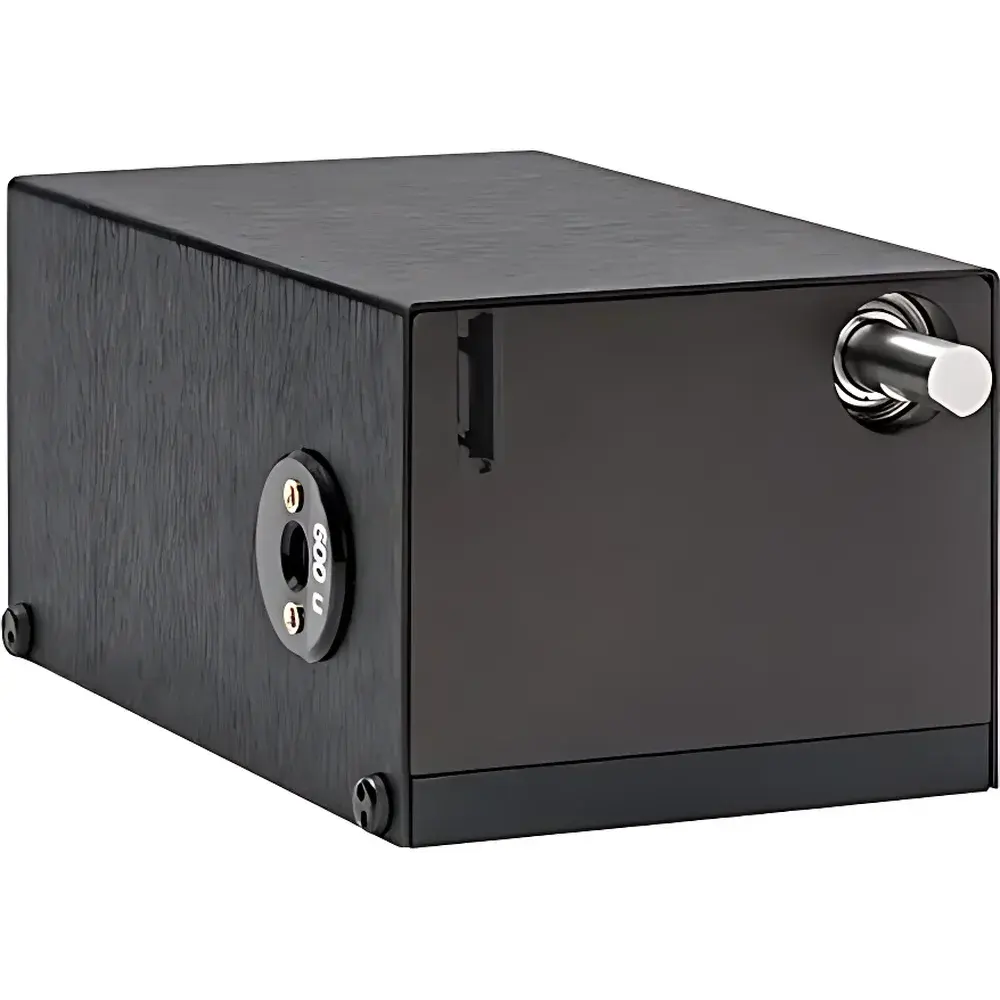
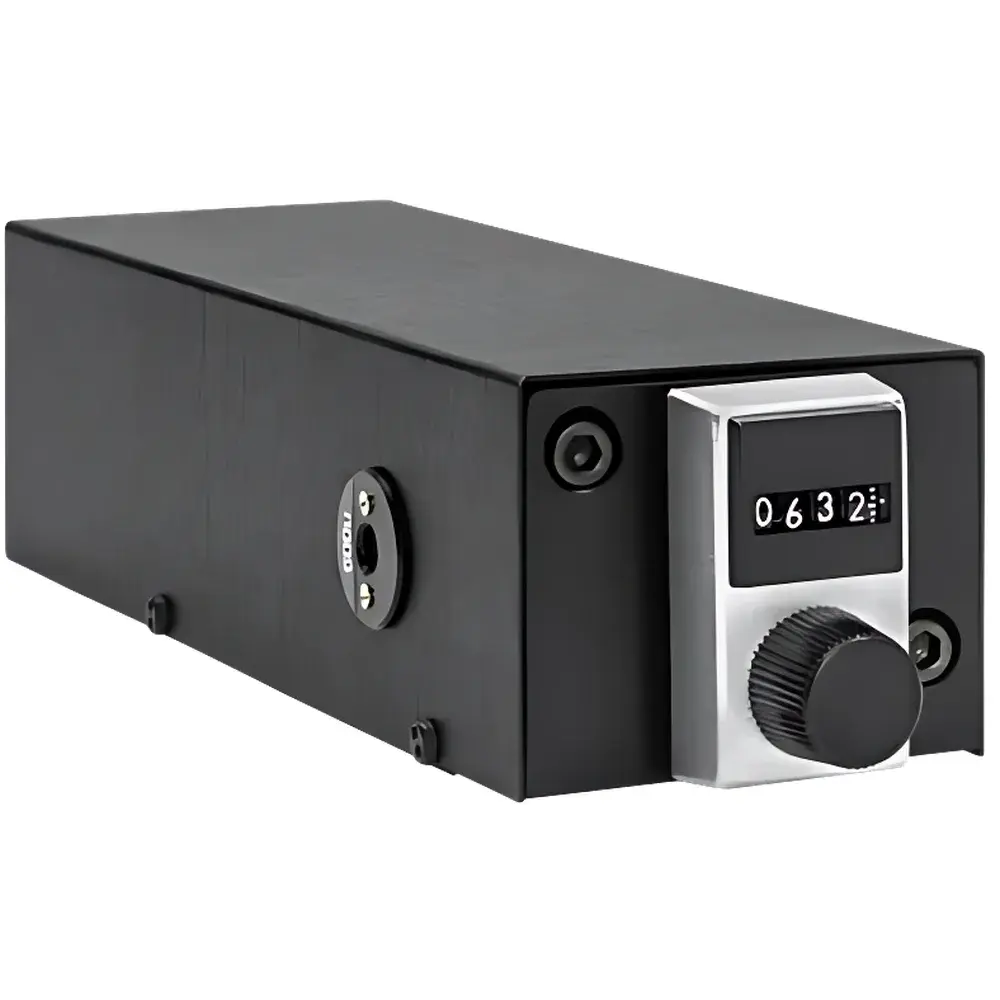
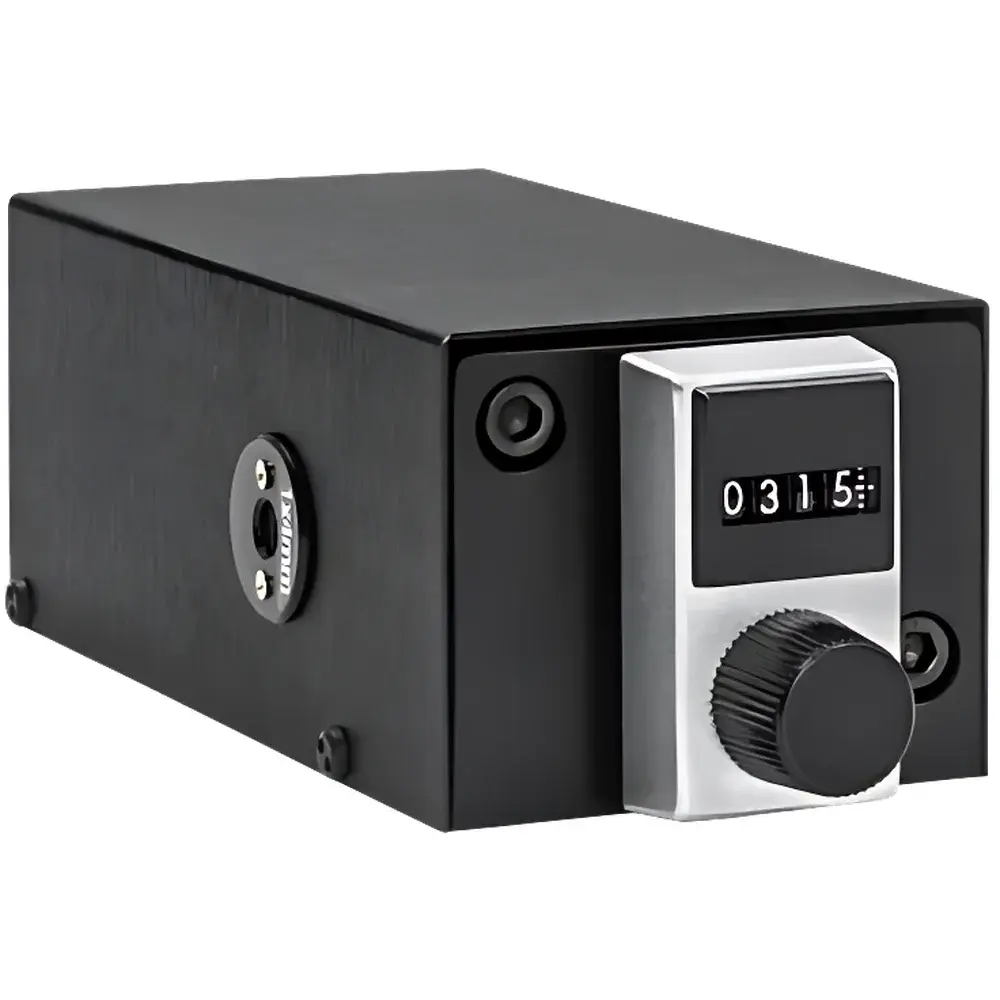
Optometrics Mini-Chrom Ebert-Fastie Monochromator
| Brand | Optometrics |
|---|---|
| Origin | USA |
| Manufacturer Type | Authorized Distributor |
| Import Status | Imported |
| Model | Mini-Chrom |
| Price | USD $2,000 |
| Application Systems | Transmission & Reflection Spectroscopy |
| Grating Mount | Rotatable Grating Table |
| Spectral Resolution | 0.3 nm (at 50 µm slit width, 2400 g/mm holographic grating) |
| Linear Dispersion | 5.34 nm/mm (2400 g/mm holographic grating) |
| Wavelength Range | 190–2200 nm |
| F/# | F/3.9 |
| Wavelength Accuracy | ±0.2% |
| Stray Light | ≤0.003% (measured at 632.8 nm HeNe laser line, 10 nm bandwidth) |
Overview
The Optometrics Mini-Chrom Ebert-Fastie Monochromator is a compact, high-performance optical instrument engineered for precision wavelength selection in UV-VIS-NIR spectroscopic applications. Based on the classical Ebert-Fastie optical configuration—a variant of the Czerny-Turner design optimized for reduced astigmatism and enhanced spectral resolution—the Mini-Chrom delivers laboratory-grade performance in a miniature form factor (74 mm focal length). Its robust mechanical architecture, combined with thermally stable aluminum optics housing and kinematically mounted optical components, ensures long-term alignment integrity under varying environmental conditions. The monochromator operates on the principle of angular dispersion via diffraction gratings, enabling selective isolation of narrow spectral bands from broadband light sources. It is widely deployed in OEM instrumentation—including clinical chemistry analyzers, HPLC UV-Vis detectors, industrial process spectrometers, and benchtop UV-VIS-NIR spectrophotometers—where space constraints, thermal stability, and reproducible spectral fidelity are critical.
Key Features
- Compact Ebert-Fastie optical layout (74 mm focal length) minimizing astigmatic aberration and maximizing resolution-to-size ratio
- Interchangeable slit pairs (50–1000 µm widths) for real-time optimization of throughput vs. resolution trade-offs
- Holographic and ruled grating options (up to 2400 g/mm), each calibrated for specific blaze wavelengths and spectral ranges (190–2200 nm)
- Stray light suppression ≤0.003% (with holographic grating, measured at 632.8 nm, 10 nm bandwidth), meeting ISO 9022-18 and ASTM E275 spectral purity requirements
- F/3.9 input/output optics supporting efficient coupling with fiber-optic interfaces (SMA 905 standard), tungsten-halogen lamps, and photodetectors
- Wavelength repeatability ±0.15%, readability 0.2 nm, and accuracy ±0.2% — traceable to NIST-traceable calibration standards
- Optical damage threshold: 100 W/cm² (CW), 2 J/cm² (100 ns pulsed), validated per ISO 11551 for high-power source compatibility
- Operating temperature range: −20 °C to +80 °C, suitable for embedded deployment in regulated environments (e.g., GMP-compliant analytical systems)
Sample Compatibility & Compliance
The Mini-Chrom supports both transmission and reflection measurement geometries, accommodating solid, liquid, and gas-phase samples via optional sample chambers or fiber-coupled probe interfaces. Its optical path is fully coaxial and accessible for integration into custom beamlines. All internal optics feature protected aluminum coatings (R > 85% from 190–850 nm); gold-coated variants are available for enhanced NIR reflectance (>95% from 800–2200 nm), complying with ISO 15399:2021 recommendations for extended-range spectrophotometry. The instrument meets electromagnetic compatibility (EMC) requirements per FCC Part 15 Subpart B and IEC 61326-1 for laboratory and industrial use. For regulated applications, its mechanical repeatability and deterministic wavelength encoding support audit-ready GLP/GMP workflows; optional motorized versions (DMC1/SDMC1 series) include firmware-logged position tracking compatible with FDA 21 CFR Part 11 electronic record controls.
Software & Data Management
While the base Mini-Chrom is manually tuned, digital variants (DMC1, SMC1, SDMC1) integrate with industry-standard control ecosystems. The DMC1 series includes a 4-digit wavelength counter with RS-232/USB interface and LabVIEW™ drivers; the SDMC1 adds programmable step-scan capability (minimum 0.1 nm step size) and full spectral sweep automation. All motorized models support timestamped wavelength logging, position history export (CSV/TXT), and synchronization with external detectors (e.g., Si, InGaAs, PMT modules). Calibration files are stored onboard and can be updated via secure firmware upload. Data acquisition software complies with ASTM E131-22 metadata tagging conventions, embedding instrument ID, grating type, slit width, and calibration date directly into exported spectra.
Applications
- UV-VIS-NIR absorbance and reflectance spectroscopy in pharmaceutical QC labs (USP , EP 2.2.25)
- Real-time monitoring of chemical reactions in flow cells and microfluidic platforms
- Multi-wavelength detection in HPLC and CE systems requiring high spectral specificity
- OEM integration into point-of-care diagnostics devices, environmental sensors, and semiconductor wafer inspection tools
- Fundamental research in photophysics, photochemistry, and material bandgap characterization
- Calibration reference source filtering for radiometric and photometric standards laboratories
FAQ
What grating options are available for the Mini-Chrom?
Eight standard grating configurations are offered—including 2400 g/mm holographic (190–650 nm), 1800 g/mm holographic (200–800 nm), and 600 g/mm ruled (850–2200 nm)—each characterized for linear dispersion, blaze efficiency, and polarization response.
Can the Mini-Chrom be used with pulsed lasers?
Yes. With a certified damage threshold of 2 J/cm² (100 ns pulses), it is qualified for use with nanosecond-pulsed Nd:YAG harmonics, Ti:sapphire OPA outputs, and supercontinuum sources when operated within specified fluence limits.
Is NIST-traceable calibration included?
A factory calibration certificate (traceable to NIST SRM 2036 and 2037) is supplied with each unit. Optional annual recalibration services are available through Optometrics’ ISO/IEC 17025-accredited metrology lab.
How is stray light performance verified?
Stray light is measured per ISO/DIS 14217 using double-monochromator methodology: a primary HeNe laser at 632.8 nm is passed through the Mini-Chrom, and out-of-band signal at ±10 nm is quantified with a calibrated photodiode referenced to an absolute power meter.
What mounting and interfacing options exist for OEM integration?
Standard ¼”-20 and M4 threaded holes enable rigid kinematic mounting; SMA 905, FC/PC, and bare-fiber coupling adapters are available. Custom flanges, motorized focus stages, and vacuum-compatible housings can be engineered under NDA.




