
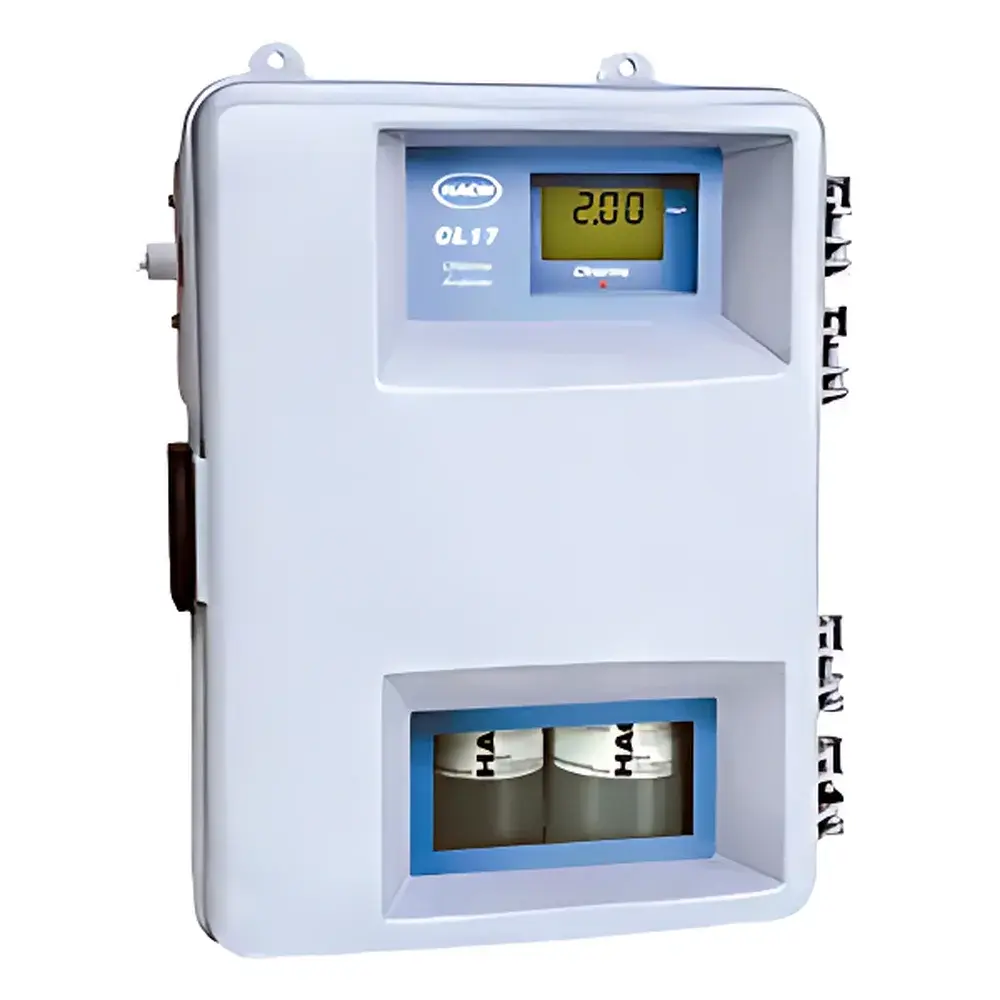
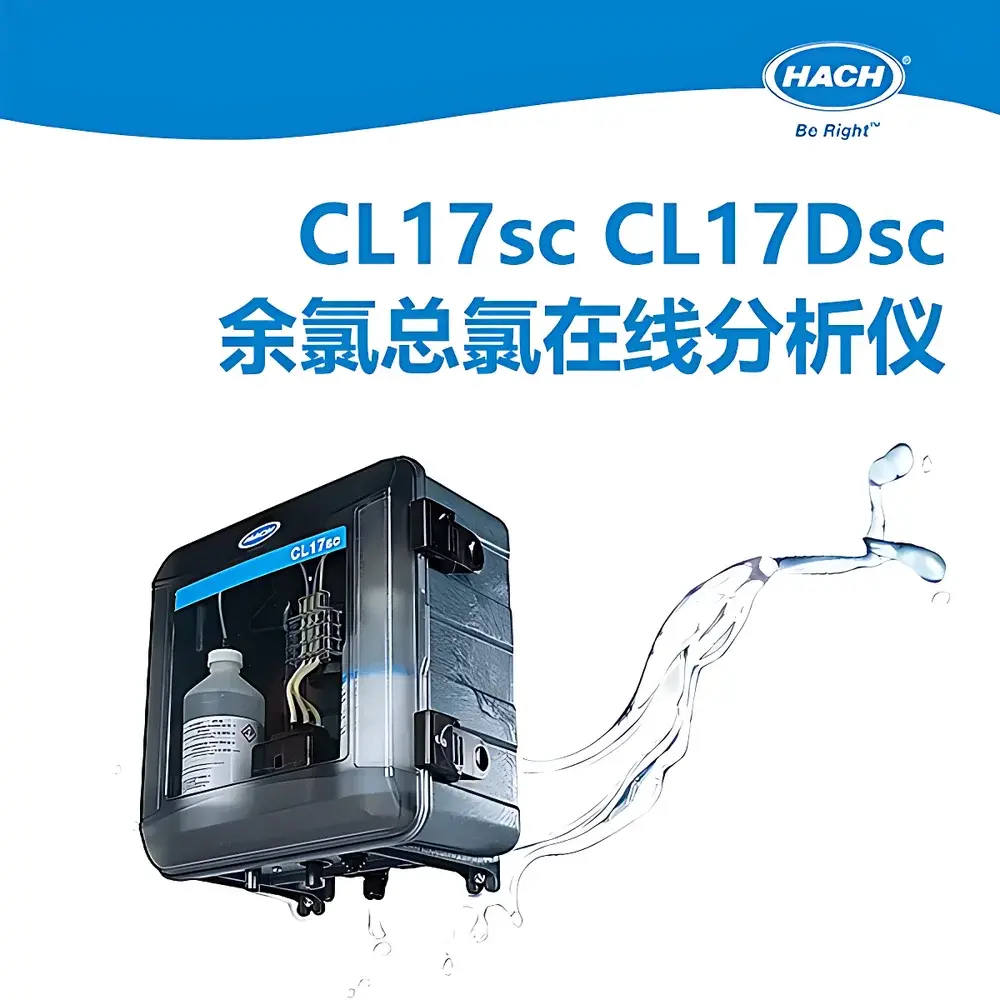
Hach CL17D Residual and Total Chlorine Analyzer – Distribution Network Version
| Brand | Hach |
|---|---|
| Origin | USA |
| Manufacturer | Hach Company |
| Product Type | Imported |
| Model | CL17D Residual and Total Chlorine Analyzer – Distribution Network Version |
| Instrument Type | Online Analyzer |
| Measurement Principle | DPD Colorimetric Method (N,N-Diethyl-p-phenylenediamine) |
| Measured Parameter | Residual Chlorine / Total Chlorine |
| Range | 0–5 mg/L as Cl₂ |
| Accuracy | ±5% or ±0.005 mg/L as Cl₂ (whichever is greater) |
| Repeatability | ±0.035 mg/L or ±5% as Cl₂ (whichever is greater) |
| Detection Limit | 0.035 mg/L as Cl₂ |
| Sample Temperature Range | 5–40 °C |
| Cycle Time | 10 minutes |
| Analog Output | 4–20 mA (configurable across 0–5 mg/L range) |
| Alarm Outputs | Two user-configurable concentration alarms, each with SPDT relay (5 A, 230 VAC) |
| Dimensions | 42 × 32 × 18 cm |
| Turbidity & Color Compensation | Automatic |
| Calibration | Built-in calibration curve |
| Diagnostic Capability | Self-diagnostic system |
| Reagent Lifetime | Up to 120 days (unopened) |
Overview
The Hach CL17D Residual and Total Chlorine Analyzer – Distribution Network Version is an online, fully automated water quality monitoring instrument engineered for long-term, unattended operation in municipal drinking water distribution systems and secondary supply points. It employs the standardized DPD (N,N-diethyl-p-phenylenediamine) colorimetric method—recognized by EPA Method 334.0 and ISO 7393-2—to quantitatively determine free residual chlorine and total chlorine concentrations in potable water. Unlike conventional laboratory or short-cycle online analyzers, the CL17D implements a precisely controlled 10-minute measurement cycle optimized for stable, low-maintenance deployment in remote or infrastructure-constrained locations. Its architecture integrates optical path stabilization, dual-wavelength photometric detection, and real-time turbidity and color compensation algorithms to mitigate interferences from naturally occurring organic matter, iron/manganese oxidation products, and suspended solids commonly encountered in distribution networks.
Key Features
- Extended 10-minute analysis cycle reduces reagent consumption by up to 75% compared to standard 2.5-minute instruments—significantly extending operational uptime between maintenance visits.
- Automatic turbidity and color compensation ensures robust performance across variable source water qualities without manual intervention or pre-filtration.
- Onboard diagnostic routines continuously monitor optical integrity, reagent delivery accuracy, pump performance, and valve sequencing—providing actionable fault codes and predictive maintenance alerts.
- Pre-programmed calibration curves eliminate the need for daily standardization; field verification can be performed using NIST-traceable chlorine standards per ASTM D1253 and USP .
- Compact industrial enclosure (42 × 32 × 18 cm) meets IP65 rating for indoor cabinet or outdoor shelter installation; compatible with standard 19-inch rack mounting via optional kit.
- Two independently configurable alarm relays support integration into SCADA systems for immediate response to disinfectant breakthrough, loss-of-residual events, or process excursions.
Sample Compatibility & Compliance
The CL17D is validated for use with chlorinated drinking water samples meeting ANSI/AWWA C651 and NSF/ANSI 61 requirements. It operates reliably within a sample temperature range of 5–40 °C and tolerates inlet pressures up to 100 psi (6.9 bar) with integrated pressure regulation. Reagents are formulated to comply with OSHA hazard communication standards and EU REACH Annex XIV restrictions. Data integrity aligns with GLP and GMP principles: all measurements include timestamped metadata (cycle start time, raw absorbance values, compensation factors), and the analyzer supports audit-trail-enabled firmware versions compliant with FDA 21 CFR Part 11 when paired with Hach’s DataStream™ software platform.
Software & Data Management
The CL17D communicates via isolated 4–20 mA analog output (fully scalable across 0–5 mg/L Cl₂), Modbus RTU over RS-485, and optional Ethernet/IP interface. When connected to Hach’s DataStream™ or third-party SCADA platforms (e.g., Ignition, Siemens Desigo, Schneider EcoStruxure), it delivers continuous time-series data with embedded QA/QC flags—including signal stability index, reagent expiration warning, and optical drift alert. All configuration changes, calibration events, and alarm triggers are logged with user ID, timestamp, and parameter context—enabling full traceability during regulatory audits or root-cause investigations.
Applications
- Real-time monitoring at critical nodes in municipal water distribution networks—including booster stations, reservoir outlets, and zone boundary valves.
- Secondary water supply systems in high-rise buildings and campus utilities where residual chlorine decay must be tracked over extended hydraulic residence times.
- Compliance reporting for regulatory mandates such as the U.S. EPA Long Term 2 Enhanced Surface Water Treatment Rule (LT2ESWTR) and the EU Drinking Water Directive (2020/2184/EU).
- Performance validation of point-of-use disinfection units and chlorine contact tank efficiency assessments.
- Integration into smart water grid initiatives requiring interoperable, low-power, long-duration sensor nodes.
FAQ
What is the recommended reagent storage condition prior to installation?
Reagents must be stored refrigerated (2–8 °C) in original sealed packaging; avoid freezing and exposure to direct sunlight. Once installed, onboard temperature-controlled reagent chamber maintains optimal stability.
Can the CL17D measure both free chlorine and total chlorine without hardware modification?
Yes—the same flow cell and optical module support both measurement modes via programmable reagent addition sequence and reaction timing; switching is performed through software configuration only.
Is the analyzer suitable for groundwater with high iron content?
Yes—automatic color compensation corrects for interference from oxidized iron species (Fe³⁺), provided turbidity remains below 5 NTU and sample pH is maintained between 6.2 and 8.0.
How does the 10-minute cycle affect detection limit and precision?
The extended reaction time improves signal-to-noise ratio for low-level residuals (<0.1 mg/L), maintaining the stated LOD of 0.035 mg/L as Cl₂ while preserving repeatability within ±0.035 mg/L or ±5% (whichever is greater).
Does the CL17D support remote firmware updates and diagnostics?
Firmware updates require local USB connection or secure FTP upload via Ethernet; remote diagnostics—including live sensor health status and historical error logs—are accessible through Hach’s cloud-based Asset Insight portal when enabled.







