
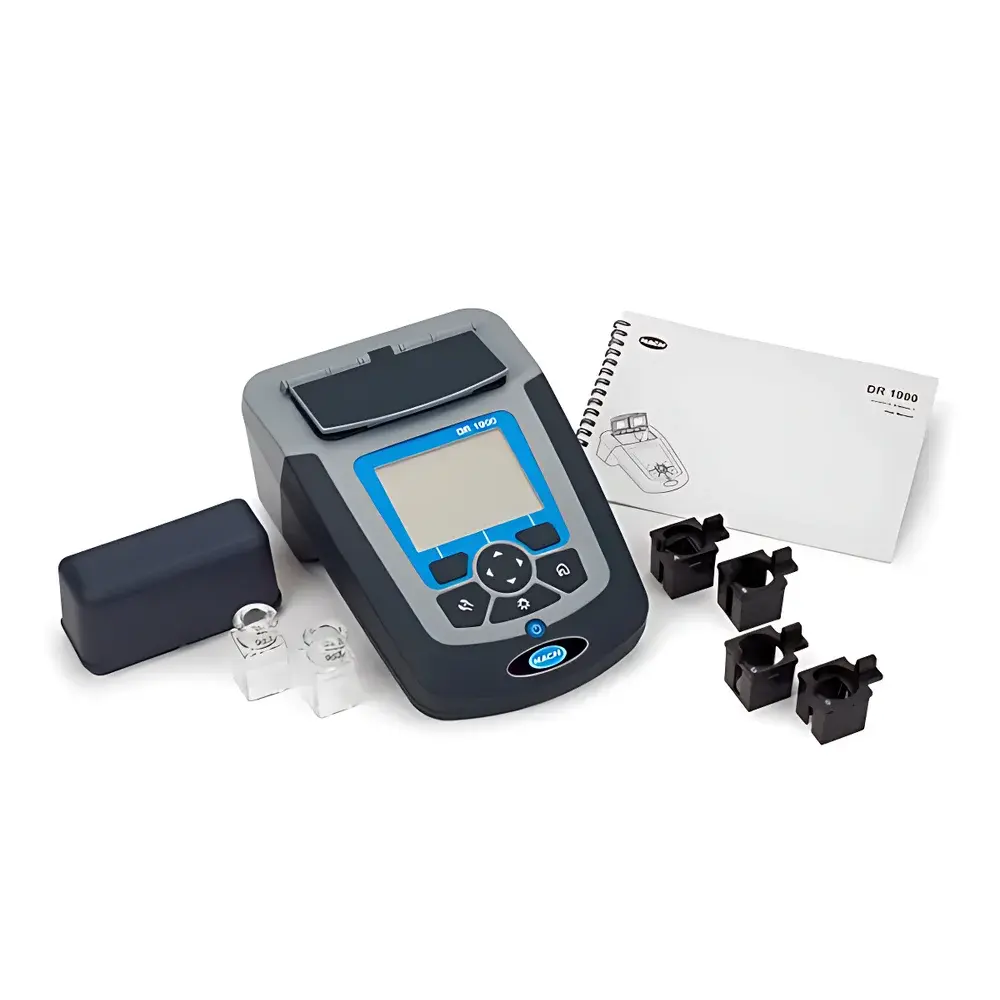
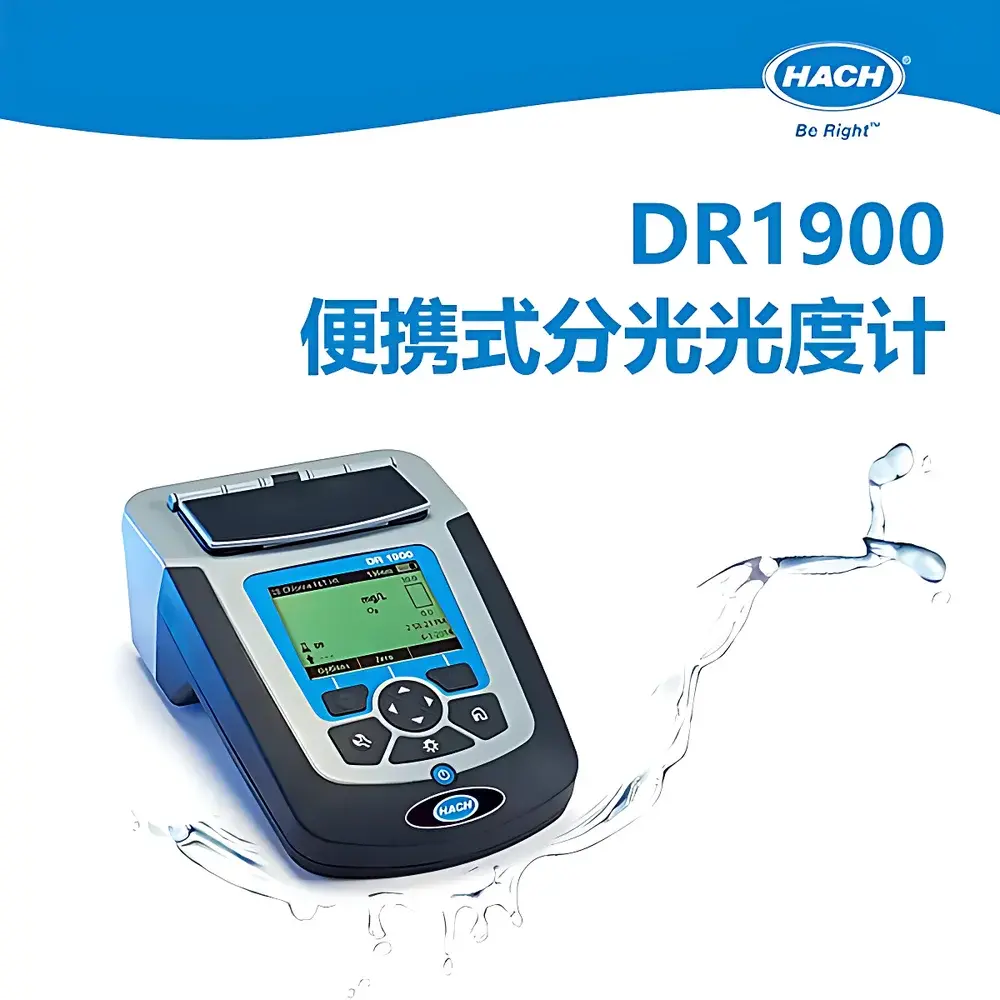
Hach DR1900 Portable Multi-parameter Spectrophotometer
| Brand | Hach |
|---|---|
| Origin | Imported |
| Manufacturer Status | Manufacturer |
| Model | DR1900 |
| Price | Upon Request |
Overview
The Hach DR1900 Portable Multi-parameter Spectrophotometer is a compact, field-deployable UV-Vis spectrophotometer engineered for rapid, reliable quantitative analysis of water and wastewater samples in situ. It operates on the principle of absorption spectroscopy—measuring the attenuation of light intensity at specific wavelengths as it passes through a sample—to determine analyte concentration via Beer-Lambert law correlation. Designed for real-time decision-making in resource-constrained or mobile laboratory environments, the DR1900 integrates a xenon flash lamp light source, fixed grating monochromator, and silicon photodiode detector to deliver consistent spectral performance across 340–800 nm. Its fully automated wavelength selection, high optical stability, and built-in calibration verification routines ensure measurement integrity without requiring routine optical recalibration. The instrument meets the functional expectations of field chemists, environmental technicians, and plant operators who require traceable, GLP-compliant data under variable ambient conditions.
Key Features
- Compact ergonomic design (178 × 267 × 98 mm; 1.5 kg) optimized for single-hand operation and extended field use
- IP67-rated enclosure—dust-tight and protected against immersion in 1 m water for up to 30 minutes—enabling deployment in humid, outdoor, or industrial settings
- Xenon lamp illumination providing broad-spectrum output with stable intensity and negligible warm-up time
- Automatic wavelength selection across 340–800 nm with ±2 nm accuracy and ±0.1 nm repeatability
- 5 nm spectral bandwidth ensuring adequate resolution for common colorimetric methods (e.g., APHA, TCU, COD, nitrate, phosphate, chlorine)
- Three measurement modes: concentration (mg/L, ppm), absorbance (Abs), and transmittance (%T), with direct method recall
- Backlit LCD display with adjustable contrast for legibility under low-light or direct sunlight conditions
- Support for multiple cuvette formats: square cells (10 × 10 mm), round cells (13 mm, 16 mm, and 25 mm diameter), and 1-inch pathlength vials
- Powered by four AA batteries (standard) or optional AC adapter (110–240 VAC, 50/60 Hz) with mini-USB data export capability
Sample Compatibility & Compliance
The DR1900 is validated for use with over 260 pre-programmed Hach methods—including EPA-approved, ISO-standardized, and ASTM-referenced procedures—for parameters such as total chlorine, free chlorine, ammonia, nitrate, nitrite, sulfate, hardness, silica, iron, manganese, and turbidity (via formazin-based calibration). Its optical architecture complies with ISO 7027 for turbidity measurements and supports US EPA Method 365.3 for orthophosphate. All stored data include timestamp, operator ID (if configured), method ID, and calibration status—fulfilling GLP documentation requirements. The instrument’s firmware supports audit trail logging when paired with Hach’s DataCapture software, aligning with FDA 21 CFR Part 11 principles for electronic records in regulated water quality testing environments.
Software & Data Management
Data generated by the DR1900 are stored locally in non-volatile memory (500 results maximum), each tagged with date/time stamp, selected method, measured value, and unit. Internal memory retains full GLP metadata—including calibration history and user-defined notes—without external dependency. Optional USB connectivity enables direct transfer of datasets to Windows-based PCs using Hach’s free DataCapture software, which supports batch export to CSV, PDF report generation, and trend visualization. User-customizable methods (up to 50) can be created, saved, and password-protected to accommodate proprietary or site-specific protocols. Firmware updates are delivered via USB and maintain backward compatibility with existing method libraries.
Applications
- Municipal drinking water treatment: residual disinfectant monitoring (free/chlorine, chloramine), raw water quality screening, and distribution system compliance checks
- Wastewater effluent and influent analysis: BOD/COD estimation support, nutrient load tracking (N, P), and process control of biological reactors
- Industrial boiler and cooling water management: corrosion inhibitor quantification, silica and iron monitoring, and cycle-of-concentration verification
- Environmental field surveys: surface water and groundwater assessment per state-certified lab protocols
- Educational laboratories: hands-on instruction in spectrophotometric principles, calibration curve development, and method validation
- Emergency response: rapid contaminant identification during spill events or infrastructure failures
FAQ
Does the DR1900 require annual factory calibration?
No. The xenon lamp and optical path are inherently stable; only periodic verification using Hach-certified absorbance standards (e.g., product #2763900) is recommended per GLP guidelines.
Can the DR1900 connect to LIMS systems?
Yes—via USB-exported CSV files or integration with Hach’s DataCapture software, which supports configurable field mapping for LIMS ingestion.
Is method validation documentation available for regulatory submissions?
Hach provides method validation summaries, uncertainty budgets, and interlaboratory study reports upon request for key EPA and ISO methods supported by the DR1900.
What is the operational lifetime of the xenon lamp?
The flash lamp is rated for ≥1 × 10⁶ flashes—equivalent to >5 years of typical field use—and does not require replacement during standard service intervals.
Are third-party cuvettes compatible?
Only Hach-certified cuvettes (including LZV537 filter set and standardized 1-inch vials) are guaranteed to meet pathlength tolerance and optical clarity specifications required for method accuracy.





