
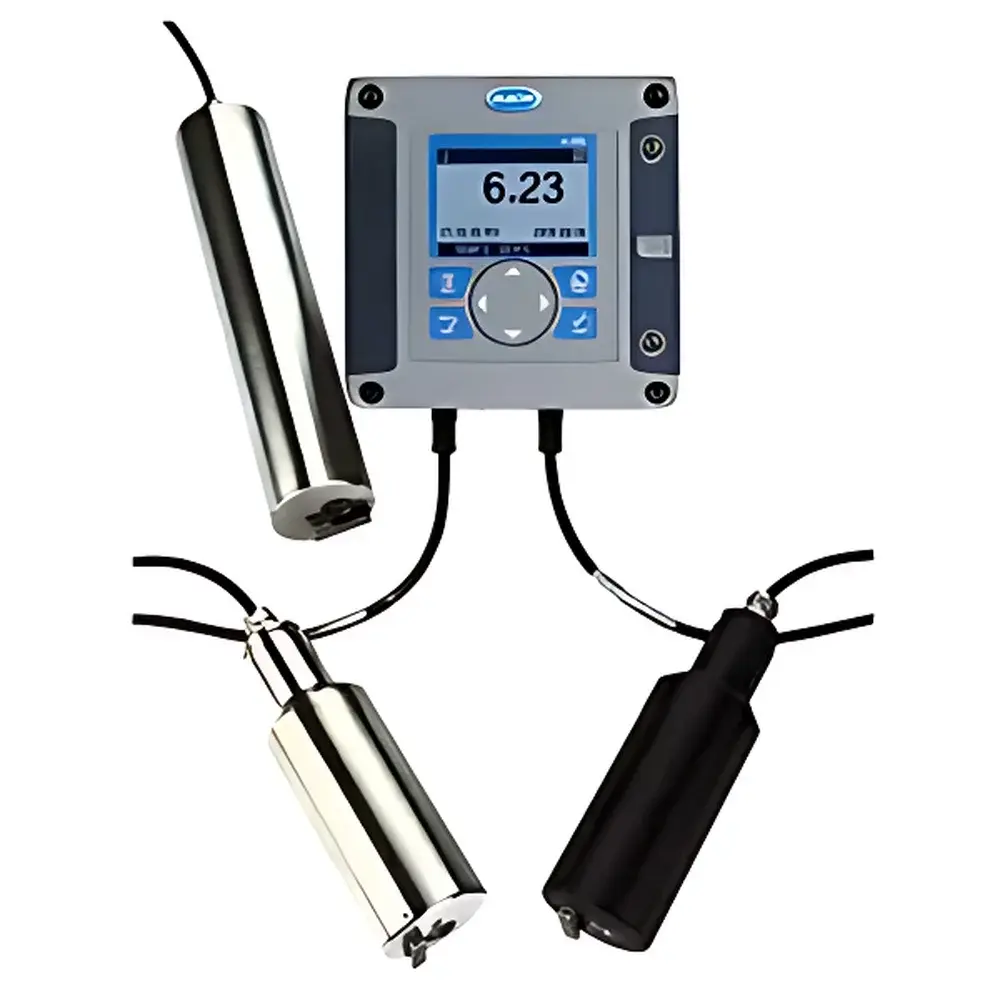
HACH SOLITAX™ sc Turbidity and Suspended Solids (Sludge Concentration) Analyzer
| Brand | HACH |
|---|---|
| Origin | Imported |
| Manufacturer Type | Manufacturer |
| Instrument Type | Online Analyzer |
| Model | SOLITAX™ sc |
| Measurement Principle | Dual-Angle Infrared Nephelometry (90° forward scatter for turbidity |
| Light Source | 880 nm LED |
| Optical Compensation | Color-independent measurement via near-infrared wavelength |
| Probe Feature | Integrated self-cleaning mechanism |
| Installation Options | Submersible, flow-through, or insertion-type mounting |
| Compliance Context | Designed for continuous compliance monitoring per ISO 7027, ASTM D6508, and EPA Method 180.1 |
Overview
The HACH SOLITAX™ sc Turbidity and Suspended Solids (Sludge Concentration) Analyzer is an industrial-grade online optical sensor engineered for continuous, real-time quantification of both turbidity and suspended solids concentration in aqueous matrices. It operates on dual-angle infrared nephelometry: a stable 880 nm light-emitting diode (LED) source emits near-infrared radiation into the sample, minimizing interference from chromophoric compounds commonly present in wastewater and process water. Scattered light is detected at two geometrically distinct angles—90° for turbidity (in accordance with ISO 7027 and ASTM D6508 principles) and 140° for suspended solids quantification—enabling simultaneous, independent measurement channels without cross-sensitivity. This dual-detection architecture eliminates reliance on empirical calibration transfer between turbidity and sludge concentration, supporting robust process control in activated sludge systems, clarifier optimization, and filtration monitoring. The analyzer is designed for permanent installation in harsh, unattended environments—including submerged, flow-cell, or pipe-insertion configurations—and integrates seamlessly into plant-wide SCADA and DCS infrastructures.
Key Features
- Dual-parameter capability: Simultaneous, independent measurement of turbidity (NTU) and suspended solids concentration (mg/L or g/L), with no shared calibration dependency.
- 880 nm near-infrared LED illumination: Provides inherent color compensation, ensuring measurement stability across colored effluents, dyed process streams, and humic-rich raw waters.
- Self-cleaning probe design: Integrated mechanical wiper or ultrasonic cleaning option (model-dependent) mitigates fouling in high-solids or biofilm-prone applications, extending maintenance intervals.
- Ruggedized stainless steel (316L) or titanium housing: Rated to IP68/NEMA 6P for submersion up to 10 m depth and resistant to chemical corrosion in municipal and industrial wastewater.
- Temperature-compensated signal processing: Onboard Pt1000 RTD enables automatic thermal correction of optical response drift across 0–50 °C operating range.
- Configurable analog (4–20 mA) and digital outputs (Modbus RTU/TCP, Profibus DP): Supports direct integration with PLCs, DCS, and asset management platforms.
Sample Compatibility & Compliance
The SOLITAX™ sc is validated for use in municipal wastewater treatment plants (WWTPs), drinking water facilities, industrial pretreatment systems, and closed-loop cooling circuits. It accommodates samples with suspended solids concentrations ranging from 0.1 to 50,000 mg/L (sludge blanket profiling) and turbidity from 0.001 to 4000 NTU (including low-turbidity filter effluent and high-turbidity return activated sludge). Its optical design conforms to ISO 7027 for turbidity measurement methodology and aligns with the technical basis of EPA Method 180.1 for suspended solids estimation in continuous monitoring contexts. While not a replacement for laboratory gravimetric analysis (e.g., Standard Methods 2540D), it delivers traceable, repeatable field data suitable for trend analysis, alarm triggering, and regulatory reporting under local discharge permits. The instrument’s firmware supports audit-trail logging and user-access controls compliant with GLP-aligned operational protocols.
Software & Data Management
Data acquisition and configuration are managed via HACH’s IntelliCAL™ software suite or integrated through the PlantWeb® Digital Ecosystem. The analyzer supports time-stamped, high-resolution data logging (up to 1 Hz sampling rate) with configurable averaging windows (1–3600 seconds). All measurements include embedded metadata: temperature, signal intensity diagnostics, cleaning cycle timestamps, and optical path integrity flags. Raw scatter signals from both detectors are accessible via Modbus register mapping for advanced process modeling. Firmware updates follow secure over-the-air (OTA) protocols with cryptographic signature verification. Data export formats include CSV and OPC UA-compliant structured payloads, enabling ingestion into MES, LIMS, or predictive maintenance platforms. Audit logs record all configuration changes, calibration events, and user authentication actions—supporting 21 CFR Part 11 readiness when deployed in regulated pharmaceutical or food & beverage water loops.
Applications
- Activated sludge process control: Real-time monitoring of mixed liquor suspended solids (MLSS) and return sludge concentration to optimize aeration energy and sludge wasting rates.
- Filtration performance assessment: Detection of breakthrough events in granular media filters using rapid turbidity rise detection (<5 sec response time).
- Clarifier and sedimentation basin optimization: Interface level tracking via vertical profiling arrays (multi-probe deployments) to prevent sludge blanket carryover.
- Industrial cooling water management: Early detection of biofilm detachment or corrosion particulate release before heat exchanger fouling occurs.
- Drinking water treatment: Monitoring of raw water variability, coagulation efficiency, and final filtered water quality against WHO and EU Drinking Water Directive thresholds.
- Combined sewer overflow (CSO) event characterization: High-range turbidity measurement during wet-weather flows to support dynamic control of retention basins.
FAQ
Does the SOLITAX™ sc require periodic recalibration?
Yes—while the 880 nm LED offers long-term photometric stability, annual verification against traceable turbidity standards (e.g., AMCO AEPA or Formazin) and suspended solids reference slurries is recommended per ISO/IEC 17025-aligned QA/QC programs.
Can it be installed in pressurized pipelines?
Yes, when configured with a flow-through cell and appropriate pressure-rated housing (up to 10 bar), subject to model-specific mechanical certification.
How does it handle air bubbles or foam in wastewater?
The dual-angle detection algorithm includes bubble rejection logic based on differential scatter response; however, persistent foam layers may necessitate mechanical skimming or installation geometry adjustment.
Is the probe compatible with hazardous area classifications?
ATEX and IECEx-certified variants (e.g., SOLITAX™ sc Ex) are available for Zone 1/21 installations with intrinsic safety barriers.
What maintenance intervals are typical in municipal WWTP applications?
With active self-cleaning enabled, routine inspection is recommended every 3–6 months; cleaning frequency scales inversely with influent solids loading and velocity profile at the installation point.
Related Products







