
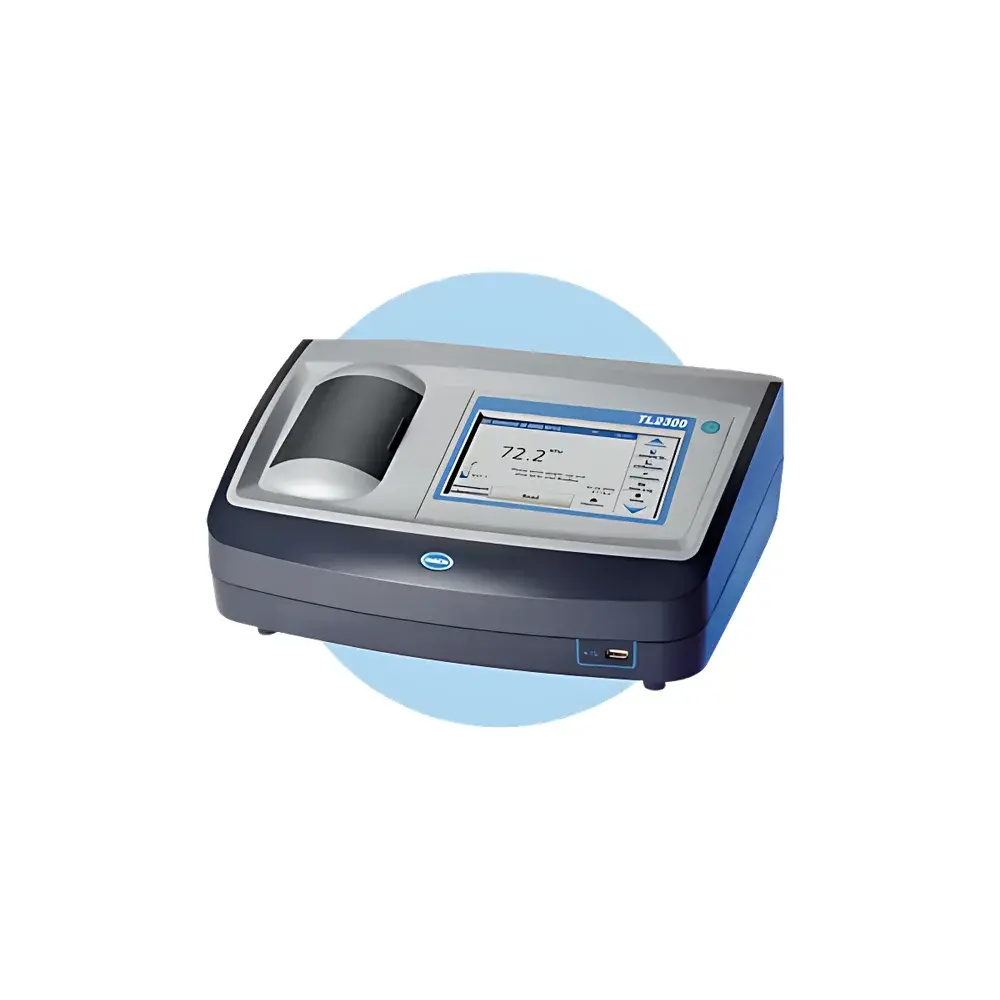
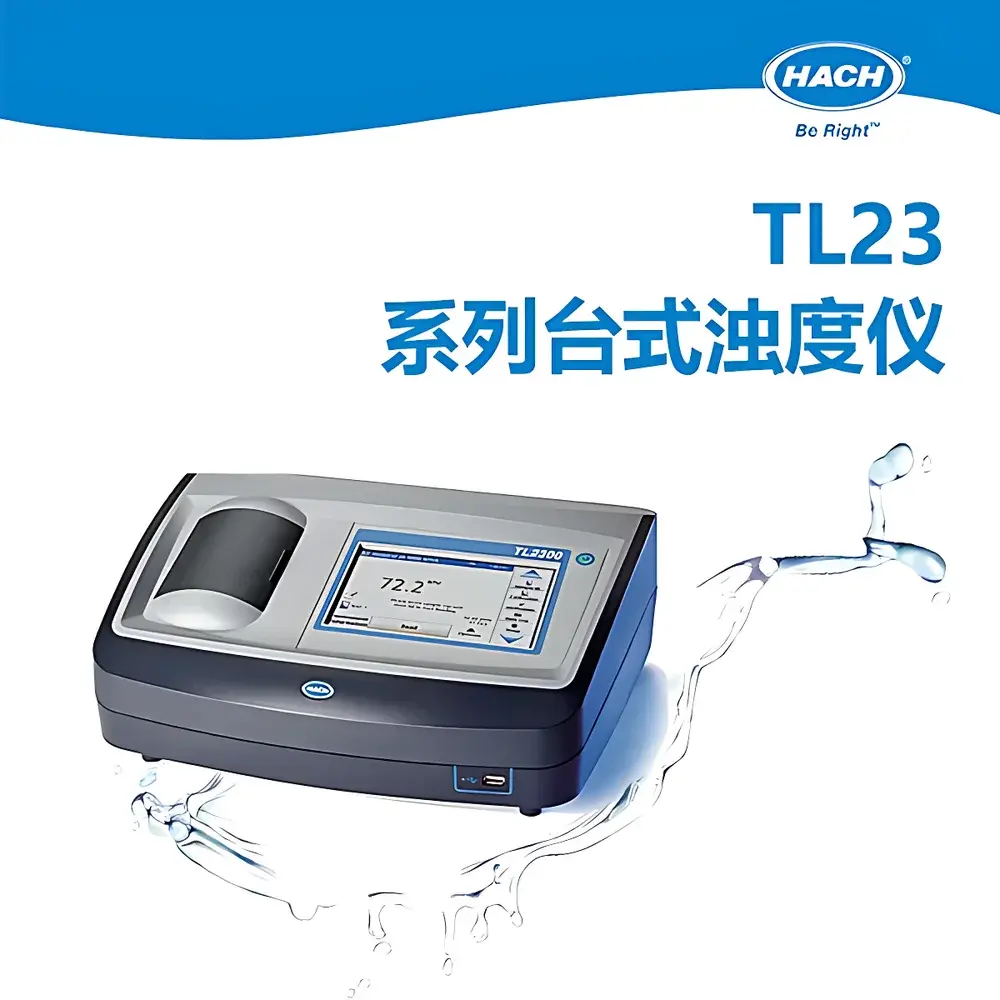
Hach TL23 Benchtop Turbidimeter
| Brand | Hach |
|---|---|
| Origin | Imported |
| Manufacturer Type | Manufacturer |
| Model | TL23 Benchtop Turbidimeter |
| Pricing | Upon Request |
Overview
The Hach TL23 Benchtop Turbidimeter is an ISO 7027-compliant, ratio-based turbidity analyzer engineered for high-precision measurement in demanding quality control environments—particularly in beverage, pharmaceutical, and food & beverage industries where colloidal stability and optical clarity are critical process indicators. Unlike conventional single-beam nephelometers, the TL23 employs a dual-detector optical architecture: one detector measures forward-scattered light at 25°, while the second captures side-scattered light at 90°. The instrument calculates turbidity as the ratio of these two signals, effectively compensating for color interference, bubble artifacts, and particle size distribution variability—key challenges in complex matrices such as wine, fruit juices, and bioprocess broths. This ratio-metric principle ensures metrological robustness across a wide dynamic range (0–4000 NTU), with enhanced linearity and reduced susceptibility to photometric drift. Designed for routine compliance with SN/T 4675.26–2016 (Determination of Turbidity in Exported Wines – Nephelometric Method) and aligned with USP , ASTM D6506, and ISO 7027–1:2016, the TL23 delivers traceable, reproducible results essential for thermal stability assessment and batch release decisions.
Key Features
- Ratio-metric dual-angle detection (25° + 90°) minimizes matrix interference from color, bubbles, and non-spherical particles
- Automatic stability recognition algorithm eliminates subjective endpoint determination—holds measurement until signal variance falls below ±0.1 NTU over 3 seconds, then locks final value
- Integrated StabCal™ calibration verification system enables on-site validation using stable, NIST-traceable formazin standards without manual vial handling
- Large backlit LCD display with intuitive icon-driven interface; supports multi-language operation (English, Spanish, French, German, Chinese)
- GLP-compliant data logging: stores up to 2,000 measurements with timestamp, operator ID, calibration history, and method name
- Robust benchtop housing rated IP32; CE, FCC, and RoHS certified; designed for continuous operation in controlled laboratory environments
Sample Compatibility & Compliance
The TL23 is validated for use with undiluted, unfiltered wine samples—including red, white, rosé, and sparkling varieties—as well as beer, cider, syrups, and fermentation broths. Its optical path accommodates standard 25-mm round glass cuvettes (10-mm or 50-mm pathlength options available). All measurements comply with the scattering geometry and wavelength requirements of ISO 7027–1:2016 (860 ± 30 nm LED source) and meet the performance criteria outlined in SN/T 4675.26–2016 for exported wines. For regulated environments, the instrument supports audit-ready data export via USB and optional Hach Lab Software integration, enabling full 21 CFR Part 11 compliance when paired with electronic signature modules and secure user access controls.
Software & Data Management
Data acquisition and reporting are managed through Hach’s proprietary Lab Software (v5.0+), which provides secure, encrypted local storage, customizable report templates (PDF/CSV), and automated pass/fail evaluation against user-defined stability thresholds (e.g., ΔNTU ≤ 2.0 after 72 h at 30 °C). The software maintains immutable audit trails—including all calibration events, method changes, and result modifications—with time-stamped digital signatures. Instrument firmware supports remote diagnostics and over-the-air updates. All raw data files include embedded metadata: instrument serial number, sensor calibration date, cuvette ID, ambient temperature, and operator credentials—ensuring full traceability per GLP and GMP documentation requirements.
Applications
- Wine thermal stability testing (Hot Stability Test): Quantifying protein-induced haze development after incubation at 30–40 °C
- In-process monitoring of fining agent efficacy (e.g., bentonite, gelatin, PVPP) during clarification stages
- Batch release qualification for clarity and colloidal stability prior to bottling
- Method validation and transfer between QC labs under ISO/IEC 17025 accreditation
- Supporting root-cause analysis of haze formation linked to pH shifts, metal ion content, or oxidation events
- Compliance testing for export markets requiring SN/T 4675.26–2016 or OIV-MA-AS313-01A certification
FAQ
Does the TL23 require daily recalibration for wine analysis?
No—StabCal verification can be performed before each analytical session or per shift; full calibration is recommended weekly or after maintenance.
Can the TL23 measure turbidity in highly colored red wines without compensation errors?
Yes—the ratio-metric design inherently corrects for absorbance-related signal attenuation, eliminating the need for dilution or correction factors.
Is method-specific validation support available for SN/T 4675.26–2016 implementation?
Yes—Hach provides application notes, IQ/OQ protocols, and on-site technical assistance for regulatory method adoption.
How does the TL23 handle air bubbles common in degassed wine samples?
The dual-detector algorithm distinguishes transient bubble scatter from true particulate turbidity by analyzing temporal signal coherence across both detectors.
What data security features ensure compliance with FDA 21 CFR Part 11?
Role-based user authentication, electronic signatures, automatic audit trail generation, and encrypted database storage—all configurable via Lab Software administrative mode.






