
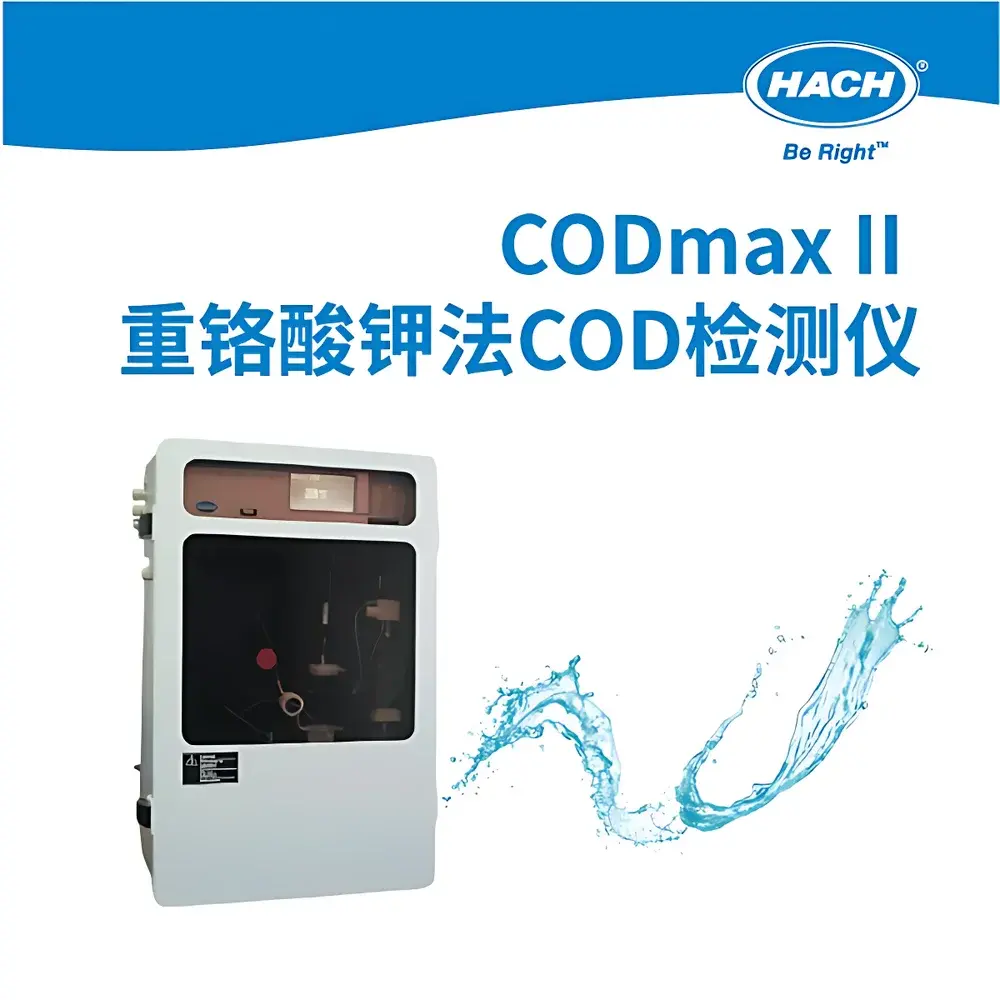
Hach CODmax II Online Chemical Oxygen Demand Analyzer
| Brand | Hach |
|---|---|
| Origin | Imported |
| Manufacturer Type | Manufacturer |
| Instrument Type | Online Analyzer |
| Measurement Principle | Potassium Dichromate Digestion Method |
| Measurement Range | 10–5,000 mg/L COD |
| Repeatability | ≤5% |
| Measurement Cycle Time | 20 min (to >90% response) |
| Batch Capacity | 15 or 30 samples per cycle |
| Digestion Temperature | 175 °C |
| Digestion Duration Options | 3–120 min (selectable in 1-min increments) |
| Calibration Interval | User-defined automatic schedule |
| Cleaning Interval | User-defined automatic schedule |
| Maintenance Requirement | ~1 hour per month |
| Analog Outputs | Two 4–20 mA isolated outputs |
| Relay Outputs | Two 24 VDC / 1 A digital relays |
| Communication Interfaces | RS232, MODBUS RTU over RS485, Profibus DP (optional) |
| Data Storage | 2,000 measurement records |
| Operating Ambient Temperature | +5 to +40 °C |
| Power Supply | 220 VAC ±10%, 50–60 Hz |
| Power Consumption | ~100 VA |
| Dimensions (W×H×D) | 550 × 810 × 390 mm |
| Weight | ~25 kg (excluding reagents) |
Overview
The Hach CODmax II Online Chemical Oxygen Demand Analyzer is an industrial-grade, fully automated system engineered for continuous, unattended monitoring of chemical oxygen demand (COD) in wastewater streams using the standardized potassium dichromate oxidation method. Based on the principle of controlled high-temperature digestion—where sample matrix, potassium dichromate, sulfuric acid, and silver sulfate catalyst are heated to 175 °C in a sealed reaction chamber—the instrument quantifies the reduction of Cr(VI) to Cr(III), proportional to the oxidizable organic content. The resulting colorimetric change is measured spectrophotometrically, and concentration is calculated against calibrated reference standards. Designed for regulatory compliance and long-term operational stability, the CODmax II meets the fundamental requirements of ISO 6060, APHA Standard Methods 5220 D, and EPA Method 410.4, supporting routine discharge monitoring at municipal wastewater treatment plants, industrial effluent outlets, and environmental compliance stations.
Key Features
- Integrated high-precision piston pump system with chemically resistant fluid path components (e.g., PTFE, ETFE, and sapphire bearings) ensuring consistent reagent delivery and minimal carryover.
- Real-time self-diagnostic architecture that continuously monitors critical subsystems—including temperature stability, pressure integrity, photometric baseline drift, and valve actuation status—reporting fault codes via LCD interface and remote communication protocols.
- Automatic leak detection circuitry that identifies micro-leakage in digestion or sampling lines prior to reagent contamination or analytical deviation.
- Onboard automatic calibration and multi-point standard verification using preloaded or user-defined reference solutions, traceable to NIST-certified COD standards.
- Programmable auto-cleaning sequence utilizing high-purity deionized water and optional acid rinse cycles to prevent biofilm accumulation and mineral scaling in the digestion cell and optical flow cell.
- Modular safety enclosure with interlocked access panel, thermal cutoffs, and acid-resistant splash guard—designed to meet IEC 61010-1 and CE machinery directive requirements.
Sample Compatibility & Compliance
The CODmax II accommodates raw influent, secondary effluent, and industrial process waters with suspended solids up to 100 mg/L (pre-filtration recommended above this level). Chloride interference—common in saline or mixed industrial discharges—is mitigated by stoichiometric addition of mercury(II) sulfate, forming stable HgCl₂ complexes. The analyzer supports method validation under GLP and GMP frameworks; audit trails for calibration, cleaning, maintenance, and error logs are retained internally and exportable via MODBUS or Profibus. All firmware operations comply with FDA 21 CFR Part 11 requirements when configured with electronic signature and role-based access control modules (optional).
Software & Data Management
The embedded operating system provides real-time graphical display of COD trends, digestion temperature profiles, reagent consumption metrics, and diagnostic health indicators on a backlit 5.7″ monochrome LCD. Measurement data—including timestamp, raw absorbance, calculated COD value, and QC flags—are stored locally (2,000 entries) with cyclic overwrite protection. External integration is supported through dual analog outputs (4–20 mA, scalable and galvanically isolated), two programmable relay outputs for alarm or pump control, and serial interfaces (RS232 primary, RS485 MODBUS RTU standard, Profibus DP optional). SCADA-compatible configuration enables centralized supervision in water utility SCADA environments and third-party LIMS connectivity via OPC UA gateways.
Applications
- Continuous compliance monitoring at municipal wastewater treatment plant discharge points per EU Urban Wastewater Treatment Directive and US Clean Water Act NPDES permit requirements.
- Process control feedback for biological treatment optimization in activated sludge and MBR systems.
- Industrial pretreatment verification at textile, pharmaceutical, food & beverage, and chemical manufacturing facilities.
- Early warning detection of accidental spills or upstream process upsets in combined sewer overflow (CSO) monitoring networks.
- Long-term trend analysis for environmental impact assessments and sustainability reporting (e.g., ISO 14001 KPI tracking).
FAQ
What digestion temperature and duration options does the CODmax II support?
The system maintains a precise 175 °C digestion temperature and allows user-selectable digestion durations from 3 to 120 minutes in 1-minute increments, enabling method adaptation for recalcitrant or low-COD matrices.
How does the instrument handle chloride interference?
Mercury(II) sulfate is dosed stoichiometrically to complex chloride ions, suppressing their oxidation and minimizing positive bias—consistent with ASTM D1252–05 and ISO 6060 protocols.
Is remote firmware update capability available?
Yes—via secure FTP or MODBUS register upload when connected to a corporate network with appropriate firewall segmentation and TLS-enabled gateway configuration.
Can the CODmax II be integrated into an existing PLC-based automation system?
Absolutely—through native MODBUS RTU (RS485) or optional Profibus DP, supporting read/write access to all operational parameters, alarms, and historical datasets.
What maintenance is required monthly?
Approximately one hour per month is sufficient for visual inspection, tubing replacement (if indicated), reagent reservoir refill, and verification of optical window cleanliness—no optical alignment or electronic recalibration is needed under normal operation.







