
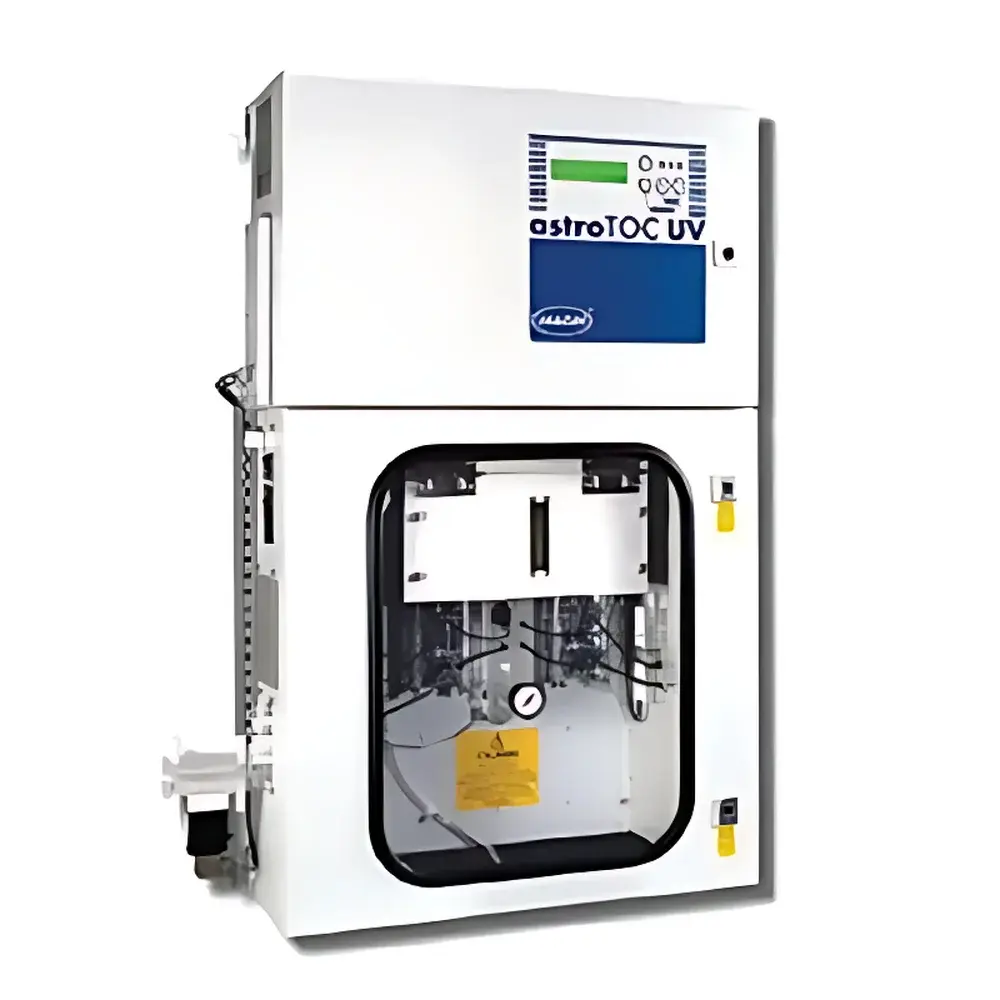
HACH Astro TOC UV TURBO Total Organic Carbon Analyzer
| Brand | HACH |
|---|---|
| Origin | Imported |
| Manufacturer Type | Manufacturer |
| Instrument Type | Online TOC Analyzer |
| Oxidation Method | UV/Persulfate (Acid + UV) |
| Detection Principle | NDIR (Non-Dispersive Infrared) |
| Measurement Range | 0–2.000 / 5.000 / 10.000 / 25.000 / 50.000 mg/L |
| Detection Limit | ≤5 µg/L (at 25°C, 0–5000 µg/L range) |
| Response Time | T₉₀ ≤ 5 min |
| Sample Flow Rate | 25–200 mL/min |
| Sample Temperature | 2–70°C |
| Operating Temperature | 5–40°C |
| Inlet Pressure | 0.15–6 bar |
| Output | Dual 4–20 mA (user-configurable) |
| Alarms | 5 programmable alarms (TOC concentration, system fault, shutdown) |
| Communication | RS232/RS485 (Modbus RTU, CSV) |
| Power Supply | 115/230 VAC, 50/60 Hz |
| Enclosure Rating | IP66 / NEMA 4 |
| Dimensions (W×H×D) | 981 × 675 × 220 mm |
| Weight | 54 kg |
| Carrier Gas | CO₂-free air or nitrogen (2.8–6.2 bar) |
| Certifications | CE, UL, CSA |
Overview
The HACH Astro TOC UV TURBO is a high-performance, online total organic carbon (TOC) analyzer engineered for continuous, real-time monitoring of ultra-pure water streams in critical industrial applications—including power plant condensate return loops, semiconductor ultrapure water (UPW) systems, and chemical process water networks. It employs a two-stage oxidation methodology: first, acidification removes inorganic carbon (TIC) as CO₂ via sparging; second, UV/persulfate oxidation mineralizes residual organic compounds into CO₂. The liberated CO₂ is then separated from the aqueous matrix using a proprietary water vapor separation module and quantified with a highly stable, temperature-compensated non-dispersive infrared (NDIR) detector. This architecture ensures exceptional specificity to TOC—free from interferences caused by sample matrix variability, volatile organics, or oxidation byproducts—and delivers robust performance under dynamic flow and temperature conditions typical of condensate recirculation environments.
Key Features
- Ultra-low detection limit of ≤5 µg/L (at 25°C, 0–5000 µg/L range), validated per ASTM D5905 and ISO 8245 protocols for trace-level TOC quantification in high-purity water.
- T₉₀ response time ≤5 minutes and T₂₀ ≤3 minutes—enabling rapid detection of organic contamination events during startup, shutdown, or process upsets.
- Integrated self-diagnostic suite with automated system health checks, including UV lamp intensity monitoring, reagent consumption tracking, pressure sensor validation, and NDIR baseline stability assessment.
- Self-cleaning fluidic path with periodic acid flush and UV chamber purge cycles—reducing maintenance frequency and minimizing downtime in unattended 24/7 operation.
- IP66/NEMA 4-rated enclosure with corrosion-resistant stainless-steel internal wetted parts and reinforced polymer housing—designed for harsh industrial environments including turbine halls and chemical processing zones.
- Dual isolated 4–20 mA analog outputs with user-defined scaling, supporting seamless integration into DCS, PLC, or SCADA platforms without external signal conditioning.
Sample Compatibility & Compliance
The Astro TOC UV TURBO is optimized for low-conductivity (<2 µS/cm), low-particulate water matrices such as steam condensate, boiler feedwater, and nuclear service water. It complies with key regulatory and industry standards governing water purity assurance: USP , EP 2.2.44, and ASTM D5905 for method validation; CE, UL 61010-1, and CSA C22.2 No. 61010-1 for electrical safety; and ISO/IEC 17025-aligned calibration traceability through HACH’s accredited service network. Its design supports GLP/GMP data integrity requirements via audit-trail-enabled firmware (optional 21 CFR Part 11 compliance package available).
Software & Data Management
Local configuration and diagnostics are performed via an intuitive, password-protected web interface accessible over Ethernet (HTTP/HTTPS). All operational parameters—including calibration history, alarm logs, UV lamp runtime, and diagnostic flags—are timestamped and stored internally for ≥90 days. Data export is supported via CSV over serial (RS232/RS485) or Modbus RTU for historian integration. Firmware updates are delivered via secure HTTPS download and verified with SHA-256 checksums. Optional HACH Insight™ cloud platform enables remote monitoring, predictive maintenance alerts, and fleet-wide performance benchmarking across multi-site deployments.
Applications
- Real-time TOC surveillance of turbine condensate return lines to prevent organic-induced corrosion in HRSG and boiler tubes.
- Monitoring of demineralized water polishing loops prior to mixed-bed ion exchange units in fossil and nuclear power generation.
- Verification of cleaning-in-place (CIP) efficacy in pharmaceutical water-for-injection (WFI) distribution systems.
- TOC trending in petrochemical refinery closed-loop cooling water circuits to detect hydrocarbon ingress or biocide breakdown products.
- Compliance reporting for ISO 14644-1 cleanroom water supply systems where organic load impacts particle nucleation kinetics.
FAQ
What carrier gas is required, and why is CO₂-free air specified?
CO₂-free air or nitrogen (2.8–6.2 bar) is mandatory to avoid background interference in the NDIR measurement cell. Residual CO₂ in standard compressed air would elevate baseline signals and compromise detection limit stability—especially critical at sub-10 µg/L levels.
Does the instrument require daily manual intervention?
No. With scheduled self-cleaning cycles and onboard diagnostics, routine operator interaction is limited to quarterly reagent replacement and annual NDIR verification—fully compatible with unmanned remote sites.
Can it be calibrated with certified reference materials traceable to NIST?
Yes. Calibration is performed using potassium hydrogen phthalate (KHP) or sucrose standards traceable to NIST SRM 1012 and ISO 8245 reference methods. Calibration certificates include uncertainty budgets per ISO/IEC 17025.
Is the Astro TOC UV TURBO suitable for seawater or wastewater applications?
No. It is specifically engineered for low-TDS, low-salinity, low-turbidity water streams. High chloride, suspended solids, or particulate load will foul the UV reactor and vapor separator—use of pre-filtration or alternative TOC platforms (e.g., high-temperature catalytic oxidation) is recommended for such matrices.
How is data security ensured during remote access?
All web-based communication uses TLS 1.2+ encryption; user roles enforce least-privilege access; and firmware updates require digital signature validation. Optional 21 CFR Part 11 mode adds electronic signature workflows and immutable audit trails for regulated environments.
Related Products







