
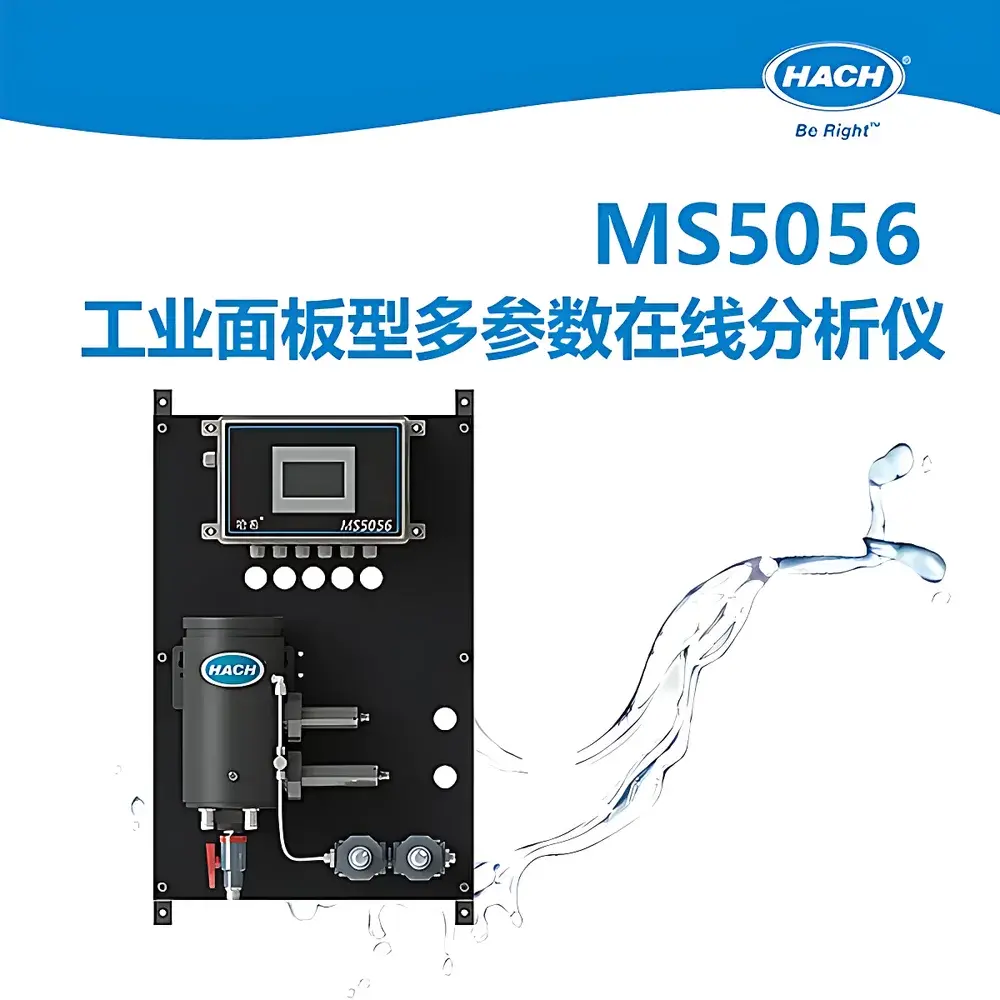
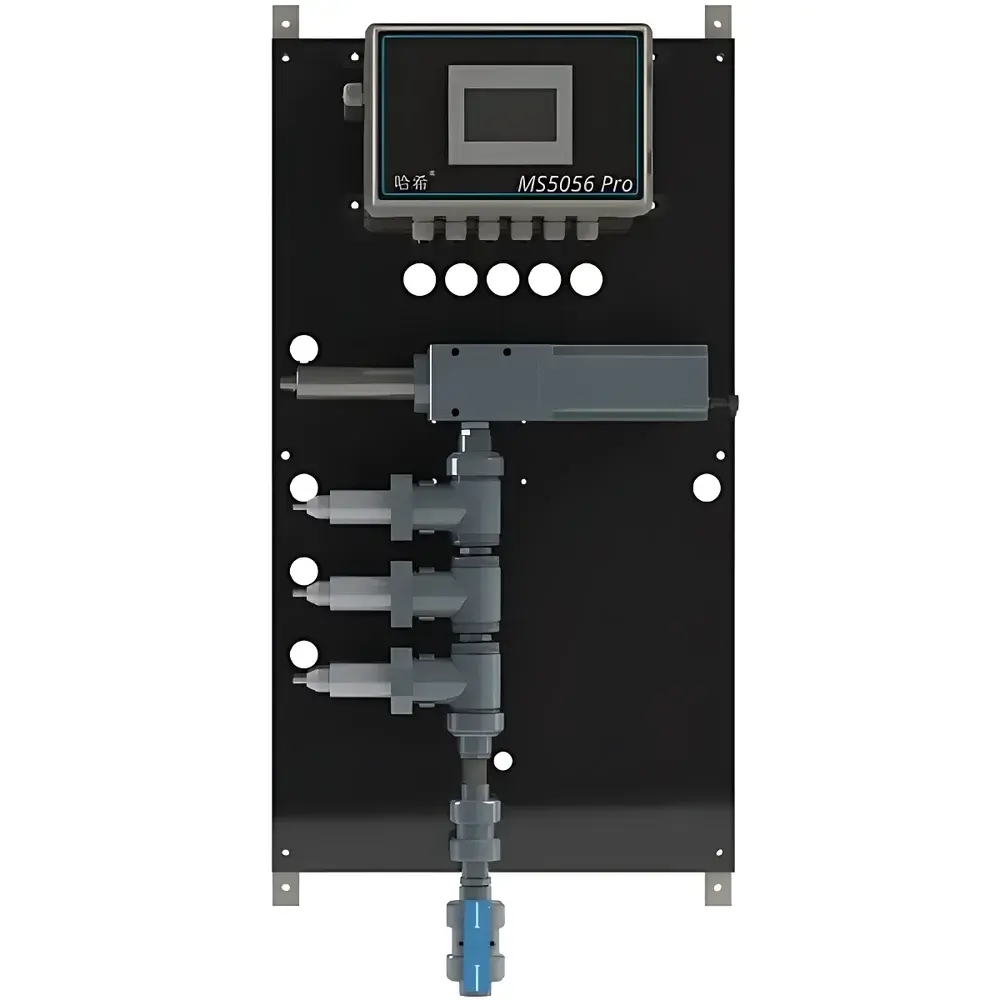
Hach MS5056 Industrial Panel-Mount Multi-Parameter Online Analyzer
| Brand | Hach |
|---|---|
| Model | MS5056 |
| Measurement Parameters | Free Chlorine/Chlorine Dioxide, pH, Temperature, Turbidity (optional: ORP, Conductivity) |
| Detection Principle | Amperometric (Constant Voltage, 3-Electrode), Glass Electrode (pH), PT100 (Temperature), 90° Nephelometry (Turbidity, EPA 180.1 compliant), Platinum Composite (ORP), Graphite 4-Electrode (Conductivity) |
| Turbidity Range (Lite) | 0–10 / 10–40 NTU |
| Turbidity Range (Pro) | 0–100 NTU |
| Free Chlorine/ClO₂ Range | 0–5 mg/L as Cl₂ or ClO₂ |
| pH Range | 2–12 |
| Temp Range | −5–65°C |
| Turbidity Resolution (Lite) | 0.001 NTU |
| Turbidity Accuracy (Lite) | ±0.01 NTU or ±2% of reading |
| Chlorine Accuracy | ±0.01 ppm or ±2% of reading (whichever greater) |
| pH Accuracy | ±0.02 @ 25°C |
| Response Time (T90) | Cl₂ ≤120 s, pH ≤30 s, Temp ≤20 s, Turbidity ≤30 s |
| Output | Dual 4–20 mA + RS-485 (Modbus RTU) |
| Enclosure Rating | IP65 |
| Display | 4.3″ TFT (480×272) touchscreen |
| Power | 100–240 VAC, 50/60 Hz |
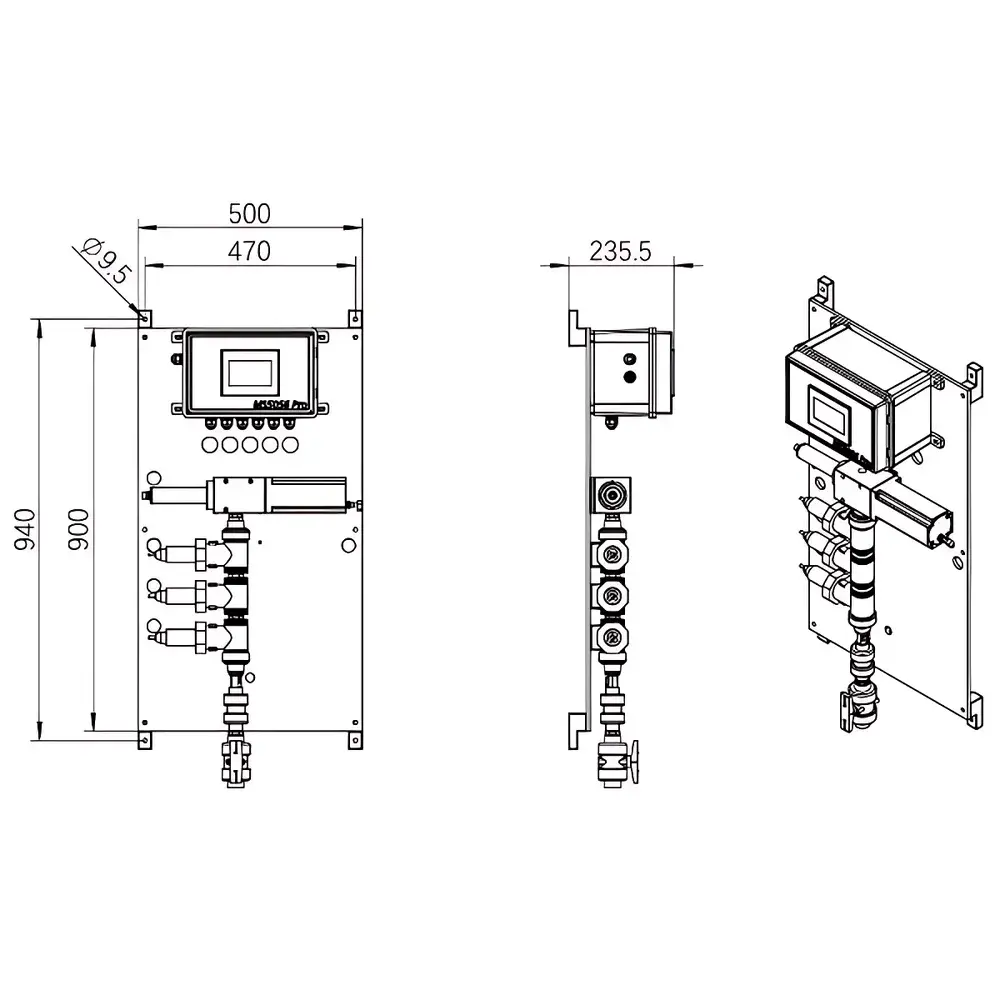
| Dimensions | 750 × 500 × 230.5 mm |
| Weight | ~25 kg (packed) |
| Operating Temp | 5–45°C |
| Storage Temp | −20–55°C |
| Humidity | 5–95% RH (non-condensing) |
| Altitude | ≤2000 m |
Overview
The Hach MS5056 is an industrial-grade, panel-mounted multi-parameter online analyzer engineered for continuous, real-time monitoring of critical water quality parameters in demanding process environments—including reverse osmosis (RO) pretreatment, cooling tower circulation, and complex industrial effluent streams. Designed with a modular architecture and field-proven sensor integration, the MS5056 employs electrochemical, optical, and potentiometric measurement principles to deliver stable, trace-level quantification across multiple analytes without cross-interference. Its core measurement platform combines amperometric free chlorine/chlorine dioxide detection using a constant-voltage, three-electrode configuration—complemented by an integrated glass pH electrode and PT100 temperature sensor—to enable simultaneous, compensated output of Cl₂ (or ClO₂), pH, and temperature from a single probe. Turbidity measurement adheres strictly to U.S. EPA Method 180.1, utilizing a warm-white LED (3200 K) and 90° nephelometric detection geometry to ensure regulatory alignment with 40 CFR 141.74(a)(1). The MS5056 Pro variant further enhances robustness with a self-cleaning flow cell and corrosion-resistant CPVC/titanium probe options, making it suitable for high-chloride, saline, or fouling-prone applications where long-term signal stability and minimal intervention are operational imperatives.
Key Features
- Triple-parameter composite sensor: Simultaneous output of free chlorine/chlorine dioxide, pH, and temperature from one low-maintenance, membrane-free, fill-free electrochemical probe.
- Integrated dual compensation: On-sensor pH and temperature compensation algorithms mitigate drift caused by variable flow velocity and thermal transients—critical for RO feed and cooling water applications.
- EPA-compliant turbidity measurement: Warm-white LED (3200 K) source and calibrated 90° scattering optics meet USEPA 180.1 requirements; Lite version achieves 0.001 NTU resolution, Pro version supports up to 100 NTU full-scale with anti-fouling optical channel design.
- Self-cleaning flow cell (MS5056 Pro only): Pneumatically or solenoid-actuated cleaning mechanism maintains optical clarity and electrode surface integrity in high-solids or biofouling environments.
- Corrosion-resilient materials: Optional CPVC-bodied chlorine/ClO₂ electrodes and titanium turbidity probes for seawater, brine, or chlorinated wastewater service.
- Flexible modular expansion: Field-selectable ORP and conductivity probes—both with integrated PT100 temperature compensation—extend system capability without hardware replacement.
- Industrial interface suite: Dual isolated 4–20 mA analog outputs per parameter, RS-485 Modbus RTU, configurable relay outputs (DC or AC), and USB-based data export and firmware updates.
Sample Compatibility & Compliance
The MS5056 accommodates a broad range of industrial water matrices under defined hydraulic constraints: sample temperature (5–45°C), pressure (0.05–0.25 MPa for Lite; 0.05–0.2 MPa for Pro), and minimum flow rate (≥470 mL/min for Lite; ≥200 mL/min for Pro). It complies with key regulatory frameworks governing drinking water and industrial discharge, including USEPA Methods 180.1 (turbidity) and 334.0 (chlorine), ASTM D1293 (pH), ASTM D512 (chloride interference mitigation), and ISO 7027-1:2016 (turbidity). For facilities operating under GLP or GMP protocols, the instrument’s audit-ready event logging, user-access-controlled calibration history, and timestamped data records support 21 CFR Part 11 compliance when deployed with validated IT infrastructure. All sensors meet IP65 ingress protection standards, and the fully plastic enclosure resists chemical degradation in acidic, alkaline, or oxidizing atmospheres.
Software & Data Management
The MS5056 operates on an embedded Linux-based firmware platform with a responsive 4.3″ capacitive touchscreen interface (480×272 resolution). Configuration, calibration, diagnostics, and alarm thresholds are managed locally via intuitive menu navigation—no PC required for routine operation. Calibration routines include multi-point pH buffer verification, chlorine standardization using DPD-based reference solutions, and turbidity validation with Formazin or AMCO AEPA standards. All measurement data—including raw sensor signals, compensated values, diagnostic flags, and calibration timestamps—are stored internally and exportable via USB flash drive in CSV format. Modbus RTU protocol enables seamless integration into SCADA, DCS, or cloud-based IIoT platforms for centralized dashboarding, trend analysis, and predictive maintenance modeling. Firmware updates are performed offline via USB, ensuring cybersecurity integrity in air-gapped facilities.
Applications
- Reverse osmosis pretreatment monitoring: Real-time free chlorine control upstream of polyamide membranes to prevent oxidative damage while minimizing dechlorination chemical usage.
- Cooling water system management: Continuous tracking of biocide residual (Cl₂/ClO₂), pH-induced scaling potential, and turbidity-driven microbiological risk in open recirculating systems.
- Wastewater disinfection validation: Regulatory-compliant residual chlorine reporting for tertiary effluent prior to environmental discharge.
- Pharmaceutical process water loops: Monitoring of purified water (PW) and water-for-injection (WFI) distribution systems per USP and EU Annex 1 requirements.
- Power plant condensate polishing: Detection of chloride breakthrough and oxidation potential shifts indicating resin exhaustion or corrosion onset.
- Food & beverage rinse water verification: Rapid confirmation of sanitizer concentration and clarity compliance prior to product contact surfaces.
FAQ
Can the MS5056 measure both free chlorine and chlorine dioxide on the same sensor?
Yes—the triple-parameter electrode supports user-selectable measurement mode for either free chlorine (as Cl₂) or chlorine dioxide (as ClO₂), with automatic range scaling and unit conversion.
Is the turbidity measurement certified for regulatory reporting?
Yes—the Lite and Pro variants both comply with USEPA Method 180.1; the Pro model is additionally validated for high-range turbidity (up to 100 NTU) in non-potable industrial applications.
What maintenance intervals are recommended for the self-cleaning flow cell?
Cleaning frequency is programmable (default: every 6–24 hours); actual interval depends on suspended solids load and should be optimized based on historical fouling trends and turbidity baseline drift.
Does the system support 21 CFR Part 11 compliance?
The MS5056 provides electronic audit trails, user authentication, and calibration lockout features; full Part 11 compliance requires integration with a validated electronic record system and procedural controls per organizational SOPs.
Can I add ORP and conductivity measurements after initial installation?
Yes—both optional probes connect via standardized M12 ports and are auto-recognized by firmware; no hardware modification or factory recalibration is required.
Related Products







