
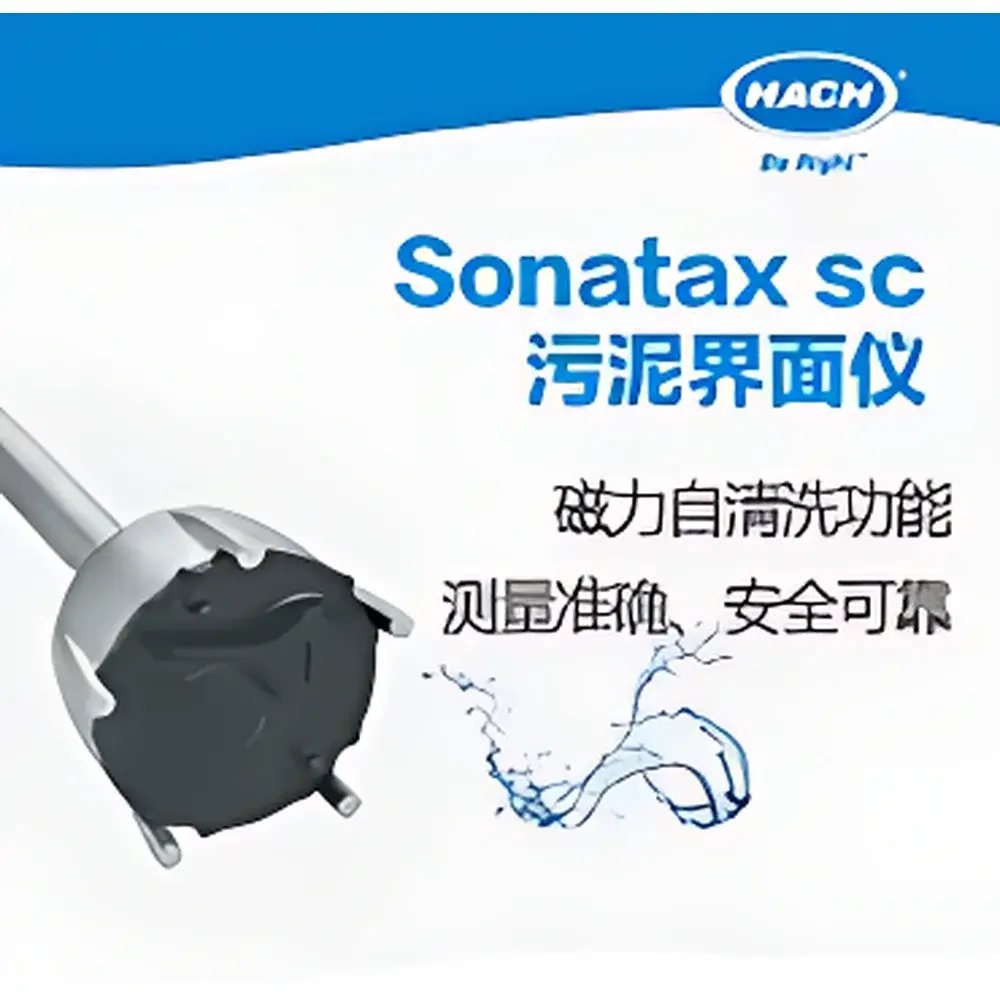
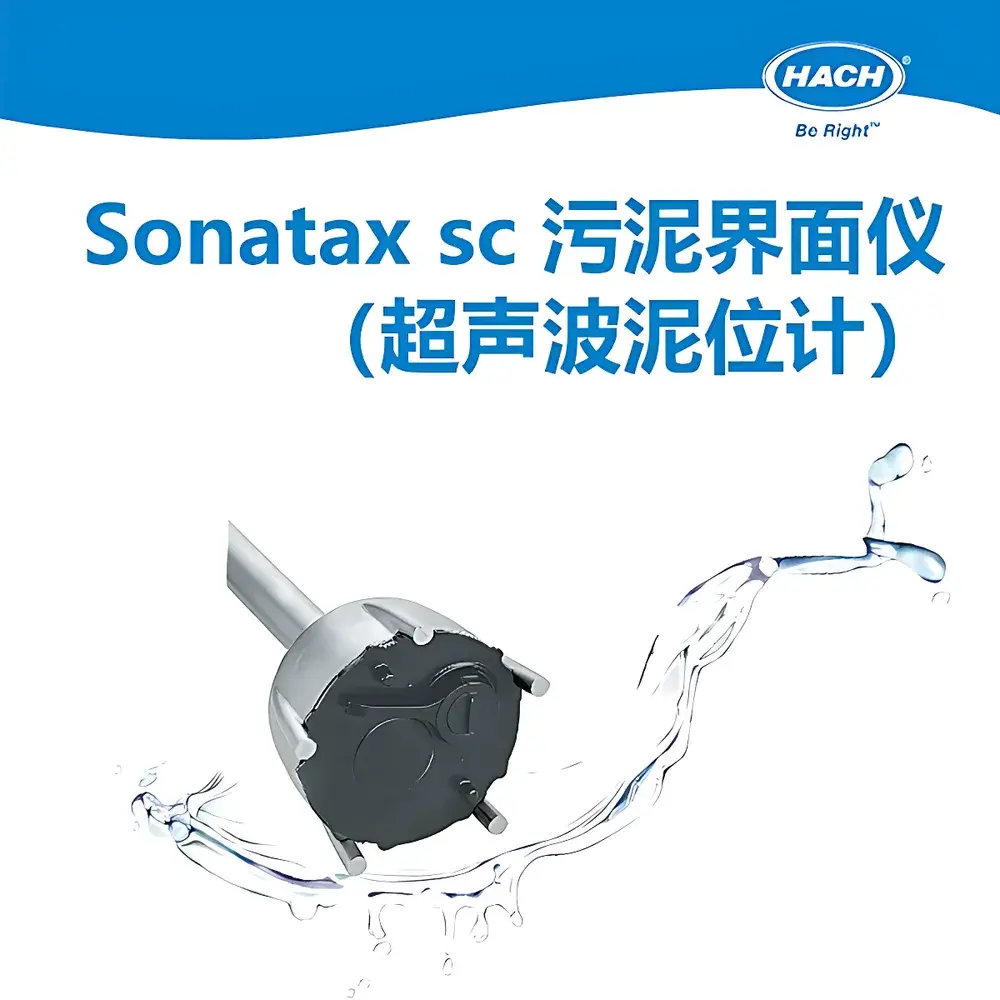
HACH SONATAX sc Sludge Interface Monitor
| Brand | HACH |
|---|---|
| Origin | Imported |
| Manufacturer Type | Manufacturer |
| Model | SONATAX sc |
| Measurement Principle | Ultrasonic Time-of-Flight |
| Measurement Range | 0.2–12 m |
| Resolution | <0.04 m |
| Accuracy | ±0.1 m (with ±0.05 m offset tolerance) |
| Response Time | 10–600 s (user-adjustable) |
| Calibration | Single-point automatic calibration at power-on |
| Pressure Rating | ≤0.3 bar |
| Operating Temperature | 0–50 °C |
| Temperature Compensation | Automatic |
| Ingress Protection | IP68 |
| Maximum Flow Velocity | ≤3 m/s |
| Dimensions (H×D) | 130 mm × 185 mm |
| Weight | ~3.5 kg |
| Maintenance Interval | <1 hour/month |
| Cable Length | Standard 10 m (extendable up to 100 m) |
| Compatible Controllers | SC100 (supports 2 probes), SC1000 (supports 8 probes) |
| Self-Cleaning Mechanism | Mechanical wiper system |
Overview
The HACH SONATAX sc Sludge Interface Monitor is an industrial-grade ultrasonic time-of-flight sensor engineered for continuous, non-contact measurement of sludge blanket depth and thickness in municipal and industrial wastewater treatment processes. It operates by emitting high-frequency ultrasonic pulses toward the liquid–sludge interface and precisely measuring the elapsed time between pulse transmission and echo return. Using calibrated sound velocity profiles—adjusted in real time for temperature-induced variations—the instrument computes sludge layer position relative to the sensor mounting point with metrological traceability. Designed for deployment in primary clarifiers, secondary settling tanks, thickening basins, and potable water sedimentation basins, the SONATAX sc delivers stable, long-term performance under fluctuating hydraulic loads, suspended solids concentrations, and variable temperature gradients. Its robust transducer housing and integrated mechanical wiper ensure operational continuity in turbid, abrasive, or biofouling-prone environments without manual intervention.
Key Features
- Ultrasonic time-of-flight measurement with automatic temperature compensation—ensures consistent accuracy across 0–50 °C ambient and process temperature ranges.
- IP68-rated stainless steel and PVDF housing—certified for permanent submersion up to 12 m depth and resistant to chemical exposure in chlorinated, sulfide-rich, or acidic effluents.
- Mechanical self-cleaning wiper system—reduces fouling-related drift and eliminates routine manual cleaning, supporting maintenance intervals of less than one hour per month.
- Configurable response time (10–600 s)—enables dynamic adaptation to rapid sludge blanket migration during peak flow events or process upsets.
- Single-point auto-calibration at power-up—minimizes commissioning time and eliminates need for periodic field recalibration under normal operating conditions.
- Modular controller integration—direct compatibility with HACH SC100 (dual-probe support) and SC1000 (eight-probe scalable architecture), enabling centralized monitoring, alarm logging, and trend analysis across multi-tank facilities.
Sample Compatibility & Compliance
The SONATAX sc is validated for use in heterogeneous aqueous suspensions containing organic and inorganic particulates typical of activated sludge, anaerobic digester supernatant, and coagulated floc layers. It complies with IEC 61326-1 (EMC for industrial environments) and IEC 60529 (IP68 ingress protection). While not intrinsically certified for hazardous areas, its low-power design (<12 V DC operation) and non-sparking mechanical actuation meet general safety requirements for Zone 2/Class I, Division 2 installations when installed per local electrical codes. Data integrity aligns with GLP and GMP principles through SC1000’s audit-trail-enabled firmware, supporting 21 CFR Part 11-compliant recordkeeping when paired with HACH’s compliant data management software.
Software & Data Management
When interfaced with the SC1000 controller, the SONATAX sc supports HACH’s Intelligence Platform™—a web-accessible interface enabling real-time visualization of sludge interface profiles, historical depth trends, and rate-of-settling calculations. All measurements are timestamped, stored with metadata (temperature, signal strength, confidence index), and exportable in CSV or MODBUS TCP format for integration into SCADA, DCS, or asset management systems. Alarm thresholds (e.g., high-sludge-level, rapid-interface-rise) trigger configurable relay outputs and email/SMS notifications via optional communication modules. Firmware updates are performed over Ethernet or USB, with version control and rollback capability maintained in controller memory.
Applications
- Optimization of return activated sludge (RAS) and waste activated sludge (WAS) flow rates based on real-time interface elevation.
- Detection of sludge bulking or deflocculation events via abnormal interface thickening or instability patterns.
- Monitoring of pre-thickener separation efficiency in dissolved air flotation (DAF) or gravity thickeners.
- Supporting adaptive control strategies for feed-forward sludge withdrawal in membrane bioreactors (MBRs).
- Verification of clarifier hydraulic performance during commissioning and routine process audits per ISO 24510 and EN 14897 standards.
FAQ
What is the maximum recommended installation depth for the SONATAX sc probe?
The probe is rated for continuous submersion up to 12 meters, with pressure tolerance ≤0.3 bar. Mounting depth must account for tank geometry, expected sludge accumulation, and minimum clearance above the interface.
Does the instrument require periodic recalibration during operation?
No—only a single automatic calibration occurs at power-on. Long-term stability is maintained via internal temperature compensation and factory-traceable transducer characterization.
Can the SONATAX sc operate reliably in high-flow channels or aerated basins?
Yes, provided flow velocity remains ≤3 m/s and turbulence does not cause sustained probe vibration. For aerated zones, mounting on stilling wells or baffle-protected brackets is recommended.
Is analog output available for integration with legacy PLCs?
Yes—4–20 mA current loop output is standard, configurable for depth, thickness, or interface velocity, with HART protocol support on SC1000-equipped systems.
How is signal integrity ensured in highly turbid or gas-blanketed sludge layers?
The instrument employs adaptive echo detection algorithms that distinguish true interface reflections from multipath noise or gas bubble interference, with user-adjustable signal confidence thresholds.
Related Products







