
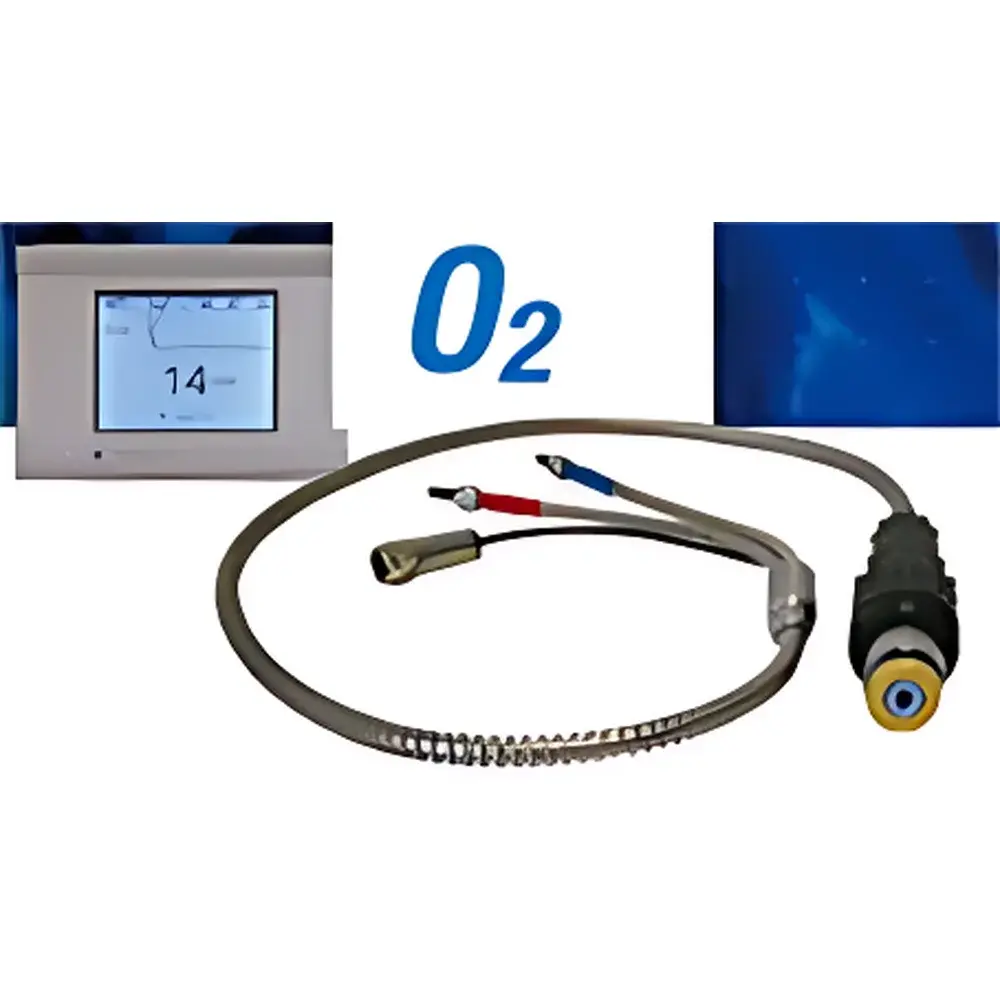
HACH Orbisphere G1100 ppb-Level Online Dissolved Oxygen Analyzer
| Brand | HACH |
|---|---|
| Origin | Imported |
| Manufacturer Type | Manufacturer |
| Model | ORBISPHERE G1100 |
| Measurement Principle | Fluorescence Quenching (Lifetime-Based) |
| Range | 0–20,000 ppb |
| Repeatability | ±1 ppb + 2% (0–600 ppb), ±2 ppb + 2.5% (0–600 ppb) |
| LOD | ±2 ppb |
| Response Time (t₉₀) | 30 s |
| Resolution | 1 ppb |
| Calibration | Fully Automated, User-Programmable Single-Point Zero Calibration with Certified N₂ (99.999%, Grade 5.0) |
| Validation | Automated Single-Point Zero Verification |
| Sample Temp. | 5–45 °C |
| Sensor Temp. Rating | −5–100 °C |
| Pressure Range | 1–4 bar abs |
| Flow Rate | 50–500 mL/min |
| Enclosure | Wall/Pipe-Mounted Stainless Steel or Panel-Mounted Aluminum, IP65 |
| Analog Outputs | 3 Smart 0/4–20 mA (500 Ω), Configurable for Linear/Tri-Linear Output or Diagnostic/Alarm Signals |
| Relays | 3 Measurement Alarms (2 A / 30 VAC or 0.5 A / 50 VDC), 1 System Alarm Relay |
| Communication | RS485, Optional Profibus DP or Ethernet, USB Client/Host |
| Data Storage | Rolling or One-Time Storage for up to 1,000 Measurements and 1,000 Operator Actions |
| Display | Monochrome STN LCD (320 × 240 px) with LED Backlight |
| Compliance | EN 61326 (EMC), EN 61010-1 (Safety), Directive 73/23/EEC |
Overview
The HACH Orbisphere G1100 ppb-Level Online Dissolved Oxygen Analyzer is an industrial-grade, fluorescence lifetime-based measurement system engineered for ultra-trace dissolved oxygen (DO) monitoring in high-purity water streams. Unlike electrochemical sensors requiring membranes, electrolytes, or frequent manual intervention, the G1100 employs a solid-state optical sensing principle grounded in oxygen-dependent fluorescence quenching. A blue LED excites a proprietary ruthenium-based fluorophore immobilized on a replaceable optical cap; the resulting red emission’s decay time—measured in nanoseconds—is inversely proportional to the partial pressure of molecular oxygen. This lifetime-based detection eliminates drift from photobleaching, temperature-induced intensity shifts, or flow-dependent signal artifacts, delivering stable, calibration-resistant performance across extended deployment cycles. Designed specifically for critical applications where DO must be maintained below 10 ppb—including oxygenated treatment (OT) and all-volatile treatment (AVT) in fossil and nuclear power plants, ultrapure water (UPW) loops in semiconductor fabrication, and pharmaceutical purified water systems—the G1100 operates continuously with minimal operator dependency and no consumables beyond the field-replaceable fluorescent cap.
Key Features
- Fully automated, user-scheduled zero-point calibration using certified 99.999% nitrogen gas—no liquid standards, no membrane replacement, no electrolyte refills
- Dry optical sensor architecture: zero maintenance downtime during calibration; typical service interval of 12–24 months limited solely to fluorescent cap replacement
- Integrated diagnostics engine providing predictive alerts—including cap end-of-life estimation, calibration gas depletion warning, auto-calibration failure detection, and sensor fault identification
- Three programmable smart analog outputs (0/4–20 mA) configurable for linear concentration output, tri-linear range segmentation, or diagnostic status transmission
- Three independent measurement alarm relays plus one dedicated system alarm relay—each assignable to discrete events (e.g., low DO, calibration overdue, sensor timeout)
- Touchscreen HMI with real-time trend visualization, historical data review (last 1,000 measurements), and full audit trail of operator actions (1,000 entries retained)
- Robust mechanical design: stainless steel wall/pipeline mount or aluminum panel-mount enclosure rated IP65; compliant with EN 61010-1 (safety) and EN 61326 (EMC)
Sample Compatibility & Compliance
The G1100 is validated for continuous operation in deionized, demineralized, and ultrapure water matrices with conductivity < 0.1 µS/cm and silica < 10 ppb. Its optical sensor tolerates inlet temperatures from 5 to 45 °C and transient excursions up to 100 °C—critical for steam-cycle condensate monitoring. The system meets requirements for regulated environments: its event-logged calibration history, password-protected configuration tiers (five access levels), and timestamped operator actions support GLP/GMP documentation practices. While not explicitly FDA 21 CFR Part 11–certified out-of-the-box, the audit trail structure—including immutable calibration records and change logs—aligns with Annex 11 and USP data integrity expectations for critical water quality monitoring. All electrical interfaces comply with CE-marked industrial safety and electromagnetic compatibility directives.
Software & Data Management
Data handling is implemented via embedded firmware supporting dual-mode storage: rolling buffer (overwrite oldest entries upon capacity saturation) or persistent logging (retention until manually cleared). Up to 1,000 measurement values—including timestamp, DO value, temperature, and diagnostic flags—are stored locally. The USB host interface permits direct export of calibration logs and operational history to FAT32-formatted flash drives; USB client mode enables remote configuration and firmware updates via PC. RS485 Modbus RTU is standard; optional Profibus DP or Ethernet/IP modules allow integration into DCS, SCADA, or MES platforms without protocol gateways. All analog and relay outputs can be dynamically mapped to diagnostic states (e.g., “Calibration Required” or “Cap Aging >85%”), enabling predictive maintenance workflows without additional PLC logic.
Applications
- Power generation: Real-time DO monitoring in boiler feedwater, condensate, and turbine drain lines under OT/AVT chemistry regimes
- Semiconductor manufacturing: UPW loop surveillance at point-of-use to prevent oxidation of copper interconnects and photoresist degradation
- Pharmaceutical water systems: Monitoring of purified water (PW) and water for injection (WFI) distribution loops per EU GMP Annex 1 and USP
- Microelectronics rinse stations: Ensuring sub-5 ppb DO to minimize surface defect formation during wafer cleaning
- Research reactor coolant circuits: Long-term stability verification under radiation-exposed conditions (fluorophore proven resistant to cumulative gamma dose ≤10 kGy)
FAQ
What calibration gas is required—and how often must it be replaced?
Certified 99.999% nitrogen (Grade 5.0) is used for zero-point calibration. A standard 1 L, 34 bar cylinder supports approximately 36 monthly calibrations—equivalent to three years of scheduled maintenance.
Does the sensor require flow control or pressure regulation?
Yes. The analyzer requires a controlled sample flow of 50–500 mL/min and inlet pressure between 1–4 bar absolute. HACH Ultra supplies compatible pressure regulators and flow restrictors optimized for low-particulate, low-gas-solubility applications.
Can the G1100 be integrated into existing plant automation systems?
Absolutely. Native RS485 Modbus RTU is included; optional Profibus DP or Ethernet/IP modules enable seamless connection to Siemens PCS7, Emerson DeltaV, Honeywell Experion, or Yokogawa CENTUM VP DCS environments.
How is sensor health monitored over time?
The instrument continuously tracks fluorophore decay kinetics, signal-to-noise ratio, and thermal stability. When cap aging exceeds manufacturer-specified thresholds, the HMI displays “Cap Replacement Recommended” and triggers a configurable relay output.
Is the display readable under direct sunlight or in low-light utility corridors?
The monochrome STN LCD features adjustable LED backlighting with six brightness levels and high-contrast pixel rendering—validated for legibility across ambient illuminances from 10 to 10,000 lux.







