
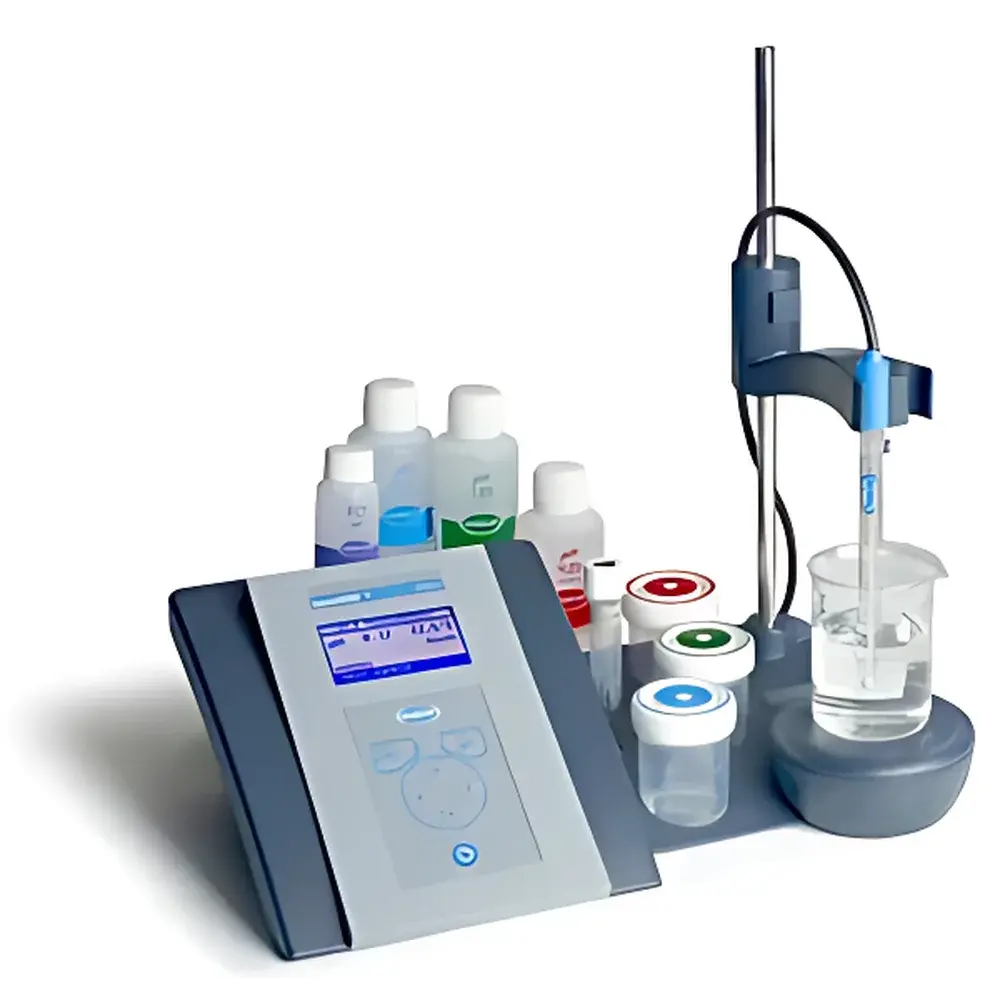
HACH sensION+ pH31 Benchtop pH Meter Kit with 5014T Electrode (LPV2114T.97.002)
| Brand | HACH |
|---|---|
| Origin | Imported |
| Manufacturer Type | Manufacturer |
| Instrument Type | Benchtop pH Meter |
| Parameter Types | Multi-parameter (pH, mV, Temperature) |
| Measurement Range | pH: −2.000 to 19.990 |
| Temperature | −20 to 150 °C |
| mV | ±2000 |
| Resolution | pH: 0.1 / 0.01 / 0.001 |
| Temperature | 0.1 °C |
| mV | 0.1 / 1 |
| Accuracy | pH: ±0.001 |
| Temperature | ±0.1 °C |
| mV | ±0.1 mV |
| Calibration Points | 1–13 (auto/manual) |
| Data Storage | 400 readings |
| Temperature Compensation | Automatic or Manual |
| Connectivity | RS232 |
| IP Rating | IP54 |
| GLP Compliance | Yes |
| Power Supply | External AC/DC adapter (20 VAC / 12 VDC, 3.3 W) |
Overview
The HACH sensION+ pH31 Benchtop pH Meter Kit (Order No. LPV2114T.97.002) is a fully integrated electrochemical measurement system engineered for precision, reproducibility, and operational robustness in regulated laboratory environments. At its core lies potentiometric pH measurement based on the Nernst equation, utilizing a high-stability glass electrode (model 5014T) optimized for samples containing reducing agents or species reactive with silver—such as sulfides, thiols, or iodides—where conventional Ag/AgCl reference systems may exhibit drift or poisoning. The system combines a dedicated benchtop meter, a specialized low-maintenance electrode with ContATC (Continuous Automatic Temperature Compensation) technology, and an integrated magnetic stirrer to ensure homogeneous sample conditions during measurement. Designed for compliance-critical workflows, the pH31 supports full GLP documentation requirements, including timestamped calibration logs, user ID tracking, and audit-ready data export via RS232.
Key Features
- ContATC-enabled electrode (5014T) provides real-time, continuous temperature compensation without manual input—minimizing thermal lag errors in dynamic or non-isothermal measurements.
- Three selectable pH resolution modes (0.1 / 0.01 / 0.001) and ±0.001 accuracy enable trace-level quality control in pharmaceutical buffer verification, electroplating bath monitoring, and semiconductor cleaning solution analysis.
- Integrated magnetic stirrer eliminates external hardware dependencies and ensures consistent mixing across repeated calibrations and sample measurements—critical for viscous or heterogeneous matrices.
- IP54-rated enclosure with sealed, industrial-grade membrane keyboard resists splashes, dust ingress, and routine chemical exposure in QC labs and pilot-scale process environments.
- Full GLP functionality includes password-protected user accounts, editable operator IDs, automatic logging of calibration history (up to 13-point), and timestamped measurement records stored internally (400 entries).
- Flexible calibration architecture supports single-, two-, or multi-point (up to 13) calibration using standard NIST-traceable buffers (e.g., pH 4.01, 7.00, 10.01), with slope and offset diagnostics displayed in real time.
Sample Compatibility & Compliance
The 5014T electrode features a double-junction, gel-filled reference system with a non-silver-based electrolyte, making it suitable for aggressive redox-active samples where traditional Ag/AgCl electrodes risk contamination or junction clogging. It maintains stable response in wastewater effluents, fermentation broths, cyanide-containing plating baths, and bioprocess media with high protein or sulfide content. The system conforms to ASTM D1293 (Standard Test Method for pH of Water), ISO 7888 (Water Quality — Determination of pH), and USP (pH Measurement). Its data integrity framework aligns with FDA 21 CFR Part 11 requirements when paired with validated third-party data acquisition software, supporting electronic signatures, audit trails, and secure export protocols.
Software & Data Management
Raw measurement data—including pH, mV, temperature, calibration parameters, date/time stamps, and operator identifiers—are retained in non-volatile memory and retrievable via RS232 serial interface. While the instrument does not include proprietary PC software, its ASCII-based output protocol is compatible with industry-standard laboratory information management systems (LIMS), SCADA platforms, and custom Python/Excel automation scripts. All calibration events are archived with slope (%), offset (mV), and buffer identification—enabling retrospective review for trend analysis, method validation, and internal audit preparation per ISO/IEC 17025 and GMP Annex 11 guidelines.
Applications
- Pharmaceutical QC: Verification of formulation buffer pH stability across shelf-life studies and lyophilization cycle development.
- Environmental Monitoring: Field-deployable lab verification of wastewater influent/effluent pH under EPA Method 150.1 compliance.
- Food & Beverage: Batch consistency checks for acidified products (e.g., pickled vegetables, fermented dairy) where reducing compounds interfere with conventional electrodes.
- Electroplating & Surface Treatment: Real-time control of cyanide-based alkaline baths and chromic acid solutions requiring extended electrode service life.
- Academic Research: Teaching labs and graduate research requiring traceable, multi-parameter electrochemical instrumentation with documented metrological traceability.
FAQ
What reference electrolyte is used in the 5014T electrode, and why is it advantageous for reducing samples?
The 5014T employs a potassium chloride–based gel electrolyte with a double-junction design and no silver components, eliminating galvanic interference and sulfide precipitation at the reference junction.
Can the pH31 perform automatic temperature compensation without an external probe?
Yes—the ContATC technology integrates a built-in Pt1000 temperature sensor directly into the 5014T electrode body, enabling true in-situ compensation independent of bulk solution probes.
Is the RS232 interface optically isolated or grounded?
The RS232 port is electrically isolated via internal optocouplers to prevent ground-loop interference in multi-instrument lab networks.
Does the system support user-defined buffer sets beyond standard pH 4/7/10?
Yes—up to 13 custom calibration points can be entered manually, including non-standard buffers such as pH 1.68 (potassium hydrogen phthalate) or pH 12.45 (calcium hydroxide saturated solution).
How is GLP compliance implemented in firmware?
All calibrations and measurements generate immutable records containing operator ID, timestamp, electrode ID, slope/offset values, and environmental temperature—exportable as CSV for archival in validated electronic lab notebooks (ELN).



